

Article
Frederic Wehrey, Charles H. Johnson
{
  "authors": [
    "Frederic Wehrey"
  ],
  "type": "commentary",
  "centerAffiliationAll": "dc",
  "centers": [
    "Carnegie Endowment for International Peace"
  ],
  "collections": [],
  "englishNewsletterAll": "menaTransitions",
  "nonEnglishNewsletterAll": "",
  "primaryCenter": "Carnegie Endowment for International Peace",
  "programAffiliation": "MEP",
  "programs": [
    "Middle East"
  ],
  "projects": [],
  "regions": [
    "Middle East",
    "Israel",
    "Palestine",
    "United Arab Emirates"
  ],
  "topics": [
    "Climate Change"
  ]
}
Source: Getty
It could intrude on COP28 in Dubai and affect the climate agenda in several key areas.
It wasn’t supposed to be like this. A new era of de-escalation, calm, and normalization in the Middle East, the narrative went, was expected to lower tensions in a conflict-wracked region, giving local governments and civil society actors much-needed space to tackle current and looming challenges at home—most crucially the threat from global warming and the imperative of the green energy transition. Now, in the wake of the incursion into Israel by Hamas and the reprisal by Israeli military forces on Gaza, the Middle East climate agenda is likely to be buffeted and strained in several key areas.
The first concerns the economic impact of the conflict. While the overall effect of the Gaza conflict on the global economy is currently minimal, a prolongation and geographic expansion of the war is likely to darken the picture considerably, according to the IMF, affecting both oil prices and growth. That may negatively influence richer countries’ ability and willingness to help poorer less-endowed climate-ravaged countries, including those in the Middle East. It could also bolster the “go-slow” voices on the transition away from hydrocarbon production.
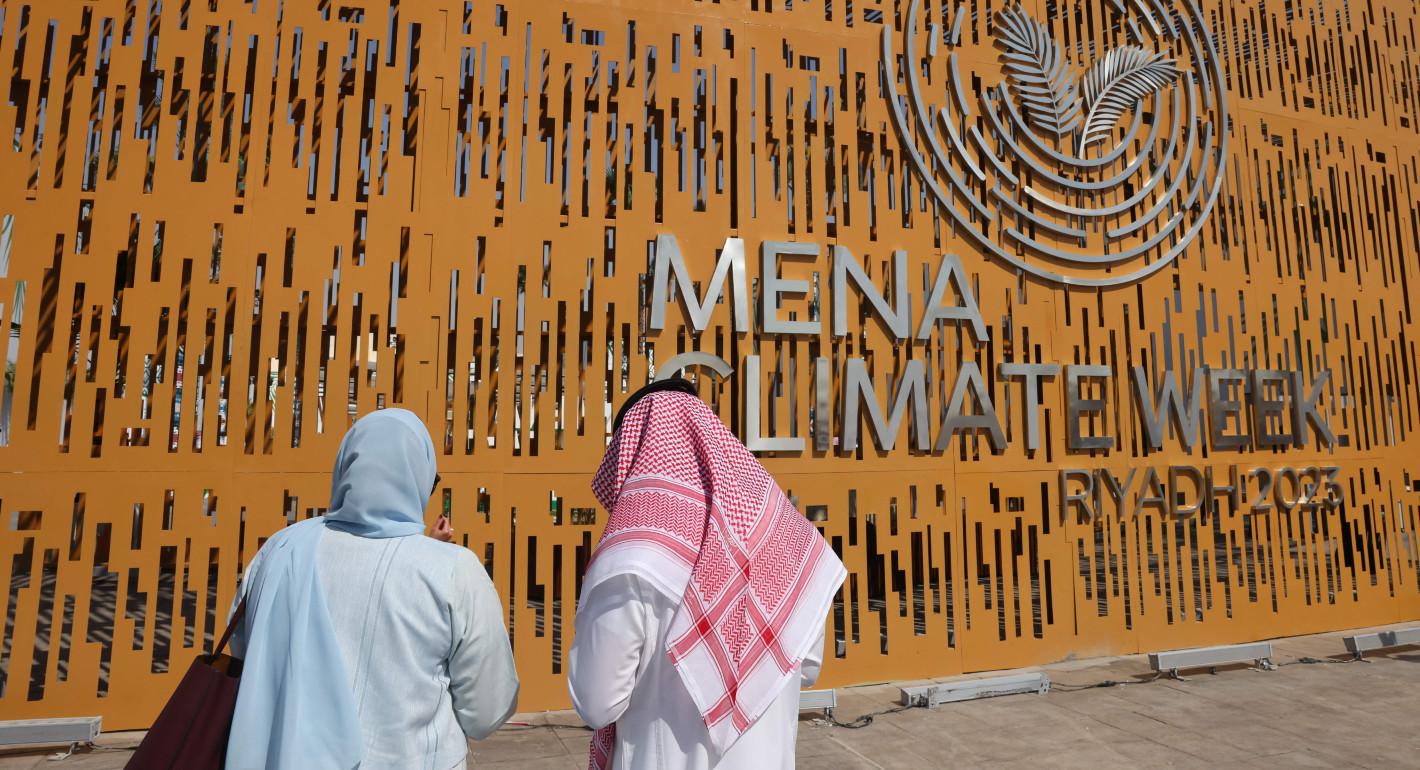
The second area concerns the war’s impact on multilateral climate cooperation between Israel and the Arab world. Encouragingly, the participation of Israeli experts at the United Nations–sponsored Middle East and North Africa Climate Week, convened in Riyadh, Saudi Arabia, immediately after the Hamas attack, went ahead as planned. Based on this precedent, other climate cooperation initiatives underway between Israel and Arab states—on water management, green technologies, and other areas—may be similarly unaffected, though such efforts could proceed even more discretely than in the past.
That said, tensions are likely to arise at the upcoming COP28 climate summit, hosted in Dubai by the United Arab Emirates, the state that has been at the forefront of Arab normalization with Israel. The Emirati government intended to use the summit as an opportunity to further cement its bilateral rapprochement with Tel Aviv, exemplified by its invitation to Israeli Prime Minister Benjamin Netanyahu to attend the proceedings in Dubai. But how the Israeli leader will participate is difficult to imagine in light of Israel’s siege of Gaza and the outpouring of solidarity with Palestinians among Arab publics—including those in the Gulf—on top of their widespread disapproval of normalization. The Emirati leadership could face lasting perceptual damage over Netanyahu’s attendance.
Beyond the optics of high-level visits, the Emirati hosts of this year’s COP will be keen to firewall and compartmentalize substantive, technical climate deliberations and exchanges from the ongoing war—and that is a wise choice to confront an existential challenge that disregards borders and politics. The expected attendance of the thousand-strong Israeli climate delegation to the COP will probably proceed.
Still, the conflict will invariably intrude on COP28. Civil society activists who attend will likely raise the plight of Gaza, drawing attention to how an escalating Israeli invasion, with its attendant destruction of water infrastructure and services and massive displacement, will have catastrophic and generational effects on Palestinians’ already severe vulnerability to climate change. These calls may well expand into a critique of Arab regimes’ normalization and cooperation with Israel, challenging the COP’s hosts to uphold their pledge of inclusion and free assembly.
Emirati officials would do well to not stifle or stage-manage these voices, but to instead follow their lead and make the protection of vulnerable communities across the region—Palestinians under siege and occupation, but also the countless other people afflicted by conflict and displacement elsewhere—a more prominent part of the summit’s adaptation agenda.
Senior Fellow, Middle East Program
Frederic Wehrey is a senior fellow in the Middle East Program at the Carnegie Endowment for International Peace, where his research focuses on governance, conflict, and security in Libya, North Africa, and the Persian Gulf.
Recent Work
Frederic Wehrey, Charles H. Johnson
Frederic Wehrey, Charles H. Johnson
Carnegie does not take institutional positions on public policy issues; the views represented herein are those of the author(s) and do not necessarily reflect the views of Carnegie, its staff, or its trustees.

Without a ceasefire with Ukraine on attacking each other’s energy infrastructure—to which the Kremlin is unlikely to agree—the diesel agreement between Putin and Trump is largely for show, rather than representing a genuine increase in the volumes of Russian diesel on the global market.

Sergey Vakulenko

When faced with fuel shortages in the past, Central Asian governments could always count on additional supplies from Moscow. That safety net no longer exists.

Galiya Ibragimova
Official discussions about mini oil refineries are unlikely to come to anything—but the mere fact they’re happening reveals the regime is failing to deliver a functioning economy.
Sergey Vakulenko
This year’s wars have made alternative routes to transit through Russia no less risky for Central Asian countries.
Galiya Ibragimova
Tokyo would have to surmount a lot of obstacles—not least Western sanctions—if it wanted to return Russian oil imports to even modest pre-2022 volumes.
Vladislav Pashchenko