

Research
- +5
Alper Coşkun, Fatih Ceylan, Tacan İldem, …
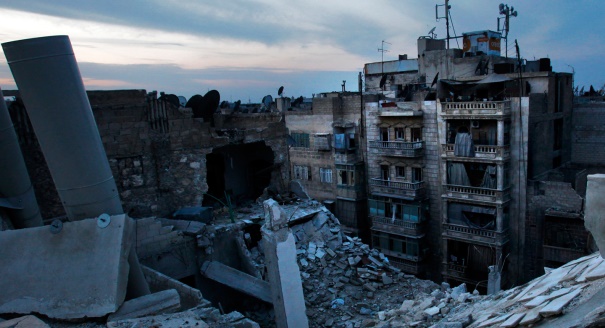
Source: Getty
Turkey and the United States should promote a regional initiative on Syria that includes Iran if they are to prevent the crisis from further undermining regional stability.
The time has come for more ambitious policy responses to the increasingly intractable Syrian civil war. When U.S. President Barack Obama and Turkish Prime Minister Recep Tayyip Erdoğan meet in the White House today, Ankara should champion a regional initiative on Syria that includes Iran. The two leaders will have to consider this difficult option if they are to prevent the Syrian crisis from further undermining regional stability and the international order.
The conflict is already reverberating across the region. The spillover was painfully clear on May 11 when car bombs in the Turkish town of Reyhanlı, near the Syrian border, led to more than 50 casualties—the deadliest terrorist attack in the country’s history. The Turkish authorities have been quick to hold the Syrian regime responsible, but many Turks blame the government for having entangled Turkey in this deadly conflict.
The attack laid bare the risks for Turkey of its aggressive policy on Syria. Still, the Turkish people are calling for retaliation. An angry Turkish public increasingly cites Israel’s alleged raid near Damascus as an example of how Turkey should respond.Ankara has refused to act unilaterally thus far, despite stalwartly opposing the Syrian regime. But the Turkish government has vowed to seek revenge for the terrorist act. Turkey’s reaction is likely to combine tactical and political approaches.
Tactically, Ankara may authorize a special operation targeting those behind the attack. When a car bomb exploded at the Turkish-Syrian border a month ago, Turkish special forces went deep into Syria to bring the culprits back to Turkey. A similar operation could be staged, if for no other reason than to placate public opinion.
In Washington, Prime Minister Erdoğan will seek support for his demands for regime change in Syria. He will press President Obama for a more interventionist U.S. policy that includes supplying arms to the opposition and the establishment and enforcement of a no-fly zone.
But Turkish policymakers are aware that there is still little hope for direct international intervention. At the same time, the supply of weapons to the opposition is becoming increasingly fraught as the rebels are co-opted by Islamists.
Regional ownership of any proposed strategy is indispensable for opening the door to a negotiated, nonmilitary settlement of the Syrian dispute. Otherwise, the external and destabilizing influences on Syria can be neither contained nor mitigated.
Egypt, Iran, Saudi Arabia, and Turkey have already set up a regional platform to tackle the politics of a lasting settlement in Syria. This is the only setup that can address the core interests of these four countries when it comes to both Syria and regional security. But the so-called quartet has only been able to meet once, as Saudi Arabia refused to associate with Iran.
Acting jointly, Ankara and Washington must convince Riyadh to take its place in the foursome despite the presence of Tehran. Yet, for this option to work, the United States also has to accept Iran’s open involvement in this regional equation.
A clear risk of such an approach would be the strengthening of Tehran’s hand in the P5+1 negotiations on Iran’s nuclear program. That is because arguably, the West’s reliance on Iran in Syria would undermine its ability to exert diplomatic pressure on Tehran elsewhere.
But the reality is that Iran has much to lose from a protracted conflict in Syria that visibly empowers armed Islamic extremists. The underlying incentive for Iran to take part in the quartet is Tehran’s fear of the emergence of Sunni extremism in Syria. In the early part of the last decade, Tehran engaged in direct talks with Washington with the objective of containing the Taliban and eradicating al Qaeda.
Now, the United States and Turkey must focus on the common objectives in Syria. While Syria is imploding, rising Syrian sectarianism is spilling over into neighboring countries and threatening the unity of Iraq and Lebanon. And as each day passes without a settlement strategy, the international community’s credibility is undermined. A regional initiative is urgently needed to counter these trends. If left unchecked, the Syrian crisis has the potential to unravel neighboring states already eaten away by the demons of sectarian strife.

Senior Fellow, Carnegie Europe
Sinan Ülgen is a senior fellow at Carnegie Europe in Brussels, where his research focuses on Turkish foreign policy, transatlantic relations, international trade, economic security, and digital policy.
Recent Work

Alper Coşkun, Fatih Ceylan, Tacan İldem, …
Carnegie does not take institutional positions on public policy issues; the views represented herein are those of the author(s) and do not necessarily reflect the views of Carnegie, its staff, or its trustees.
Ultimately, Zelensky sided neither with the reform camp nor with the military establishment as such, but with political control.

Balázs Jarábik
Tokayev’s predecessor, Nursultan Nazarbayev, outlined arrangements for a power transition too soon and in too much detail, ultimately losing control over the process. Tokayev is determined not to meet the same fate.

Temur Umarov

Andrey Melnichenko’s essay offers no answer to the fundamental question of how, under any kind of negotiated settlement, Europe can protect itself from the Russian ressentiment that is inevitable in all scenarios except for an outright victory for Putin.

Leonid Bershidsky

Despite unhappiness on the ground, Moscow is determined to use both carrot and stick to ensure there is record support for United Russia in occupied Ukraine.

Konstantin Skorkin

Whether PAS can refocus on the unfinished business of state-building may ultimately prove more consequential for Moldova’s European future than the pace of its accession negotiations.
Balázs Jarábik