

Commentary
The European Commission is preparing the EU for its next enlargement. But member states need to make it a project that European citizens can understand, shape, and support.
Source: Getty
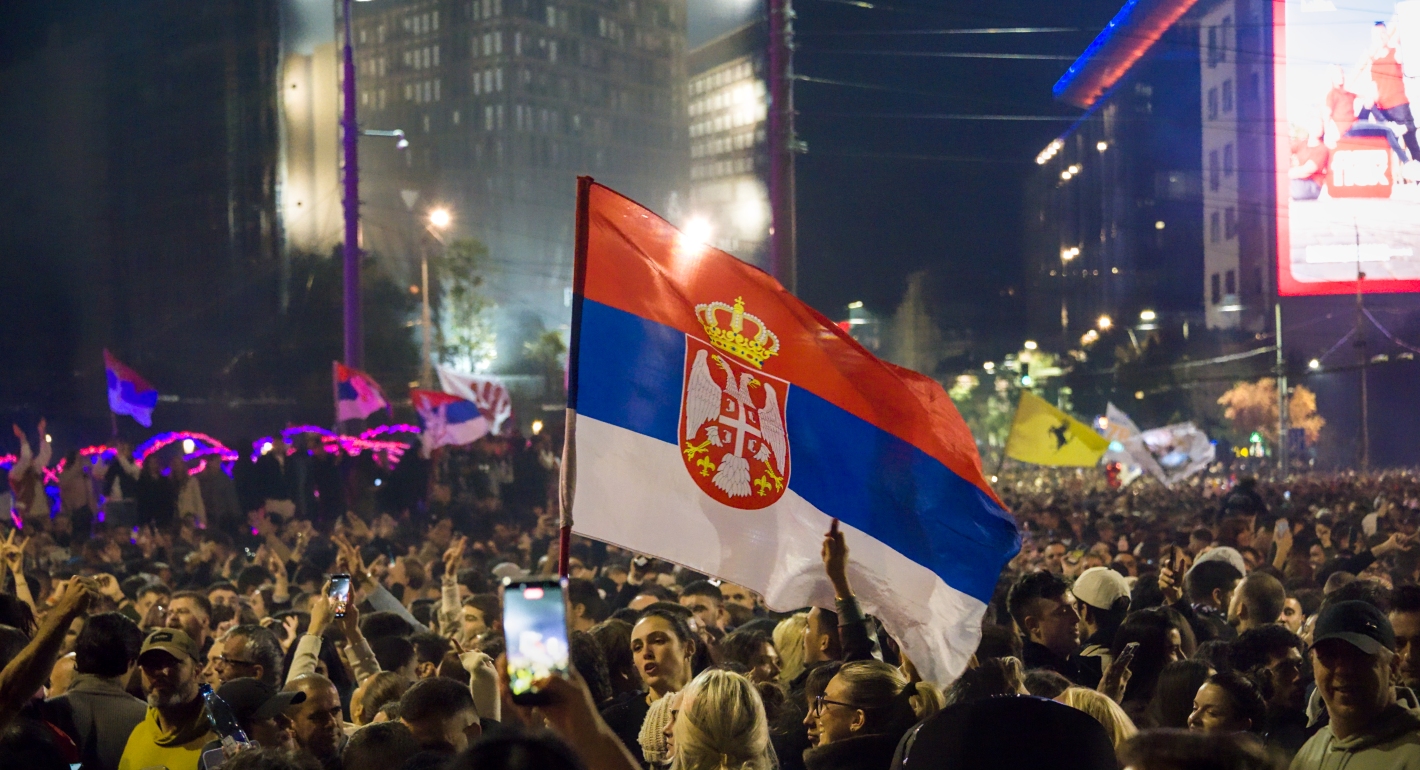
After two years of mass protests, Serbia’s student-led movement has ousted Aleksandar Vučić’s. Now the Student List must prove it can deliver on its promises.
Aleksandar Vučić is gone, but what next? Euphoria following the October 25 ouster of Serbia’s strongman leader is still running strong. But as citizens jubilate and breathe a sigh of relief after fourteen long years under the Serbian Progressive Party (SNS), questions persist about the country’s domestic trajectory and relations with the world. Both locals and foreign observers of the Western Balkans feel Serbia is at an inflection point. But whether the victorious Student List (SL), a grassroots movement born out of a mass protest wave, will deliver on its promise remains to be seen.
Much is at stake—for Serbia, its neighbors, and Europe as a whole. The defeat of Vučić’s SNS in a snap parliamentary election is being chalked up as a rare victory for democracy against the global wave of autocracy. Observers have drawn a parallel with the fate of Viktor Orbán, an ally in neighboring Hungary dethroned in April’s parliamentary election. And, much as in the Hungarian case, analysts have portrayed the outcome in Serbia as a victory for the EU against its adversaries, notably Russia, China, and the administration of U.S. President Donald Trump, which all counted Vučić as a friend. European Commission President Ursula von der Leyen and European Council President António Costa welcomed the SL’s win, vowing “to work together to advance Serbia’s future in the European Union.”
That is all fine; there is a grain of truth in looking at events through the lens of geopolitics. But much recent analysis also misses the obvious: For better or worse, this was a Serbian election shaped by Serbian conditions, idiosyncrasies, grievances, resentments, and hopes. The question is therefore whether Serbia will become a more decent place to live. After all, that is what most Serbians voted for. They scrapped Vučić for the SL in the hope that state capture would be reversed, civil freedoms restored, and daily life improved as a result. What hangs in the balance is the future of Serbia, much less that of the EU or liberal democracy as a whole.
What the public expects from the new government is that it will clean Serbia’s Augean stable. Since the days when Slobodan Milošević held power and wars raged across the former Yugoslavia, the cozy relationship between senior officials, criminal kingpins, crooked cops and intelligence operatives, shady oligarchs, and nationalist zealots has been a defining feature of governance. Throughout the 2000s, governments went some way toward dismantling those networks and Milošević’s authoritarian legacy, particularly in the wake of former Serbian prime minister Zoran Djindjić’s shocking 2003 assassination by a criminal clan in cahoots with the deep state. However, the rise of the SNS—the so-called Progressives, an ostensibly EU-friendly spin-off of former deputy prime minister Vojislav Šešelj’s far-right Serbian Radical Party—saw mafia-style statecraft come back with a vengeance.
Vučić’s reign offered egregious examples. In the run-up to this year’s election, investigative media published leaked messages from a jailed drug lord, Darko Šarić, boasting about his close personal ties to the Serbian leader, his son, and his businessman brother, Andrej Vučić. The exchanges hinted at favors traded in both directions. The scoop would have been a bombshell in many other democracies. In Serbia, it was more of the same. Few were truly surprised: Breaking the law is how one gets to both win and keep power. Yet, marathon protests lasting nearly two years, with hundreds of thousands taking part, revealed that society’s patience had been exhausted. The November 2024 collapse of a canopy at the Novi Sad train station, the original trigger for the protests, exposed the deadly price of systemic corruption. In the face of mass anger, Vučić tried every trick in the book—even considering a coup, according to reports, which he denies—but failed to keep his job.
Now, the SL has a clear shot at meeting at least some expectations. With a comfortable share of 140 seats in the 250-member Skupština, or National Assembly, the movement has the popular support and legislative heft to see through meaningful reforms. Dejan Šoškić, a respected economist and former governor of the central bank, would make a credible prime minister. “We have a plan,” he reassured a podcaster days before the election. Šoškić would also enjoy goodwill abroad. For all the acrimony toward the EU for giving Vučić a free pass for many years, Brussels and EU member states, which have a stake in Serbia’s success, are cheering at the prospect of a reformist outfit being in charge in Belgrade. The SL will likely carry the presidential election at the end of this year, as the current caretaker head of state, Ana Brnabić, who owes her political career to Vučić, is hardly a viable proposition.
Yet, Serbia’s incoming leadership will have a steep hill to climb. Vučić’s loyalists and clients are firmly ensconced in local government, the security apparatus, the judicial branch, the economy, and the media. Some may transfer their allegiance to the new elite, but others will probably stick with the SNS. The SL—a collection of university professors and activists with limited experience in the sausage-making that is parliamentary politics and public administration—could suffer because of internal squabbles and splintering. Some might succumb to the temptation of self-enrichment associated with holding power in a political system with weak checks and balances. Finally, there will be those urging caution in taking on high-level graft because of the risks involved. Everyone remembers Djindjić’s fate. History does not repeat itself, but it rhymes. At the same time, the SL should be given the benefit of the doubt. It has the best intentions and brings in professionals from different walks of life whom Serbians trust. This is more than a good start.
To deliver to society, maintain momentum, and offset threats, the SL should consolidate by moving from a social movement united by its defiance of a strongman to something that resembles a political party. The group need not use the word “party,” which is toxic in a country that views parties, including the old opposition to Vučić, as self-serving cliques whose sole purpose is to siphon off public resources. But Ilija Srdanović, the Novi Sad–based cardiologist who has emerged as the SL’s informal leader, should take institutionalization seriously.
The SL will also have to take into account its opponent. As deeply tainted as the SNS is, it can reassert itself in a scenario in which society grows disillusioned while the economy stagnates. The opposition will tap Serbian nationalism, seizing every opportunity to accuse the government of treason, even though the students have taken a hard stance on Kosovo. This could happen under a new leader, with Vučić pulling the strings behind the scenes. Vučić is down but not necessarily out. He might end up being prosecuted for corruption and face long-term imprisonment. But equally plausible is that he pulls through with a little help from his friends in the state machine and the judiciary. In neighboring Montenegro, former leader Milo Djukanović walked free despite an accumulation of allegations over his nearly three decades in power. The silver lining in this story is that competition will make Serbian politics healthier. Vučić’s departure is an opportunity to redemocratize Serbia by affording the SNS—or whatever emerges from the rubble—a new role.
The fact that the SNS and the SL will be competing in the Skupština and arguing about decisions made by the new cabinet matters too. Constitutionally, Serbia is a parliamentary republic and it has always been vulnerable to power grabs by imperious presidents, who often assert their writ through informal channels. Vučić illustrated the perils of this arrangement, notably the hollowing out of party politics. His demise is a chance to restore not only the spirit but also the letter of the constitution.
What will be the Serbian election’s impact on the wider region? The result is excellent news for those who wish to see the Western Balkans move faster toward EU membership. Though on paper Vučić pushed for Serbia’s EU accession, in practice he personified the notion that a country could thrive without joining the union as a full-fledged member or conforming with the bloc’s rigorous entry conditions. Under his leadership, Serbia cherry-picked elements of European integration, prioritizing trade and investment ties with the EU over values. He was as much at home in Beijing or Abu Dhabi as in Brussels, casting Serbia as a version of nonaligned Yugoslavia. Pro-Europeans saw Vučić as a potential spoiler in the neighborhood: telling Montenegrins the EU would never welcome them; backing moves by Milorad Dodik, leader of the Bosnian Serbs, to undermine Bosnia and Herzegovina as a viable state; and profiting from disillusionment with the EU in North Macedonia, where Serbia under Vučić was seen as a leading international ally.
By contrast, Serbia’s new government looks intent on engaging with the EU. The two sides’ agendas are in sync. The rule-of-law conditionality of EU membership negotiations will no doubt be central to efforts to dismantle the former regime’s toxic legacy. The government will probably give its approach a patriotic spin. Belgrade will undertake reforms not to please the European Commission but for Serbia’s own good. Key figures in the SL have pointed out that “commitment to European principles and values” appears in Article 1 of the nation’s constitution.
Such an approach is fully warranted. Euroskepticism holds sway over Serbian society. Because of Vučić and the anti-European discourse in media that backed the former government, support for EU membership in Serbia is the lowest in the region, hovering at around 34 percent in 2024, with 26 percent against. That compares with 10 percent against in Montenegro.
In Serbia, anticorruption bridges the pro- versus anti-EU divide. The SL is a product of this alliance, which grew after popular opposition in 2021 to an EU-backed concession to mine lithium in western Serbia. It would therefore be prudent for the new government not to rely on the EU as a paramount source of legitimacy. Justifying each and every decision and policy through the EU might backfire. At the same time, change could have a beneficial impact on Brussels’s image in Serbia. The negative campaign waged by the Vučić-aligned mediasphere may be toned down. Outlets like Informer used to sling mud not only at protesters but also at the EU and the West. To discredit the latter, these outlets spoke of a color revolution orchestrated by unnamed foreign forces. On February 22, 2022, two days before Russia’s full-scale invasion of Ukraine, Informer ran a headline “Ukraine attacked Russia.” Such anti-European narratives may not go away, but they will not be as prominent going forward. A shift by the public broadcaster RTS and the four private TV channels with national coverage will make a difference.
One area in which there will be more continuity than change is foreign policy. SL representatives have made it clear that Serbia won’t be joining Western sanctions against Russia. That is understandable for two reasons. First, Belgrade is not changing course on Kosovo. The new government will continue Vučić’s policy of engaging in EU-sponsored normalization talks with Prishtina. Ideally, Belgrade might even move to implement the 2023 Ohrid Agreement aimed at regularizing Serbia-Kosovo relations, which would earn the new government points in Brussels and make the cost of any domestic backlash bearable. However, Serbia will continue to oppose Kosovo’s independence. To that end, Russian diplomatic support will remain essential.
Second, Serbia’s economic ties won’t be undone either. The October 30 closure of Alta Bank, where many Russians deposited cash, does not change the big picture. Russia’s Gazprom will continue to supply gas to Serbia, while the country’s national oil company NIS remains in the ownership of Gazprom Neft, with the Trump administration continually granting exceptions to U.S. sanctions on Russian exports. That said, the chances are that Serbian factories will go on churning out ammunition for Ukraine—as well as Israel—as they did under Vučić.
No U-turn is to be expected on China, either. To be sure, the ill-fated renovation at the Novi Sad train station that kicked off the 2024 protests was paid for by a Chinese loan. But again, Serbia’s economic ties have become structural. China accounts for 11.5 percent of the overall stock of foreign direct investment in Serbia. Though this pales in comparison with the EU’s share of 62.6 percent, China is still number two.
What will probably be seen is some alignment with the EU on protection from unfair competition from China in the area of trade. The European Commission’s new proposals on the staged integration of candidate countries into the European single market identify compliance with EU defense policies and rules as a prerequisite. Serbia’s new prime minister won’t enjoy the personal relationships Vučić cultivated with China’s Xi Jinping and Russia’s Vladimir Putin. But he or she will always be welcome in both Beijing and Moscow, which will continue to see Belgrade as a partner in Europe.
There is no denying that Serbia is entering a new phase of its political history. The result of the October 25 parliamentary election is an opportunity to reset the nation’s politics and, hopefully, its relations with the EU. A new generation has come of age after two years of protests demanding accountable government. Serbia will now be run by a set of professionals who have shown integrity. Yet, the shift at the top is just a first step in a protracted and complicated process.
The European Commission is preparing the EU for its next enlargement. But member states need to make it a project that European citizens can understand, shape, and support.

Senior Fellow, Carnegie Europe
Dimitar Bechev is a senior fellow at Carnegie Europe, where he focuses on EU enlargement, the Western Balkans, and Eastern Europe.
Recent Work
Dimitar Bechev
Carnegie does not take institutional positions on public policy issues; the views represented herein are those of the author(s) and do not necessarily reflect the views of Carnegie, its staff, or its trustees.
Mikhail Zvinchuk’s detention could have dealt a serious blow to Russia’s propaganda infrastructure in the Balkans. Instead, the incident has made something else eminently clear: Moscow values and protects its propagandists, while Europe still hasn’t figured out what to do with them.
Ivan Filippov, Ksenia Luchenko
The new Serbian leadership may have promised to keep on cooperating with Russia, but soon they will have to make a choice between fighting corruption and sealing lucrative deals with Moscow. The two are mutually exclusive, even if the new leaders in Belgrade haven’t yet realized it.
Maksim Samorukov
Serbia’s electoral earthquake is an extremely rare example of an entire political system being defeated by street protesters who played by the rules.
Alexander Baunov

The concept authored by Sergei Kiriyenko and his team can be considered not only an apologia for the Putin regime, but also a blueprint for Russia’s future configuration.
Andrey Pertsev
The pressures of war are gradually warping Russia’s system of governance, making it more vulnerable to a future crisis.

Tatiana Stanovaya