

Springing Forward: Relaunching the Africa Technology Policy Tracker
AfTech 2.0 offers the most comprehensive and accessible view of how African governments are structuring their digital economies.
April 2026
This month, the Carnegie Africa Program was thrilled to launch a major update to the Africa Technology Policy Tracker (AfTech). AfTech 2.0 now aggregates 1,034 laws, policies, and regulations across 54 African countries and the African Union, offering the most comprehensive and accessible view of how African governments are structuring their digital economies.
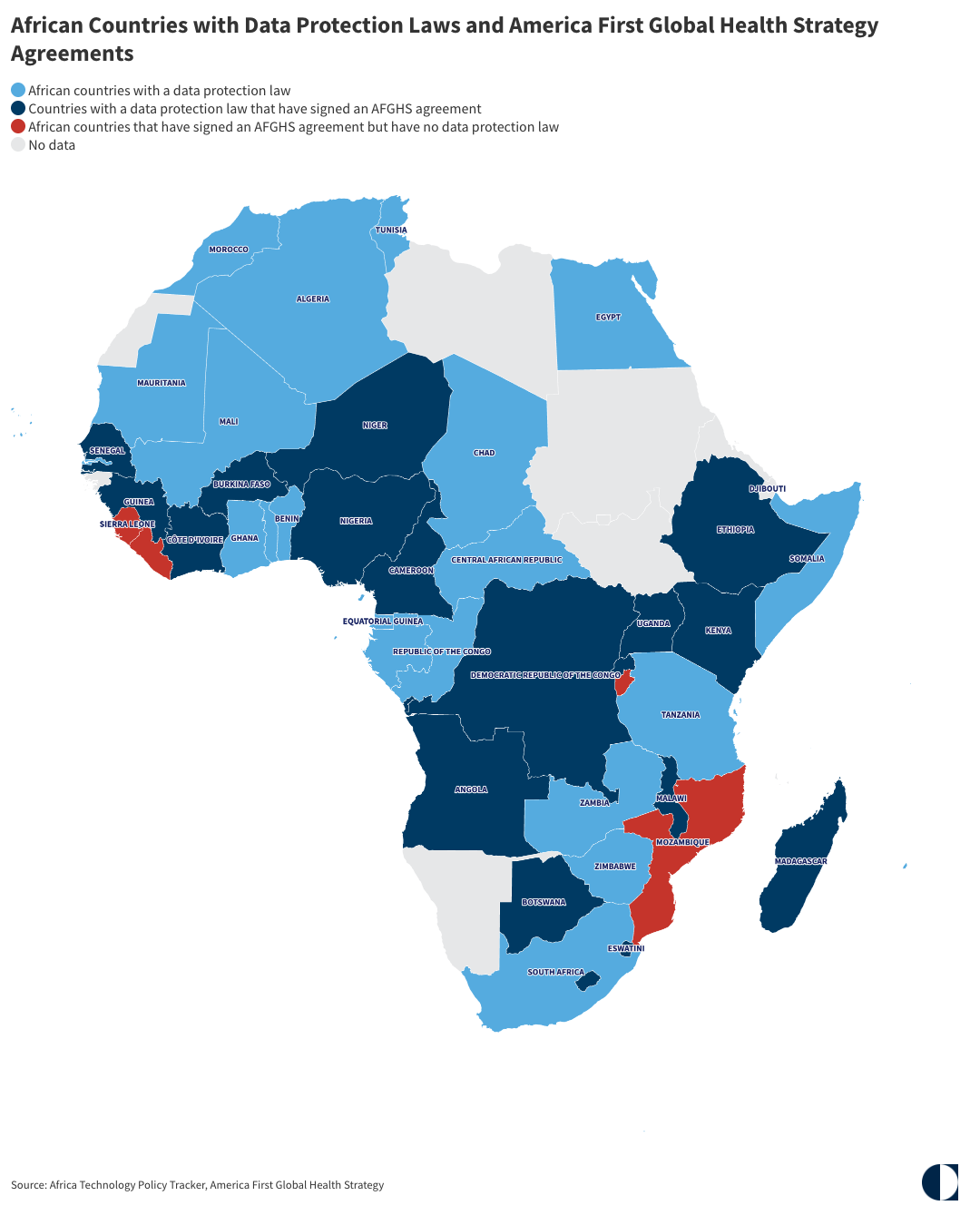
Jane Munga’s latest analysis draws from the updated data, showing that digital infrastructure is a top priority for African policymakers shaping the continent’s digital economy. Beyond that piece, AfTech 2.0 also underpins new work by Jane Munga and Rose Mosero examining how African data protection laws are constraining external access to data under the Trump administration’s America First Global Health Strategy. Our Chart of the Month, sourced from this piece, lays out how African countries’ data protection laws match up with signed health deals.
As the Middle East war stymies global trade, threatens supply chains, and recasts diplomatic relationships, Africa Program scholars have been at the forefront of trade-related discussions on the continent and here in Washington, DC. At the recent World Trade Organization Ministerial Conference in Yaoundé, Kholofelo Kugler spoke at multiple events and was interviewed on Cameroon Radio Television. Takeaways from the ministerial further informed her recent publication with Georgia Schaefer-Brown on Africa’s economic edge and key sectors for investment. Also at the conference, Henok Asmelash contributed to pre-ministerial discussions on how the African Continental Free Trade Area is reshaping African countries’ positions in multilateral trade negotiations.
Energy, industrial policy, and U.S. relations with the Democratic Republic of the Congo (DRC) remain on our agenda. At the Powering Africa Summit, Ramsey Day spoke on an energy security and critical minerals supply chains panel while Katie Auth moderated a panel on the role of investment in Africa’s universal energy access. Christian Géraud-Neema was on several podcasts, discussing topics from the U.S.’s evolving role in Africa, to minerals and peace in the DRC, with Chatham House.
Carnegie scholars are also providing insights on Africa’s place in geopolitical contestation, including Russia-Africa dynamics. On Capitol Hill, Frances Z. Brown briefed a bipartisan group of foreign affairs staffers on findings from Carnegie’s recent Russia in Africa compendium, convened as part of the ONE Campaign’s Africa Fellows program. In a new Foreign Affairs publication, Frederic Wehrey and Andrew S. Weiss describe Russia’s slipping grip on the Sahel.
Here at our headquarters in Washington, DC, this month we are thrilled to be welcoming Fonteh Akum as the new Carnegie Africa Program director and senior fellow, and Lesley Anne Warner as a visiting scholar. Stay tuned for more impactful work about the African continent from our world-class scholars. Follow us on LinkedIn, and on X @AfricaCarnegie.
Chart of the Month
Features
Africa’s Digital Infrastructure Imperative
The Africa Technology Policy Tracker reveals policymakers’ priorities for the continent’s digital transformation.
By Jane Munga
Africa’s Global Economic Edge: Advancing Strategic Sectors
In key sectors such as critical minerals, specialty agriculture, and fintech, Africa can become a global powerhouse by investing more in manufacturing, value-add, and scaling.
By Kholofelo Kugler and Georgia Schaefer-Brown
Kenya’s Health Deal is a Stress Test for the America First Global Health Strategy
U.S. agreements must contend with national data protection laws to make durable foreign policy instruments.
By Jane Munga and Rose Mosero
Russia in Africa: Examining Moscow’s Influence and Its Limits
As Moscow looks for opportunities to build inroads on the continent, governments in West and Southern Africa are identifying new ways to promote their goals—and facing new risks.
By Nate Reynolds, ed., Frances Z. Brown, ed., Frederic Wehrey, ed., Andrew S. Weiss, ed.
Why Russia Is Losing the Sahel
Moscow’s Missteps Offer a Warning—and an Opening—for Washington.
By Frederic Wehrey and Andrew S. Weiss
“Greening” the Maghreb or Exploiting It?
Unless the European Union-led energy transition provides economic development to Algeria, Morocco, and Tunisia, the process may be perceived as a new form of extraction.
By Yasmine Zarhloule
Report Offers New Evidence of Starvation Crimes in Darfur
By Tom Dannenbaum and Oona A. Hathaway
Civil Society Restrictions in North Africa: The Impact on Climate-Focused Civil Society Organizations
For climate-focused civil society in countries like Morocco, Algeria, and Tunisia to be most effective, organizations should work together to develop networks that extend their reach beyond their local area and connect across borders to share best practices and amplify each other’s work.
By Sarah Yerkes
From the Archive
In August 2022, Rose Mosero published “In Kenya’s 2022 Elections, Technology and Data Protection Must Go Hand-in-Hand,” exploring the relationship between Kenya’s Data Protection Act (DPA) and its electoral process. In last month’s article “Kenya’s Health Deal Is a Stress Test for the America First Global Health Strategy,” Rose Mosero joins Fellow Jane Munga in unpacking how Kenya’s DPA and other African data protection laws may help countries protect their data sovereignty as they consider bilateral health deals couched in the America First Global Health Strategy.
Carnegie does not take institutional positions on public policy issues; the views represented herein are those of the author(s) and do not necessarily reflect the views of Carnegie, its staff, or its trustees.