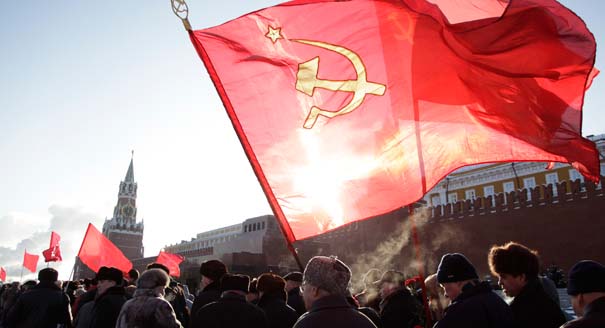
Twenty years after the disintegration of the Soviet Union, Russia’s disinterest in its former empire has been matched by the other former Soviet republics distancing themselves from the former imperial center.
What Russian Empire?Twenty years ago this month, the Soviet Union — the last of the great 20th century empires — started to crumble following the ill-advised putsch of August 1991. Within two years, it had vanished altogether.
Compared to the prolonged and bloody demises of the British and French empires, the Soviet Union’s collapse was remarkably calm. The “Commonwealth of Independent States” (C.I.S.), which many people mistook for a new name for the Soviet Union — and some dubbed “a fresh edition of the Russian empire” — accomplished the mission of making sure that the dissolution of the U.S.S.R. was one of the most peaceful and least violent imperial exits in history.
It was able to do so because the Russian Federation, counterintuitively, did and has done little to attempt to hold on to its “near abroad.” It has had few resources to spare, and no will to subdue.
The regional integrative bodies that did emerge in the post-Soviet space — such as the customs union of Belarus, Kazakhstan and Russia, or the Collective Security Treaty Organization (C.S.T.O.), which also includes Armenia, Kyrgyzstan, Tajikistan and Uzbekistan — have been pragmatic arrangements that cannot be compared to E.U./NATO or the defunct Comecon/Warsaw Pact.
Much has been made, in the wake of the 2008 Georgia war, of President Dmitri Medvedev’s formulation of Russian “zones of privileged interests.” But today these may be said to include only two areas — Abkhazia and South Ossetia. Three years after the war in the Caucasus, not a single member of the C.S.T.O. has followed Russia’s recognition of Abkhaz and South Ossetian statehood. In this part of the world, sovereignty means, above all, independence from Moscow.
As for the 25 million or so ethnic Russians who were left behind throughout the former Soviet borderlands, Moscow has done next to nothing to get them out of civil conflicts, as in Tajikistan or Kyrgyzstan, to speak nothing of supporting irredentism where Russians form a majority, as in Crimea. The Kremlin has only paid lip service to upholding ethnic Russian citizenship claims in Estonia and Latvia, and not even that in Turkmenistan.
In fact, Russia’s foreign policy has served to push these countries away from its imperial embrace and toward greater independence. Despite ritual declarations that C.I.S. is its top priority, Moscow has pointedly refused to invest in creating “a better union.” In the mid-2000s, Gazprom drastically hiked prices for its former Soviet customers, bringing them to the European level, and the Russian Parliament passed a restrictive citizenship law ending privileges for former Soviet passport holders. At a stroke, the former Soviet Union ceased to exist: “near abroad” became simply “abroad.”
Russia’s remarkable disinterest in its former empire has been paralleled by the other former Soviet republics distancing themselves from the former imperial center. Several have proclaimed a European vision or vocation. Others reaffirmed Muslim roots and focused on their neighborhoods. A couple have gone into isolation.
Russia has taken it all in stride. Since the termination of the “ruble zone” in 1993, its economic links with former Soviet republics have been slackening. The C.I.S. now accounts for a mere 15 percent of Russia’s foreign trade.
The problem for students of Soviet affairs has been what to call this former Soviet space. With the vantage of 20 years, it can be said that three distinct regions have formed.
One is the New Eastern Europe: Ukraine, Belarus and Moldova. Kiev and Chisinau have proclaimed a European orientation, which has survived changes of governments. As for Belarus, Aleksandr Lukashenko has made his country so different from its neighbors that he has effectively set the foundation of Belarusian independence — something early Belarusian nationalists, with their Russophobia, might not have managed. When the Belarusians finally have their say, they are likely to also opt for Europe.
Another region is the South Caucasus. Some would like to see it as South-east Europe. Tbilisi is certainly poised that way. Georgia’s road to Europe will be difficult, but the future of Azerbaijan and Armenia is even less certain. Like New Eastern Europe, the South Caucasus will be on its own for quite a while, wedged as it is between the European Union, Turkey, Iran and Russia.
Central Asia is the third new grouping. There, “Eurasianness” applies only to Kazakhstan, due to its ethnic composition and cultural and religious diversity. The rest is “Middle Asia,” as Soviet geographers once called it: Islamic revival and the proximity to the Middle East and China have reshaped a part of the world that formerly was a Russian and then Soviet backyard.
Finally, there’s Russia itself. Culturally European, it is not, politically, of Europe. It abuts Asia, but to many Asians it has become irrelevant. It can hardly be integrated into Europe, and cannot or will not integrate others within the C.I.S.
Paradoxically, this may be for the better. If Russian society can find the energy and will to exit from its current atomized condition and start building a post-imperial nation-state, Russia will find its place on the global map as a Euro-Pacific nation and draw its strength from that.
With links multiplying between the E.U. on the one hand and China, India, Japan, Korea on the other, and with Russia and its neighbors in the middle, a new Eurasia is emerging, no longer dominated by a single power and for the first time living up to its geographical name.
Carnegie does not take institutional positions on public policy issues; the views represented herein are those of the author(s) and do not necessarily reflect the views of Carnegie, its staff, or its trustees.
China’s political future will be shaped between now and next October. As the Communist Party enters its intense “campaign season” to prepare for a major political transition in 2027, reading Beijing's actions and responses may become more difficult as domestic politics weigh on its behavior more than usual.
U.S. unpredictability has allowed China to capitalize on its positioning as the “responsible great power”. Paradoxically, the more China wins the perception game, the more likely expectations will rise for Beijing to deliver not just words but to demonstrate with its deeds.
Hanoi and Beijing have long treated each other as distant cousins rather than comrades in arms. That might be changing as both sides draw closer to hedge against uncertainty and America’s erratic behavior.
Across Asia, China is better positioned to withstand energy shocks from the fallout of the Iran war. Its abundant coal capacity can ensure stability in the near term. Yet at the same time, the country’s energy transition away from coal will make it even less vulnerable during the next shock.