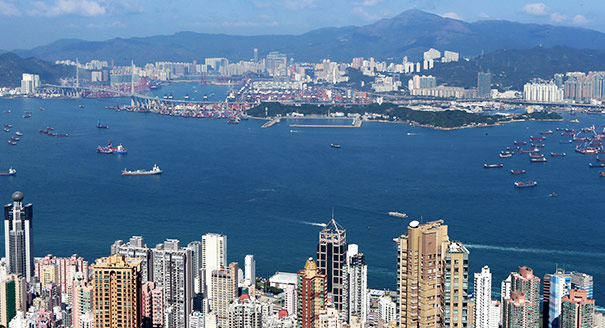
The Asia-Pacific region contains dynamic twenty-first century global economies in the midst of a positively nineteenth-century set of security policy arrangements. Unresolved territorial disputes litter the region, including the Korean peninsula, the East China Sea, Taiwan, the South China Sea, the Sino-Indian border, and the continuing problem of Kashmir. These unresolved territorial disputes have given rise to multiple fractious security arrangements.
In Europe at the height of the Cold War, the Soviet Union, the United States, NATO, and the Warsaw Pact states succeeded in agreeing on the Helsinki Accords, which included the establishment of the Conference on Security and Cooperation in Europe (CSCE). Forty years later, the legacy of the Helsinki Accords remains alive in what is now the OSCE, which still counts the United States and Russia among its members.
The cold, hard reality is that we have no equivalent institution in the Asia-Pacific region. Of course, as we know from Europe’s experience, neither the CSCE nor the OSCE has succeeded in resolving fundamental security problems. But at times of crisis, these institutions have helped manage and, in some cases, reduce tensions.
That is why for some years now, I have advocated for the evolution of what I have called an Asia-Pacific Community (APC), which could incorporate a number of the principles contained in the OSCE process. One possible platform for such arrangements is the existing East Asia Summit (EAS).
The United States is demonstrably a Pacific power. And anyone familiar with elementary geography knows that Russia, too, is a Pacific power. That’s why in 2010, as prime minister of Australia, I campaigned long and hard with other countries in Southeast Asia to invite both the United States and Russia to become members of the East Asia Summit. ASEAN took that decision in 2010. The EAS also includes other major regional powers, such as Japan, Indonesia, India, and South Korea, among others. As of 2010, we have had the appropriate powers around one table to deal with most regional security challenges.
The organizing principles of the East Asia Summit, which has just celebrated its tenth anniversary, are outlined in the Kuala Lumpur declaration of 2005. This founding document of the EAS provides for comprehensive dialogue and cooperation in the political, security, and economic domains. At the 2015 East Asia Summit, member states decided to further develop the EAS in the future.
One practical manifestation of this future development could be a decision to incorporate the mechanism called the ASEAN Defense Ministers’ Meeting Plus Eight (ADMM+8) into the machinery of the EAS. The membership of both mechanisms is identical. Furthermore, it would provide a wider political and military apparatus for EAS leaders to begin to develop the confidence and security-building measures the Asia-Pacific region sorely needs.
This, in turn, could evolve in the direction of a more comprehensive Asia-Pacific Community of the type I first proposed as prime minister of Australia in 2008. This is not intended to replicate some sort of European community in the East. Rather, it is a narrower concept called upon to begin developing a regional culture of common security cooperation in order to de-escalate security tensions and crises.
This brings us to the question of the future of the global order itself.
The underpinnings of the post-1945 global order are at present under considerable stress. This is reflected in the state of great power relations. It is also evident from the operation of our global institutions. In fact, as the demand for effective global governance increases, the supply of such governance seems to be in decline. We see this through the institution of the United Nations, as well as in the Bretton Woods institutions.
The challenges faced by the UN system today are formidable. There are multiple crises in which the UN is not central to the major political, security, and even humanitarian debates. The Iranian nuclear negotiations are a case in point. The European refugee crisis is another.
For there to be a fully functioning global order, the world needs the great powers around the table, cooperating and responding to the big challenges the international community faces. Russia therefore must be fully at the table. China must be fully at the table. The United States must be fully at the table. And unless and until this is happening in the day-to-day business of the international system, our global order will become increasingly fragmented.
I strongly agree with Henry Kissinger in his diagnosis of the problems of global order. Whatever the problems of global order may be, the alternative is infinitely worse. History reminds us of what periods of global disorder resemble.
It was not so long ago that we experienced a colossal human catastrophe of disorder. Russia, in particular, is acutely mindful of what happens when the global system collapses. The staggering numbers of Russian war dead from World War II remind us of this fact.
Global leaders cannot afford to adopt a passive approach to the challenge of continuing to support, sustain, and where necessary reform the core architecture of a stable global order. In the two generations since the end of World War II, we have perhaps forgotten the price of allowing global order to disintegrate.
We cannot afford for that to happen again.
The Honorable Kevin Rudd, the 26th prime minister of Australia, is president of the Asia Society Policy Institute and chair of the Independent Commission on Multilateralism. This article is adapted from an address to the Diplomatic Academy of the Russian Federation, delivered in Moscow on February 19, 2016.