• Research
  • Strategic Europe
  • About
  • Experts
Carnegie Europe logoCarnegie lettermark logo
EUNATO
  • Donate
{
  "authors": [
    "Maria Lipman"
  ],
  "type": "legacyinthemedia",
  "centerAffiliationAll": "",
  "centers": [
    "Carnegie Endowment for International Peace",
    "Carnegie Russia Eurasia Center"
  ],
  "collections": [],
  "englishNewsletterAll": "",
  "nonEnglishNewsletterAll": "",
  "primaryCenter": "Carnegie Russia Eurasia Center",
  "programAffiliation": "",
  "programs": [],
  "projects": [],
  "regions": [
    "Caucasus",
    "Russia"
  ],
  "topics": [
    "Political Reform"
  ]
}
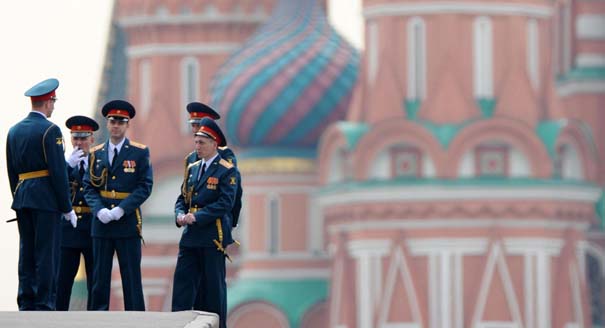
Source: Getty

In The Media
Carnegie Russia Eurasia Center

Russia, Again Evading History

The Russian government has intensified its attempts to edit the nation's past by establishing an anti-falsification commission whose potential effects on academic research are disquieting.

Link Copied
By Maria Lipman
Published on Jun 20, 2009

Source: the Washington Post

Russia, Again Evading HistoryThe Russian government has intensified its attempts to perfect the nation's past. The Defense Ministry posted an academic article on its Web site arguing that Hitler's territorial claims on Poland were "moderate" and "can hardly be referred to as unsubstantiated." After Poland rejected these claims, seeking "to gain a great power status," the article went on, it was only natural that Germany would attack -- starting World War II. When the article became the subject of news coverage, sparking discussion at home and abroad, it was removed from the site.

Even if the Defense Ministry, or the government at large, would balk at supporting the theory of Poland's "guilt" in provoking World War II, the publication of this article -- "Fabrications and falsifications in evaluating the role of the U.S.S.R. on the eve and at early stages of WW2" -- on an official site cannot be ignored. The article's title echoes the goal of a government commission established last month by President Dmitry Medvedev's decree: to oppose attempts to falsify history that damage Russia's interests. This mission shows the potential for interpretation -- and abuse: It implies that genuine historical fact cannot be damaging to Russia's world stature, but also that there's nothing wrong with the distortion of facts if it embellishes the country's image.
The commission, which is headed by Sergey Naryshkin, Medvedev's chief of staff, includes high-ranking officials from various government agencies, as well as the directors of two leading historical research institutions. Some members have indicated that the panel will focus on Eastern European and Baltic interpretations of the war history. Naryshkin said the commission would deal with attempts by "a number of political movements and even governments to belittle the role of our country [in the war] and even . . . to lay certain claims. We can't tolerate it. . . . We don't have the right to keep silent while listening to whiffets' peeping and yelping. We must respond." 
 
Sergey Markov, a Kremlin loyalist and member of the commission, was more specific: Estonia, Latvia and Ukraine, he said, "have fully committed their government powers to finance falsifications of history." Markov, who is known for his grandiloquence, plans "to liberate historians in Ukraine, Latvia, Estonia, Georgia and Poland from the pressure of state dictatorship applied unto them."
 
For most of the 20th century, the Communist Party's historical falsifications and fabrications were of Orwellian proportions. In Stalin's time, schoolchildren were routinely told to blacken portraits of "enemies of the people" in their books; unwanted images were removed from official photos, eliminating all traces of former members of the communist elite who were killed by the Soviet regime.
 
In contrast, today's government does not seek to eliminate ideologically incorrect interpretations from every history book. Even Markov says academic research should not be constrained. (There's evidence, however, that the government has asked professional historians to identify instances of "falsifications" by their foreign colleagues.) What the Kremlin has been after in recent years is boosting the sense of Russia's greatness and the infallibility of its leaders -- current leaders included -- in the national mind-set. This is a substantial task given the communist dictatorship's mass exterminations of innocents during the 20th century. Hence the government's systematic effort to prevent broad public discussion of the crimes of totalitarianism or the fabrications used to cover up those crimes. The official outlook on recent history is focused on the Soviet victory over Nazi Germany, which is a uniquely positive memory shared by the overwhelming majority of Russians.
 
To Russian officialdom, the fact that the Soviet Union defeated Hitler preempts critical analysis of all other pre- and postwar developments. But while no one would deny Russia's victory over the Third Reich, the Soviet role as an occupier and oppressor cannot be erased from the national memory of Eastern European and Baltic countries. This perception of the Soviet Union is used (and sometimes abused) by those countries to strengthen their national identities and senses of statehood.
 
Regardless, it is impossible to force a Russian vision on other nations (just as foreign countries can't impose their interpretations on Russia). What the Russian government can do, however, is impose politically motivated interpretations on its domestic audience, in schoolbooks and in the media.
 
There is another concern about the government assuming the authority to differentiate between genuine and false views of history. During Vladimir Putin's tenure, access to historical archives has become increasingly restricted. The historical records kept in those archives contain too many genuine facts that seriously tarnish Russia's image.
 
Arseny Roginsky, director of the Russian Memorial Society, a nonprofit organization that has done archival research and commemoration work related to the victims of Soviet totalitarianism, expects the commission to further obstruct such work. He is also concerned, as he told me recently, that "government attention will be inevitably focused even more on the expressions of alternative views on sensitive historical issues."
 
The anti-falsification commission may not directly interfere with academic research, but its potential effects are disquieting. Its work will probably result in professional historians being pushed even further from the broad public sphere, and it will marginalize even more organizations such as the Memorial Society. Meanwhile, its very existence will likely encourage more absurd and counterfactual theories, such as the one blaming Poland for starting World War II.

About the Author

Maria Lipman

Former Scholar in Residence, Society and Regions Program, Editor in Chief, Pro et Contra, Moscow Center

Lipman was the editor in chief of the Pro et Contra journal, published by the Carnegie Moscow Center. She was also the expert of the Carnegie Moscow Center’s Society and Regions Program.

    Recent Work

  • Commentary
    The Russian State Power and the Ukrainian Human Factor

      Maria Lipman

  • Commentary
    Putin’s Crimean Conquest Pushes Russia to an Anti-Modernization Course

      Maria Lipman

Maria Lipman
Former Scholar in Residence, Society and Regions Program, Editor in Chief, Pro et Contra, Moscow Center
Maria Lipman
Political ReformCaucasusRussia

Carnegie does not take institutional positions on public policy issues; the views represented herein are those of the author(s) and do not necessarily reflect the views of Carnegie, its staff, or its trustees.

More Work from Carnegie Europe

  • Commentary
    Strategic Europe
    There Is No Shortcut for Europe in Armenia

    Europe has an interest in supporting Armenian leader Nikol Pashinyan as he tries to make peace with neighbors and loosen ties with Russia. But it is depersonalized support in the long term, not quickfire flash, that will win the day.

      Thomas de Waal

  • Commentary
    Strategic Europe
    How to Join the EU in Three Easy Steps

    Montenegro and Albania are frontrunners for EU enlargement in the Western Balkans, but they can’t just sit back and wait. To meet their 2030 accession ambitions, they must make a strong positive case.

      Dimitar Bechev, Iliriana Gjoni

  • Article
    Rewiring the South Caucasus: TRIPP and the New Geopolitics of Connectivity

    The U.S.-sponsored TRIPP deal is driving the Armenia-Azerbaijan peace process forward. But foreign and domestic hurdles remain before connectivity and economic interdependence can open up the South Caucasus.

      • Areg Kochinyan

      Thomas de Waal, Areg Kochinyan, Zaur Shiriyev

  • Commentary
    Strategic Europe
    Russia’s Imperial Retreat Is Europe’s Strategic Opportunity

    The war in Ukraine is costing Russia its leverage overseas. Across the South Caucasus and Middle East, this presents an opportunity for Europe to pick up the pieces and claim its own sphere of influence.

      William Dixon, Maksym Beznosiuk

  • Commentary
    Is the Radical-Right Threat Existential or Overstated?

    Amid increased polarization and the influence of disinformation, radical-right parties are once again gaining traction across Europe. With landmark elections on the horizon in several countries, are the EU’s geostrategic vision and fundamental values under existential threat?

      Catherine Fieschi, Cas Mudde

Get more news and analysis from
Carnegie Europe
Carnegie Europe logo, white
Rue du Congrès, 151000 Brussels, Belgium
  • Research
  • Strategic Europe
  • About
  • Experts
  • Projects
  • Events
  • Contact
  • Careers
  • Privacy
  • For Media
  • Gender Equality Plan
Get more news and analysis from
Carnegie Europe
© 2026 Carnegie Endowment for International Peace. All rights reserved.