

Commentary
With its public finances in shambles, the far right polling at 35 percent ahead of the 2027 presidential election, and a growing protest movement, is France’s crisis a threat to the EU’s geopolitical awakening?
Rym Momtaz, ed.
{
  "authors": [
    "Taiya M. Smith",
    "Douglas Rediker"
  ],
  "type": "legacyinthemedia",
  "centerAffiliationAll": "dc",
  "centers": [
    "Carnegie Endowment for International Peace"
  ],
  "collections": [],
  "englishNewsletterAll": "asia",
  "nonEnglishNewsletterAll": "",
  "primaryCenter": "Carnegie Endowment for International Peace",
  "programAffiliation": "AP",
  "programs": [
    "Asia",
    "Sustainability, Climate, and Geopolitics"
  ],
  "projects": [],
  "regions": [
    "North America",
    "United States",
    "East Asia",
    "China"
  ],
  "topics": [
    "Economy",
    "Trade",
    "Foreign Policy"
  ]
}
Source: Getty
A tightly coordinated, well-executed S&ED may be just the format to advance the world's most important bilateral relationship.
Source: Washington Note

The meeting, at which top level delegations from the world's two most powerful nations get down to business and discuss some of the world's most pressing issues side by side - or at least across the same table, represents far more than a shift in punctuation. It is a test of whether the Obama Administration can present a unified front and demonstrate that it is serious about working together to improve and expand the U.S.'s relationship with China.
The original SED was the vision of then-Treasury Secretary Hank Paulson in 2006. Pre-dating today's calls by some for a "G-2", the SED reflected Paulson's belief that that China views strategic issues, outside Tibet and Taiwan, primarily through an economic lens.
The SED provided a single, comprehensive, high level forum at which the U.S. and China could discuss issues as disparate as the Doha round, Iran, energy policy and climate change from a similar (economic) vantage point. By getting multiple cabinet departments in the same room, it provided both governments with access to nearly every aspect of the other's policy making apparatus - each speaking with one voice.
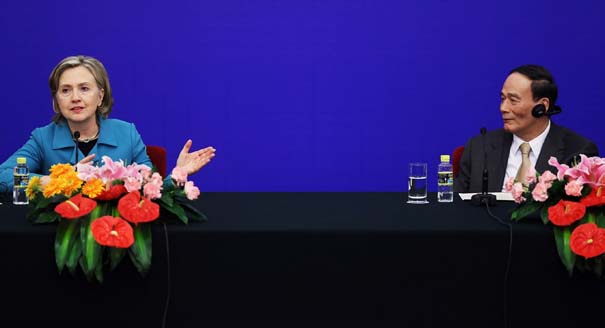
The Obama Administration has taken this precedent and made several structural modifications, the most significant of which is that while the SED was solely led by the U.S. Treasury Secretary and Chinese Vice Premier Wang Qishan, the S&ED includes both Secretary of State Hillary Clinton and the Chinese State Councilor Dai Bingguo as joint leaders of their delegations.
This shift appears to be the result of an Obama Administration compromise to avoid choosing between Secretaries Clinton and Geithner as to which would take the lead in handling our most important bilateral international relationship.
As a consequence, instead of looking at strategic issues from an economic perspective, "strategic" issues are now formally separated out from "economic" ones, thereby dividing the dialogue into two separate discussions under two distinct sets of leadership.
This division risks undermining the basic thesis of the original format - that, when dealing with China, economic issues are themselves inherently strategic. It also adds a complex and political layer of domestic coordination to the already difficult international one. With four principals speaking on economic issues rather than two, the risks of inconsistent messages and misunderstandings increase significantly.
To maximize the chance of a successful outcome from this initial S&ED, we recommend:
Lack of coordination, consistency or other missteps at the S&ED will not end the U.S.-China relationship. The SED built a strong foundation and there are numerous other dialogues and forums through which China and the U.S. can meet and discuss important issues. But, the potential undermining of this one harmonized meeting would be a setback to how effectively that relationship can be managed.
At some point down the road someone may seek to redefine the relationship and call it the "G-2". In the meantime, a tightly coordinated, well-executed S&ED may be just the format to advance the world's most important bilateral relationship.

Former Senior Associate, Energy and Climate Program, Asia Program
Smith has spent the last decade working in international negotiations. Most recently, she served as a member of Secretary Hank Paulson’s senior management team from 2006 to 2009 as the deputy chief of staff and executive secretary for the U.S. Department of the Treasury.
Douglas Rediker
Carnegie does not take institutional positions on public policy issues; the views represented herein are those of the author(s) and do not necessarily reflect the views of Carnegie, its staff, or its trustees.

With its public finances in shambles, the far right polling at 35 percent ahead of the 2027 presidential election, and a growing protest movement, is France’s crisis a threat to the EU’s geopolitical awakening?

Rym Momtaz, ed.

Ahead of a tough winter for Ukraine, Donald Trump’s swing back toward Russia bodes ill. But instead of panicking, Kyiv’s European allies are focusing on action.
Rym Momtaz

Funding Ukraine remains a priority for European leaders. As Russia’s war of aggression heads into another winter, two feasible options to mobilize support for Kyiv should be fast-tracked.


Vladyslav Rashkovan, Gregory P. Wilson

While the EU and European governments are embracing the much-lauded middle-power moment, this entails three difficult conundrums.

Richard Youngs

Europe is facing rising populism internally as well as external pressures from Russia, China, Turkey, and the United States.

Dimitar Bechev