• Research
  • Strategic Europe
  • About
  • Experts
Carnegie Europe logoCarnegie lettermark logo
EUUkraine
  • Donate
{
  "authors": [
    "Maria Lipman"
  ],
  "type": "legacyinthemedia",
  "centerAffiliationAll": "",
  "centers": [
    "Carnegie Endowment for International Peace",
    "Carnegie Russia Eurasia Center"
  ],
  "collections": [],
  "englishNewsletterAll": "",
  "nonEnglishNewsletterAll": "",
  "primaryCenter": "Carnegie Russia Eurasia Center",
  "programAffiliation": "",
  "programs": [],
  "projects": [],
  "regions": [
    "North America",
    "United States",
    "Caucasus",
    "Russia"
  ],
  "topics": [
    "Political Reform",
    "Foreign Policy"
  ]
}
Source: Getty

In The Media
Carnegie Russia Eurasia Center

Words for a Russian Ghetto

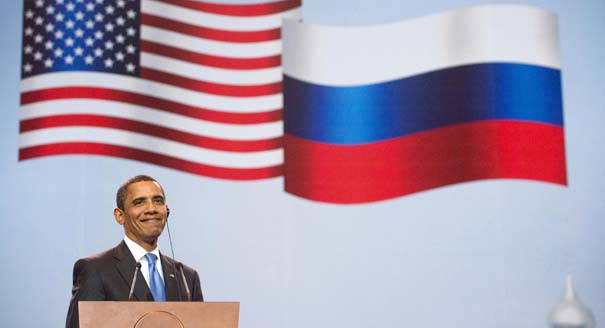
President Obama spoke brilliantly and powerfully at Russia's New Economic School during his Moscow trip. Unfortunately, few Russians heard his speech or got more than a glimpse of the American president on the television news.

Link Copied
By Maria Lipman
Published on Jul 9, 2009

Source: the Washington Post

Words for a Russian Ghetto President Obama spoke brilliantly and powerfully at Russia's New Economic School Tuesday. And his broader effort to reach out to Russian society during his trip -- meeting with civil society and human rights activists, as well as a group of opposition politicians -- was commendable. Unfortunately, few Russians heard his speech or got more than a glimpse of the American president on the television news.

If they had heard Obama's address, they probably would have appreciated that Obama spoke with high respect for Russian culture and history. He paid tribute to Russia's colossal contribution to the victory over Nazi Germany -- a victory in which Russians commonly believe their role is not properly recognized abroad. Obama was delicate and subtle, as well as firm and concrete. He described the end of the Cold War not as a victory of one political order over another but as a result of "the actions of many nations over many years." He admitted that America is not perfect. And he referred to democracy not as a moral virtue but as an effective means toward peaceful, secure and prosperous life.
 
But the president's speech -- at a Westernized institution founded by prominent Russian economists and modeled after the best American universities they attended -- was not broadcast live by any of the mass-audience television channels. These channels, which the Kremlin has long used as effective tools for shaping public opinion, offered benevolent but restrained coverage of the summit. Obama's performance in Russia, his eloquence, his ideas and his charms were thus mostly confined to those limited audiences, venues and outlets where free expression and public debate are still maintained. The Kremlin has mastered the art of keeping these liberal "ghettos" politically irrelevant.
 
The Kremlin keeps a firm grip on societal forces: Its concept of civil society implies loyalty to the state and rules out genuine autonomy. Those who dare defy the Kremlin vision may be tolerated, but they are consistently marginalized. Assistance to such groups from abroad is treated with great suspicion. Moreover, the West, and the United States in particular, are viewed as a threatening force seeking to do harm to Russia.
 
This dramatically hampers Russian development and leaves Russia still further behind the developed nations. A summit with Obama, and his attempt to reach out to the Russian people, no matter how brilliant or subtle, can hardly change this state of affairs. It is up to the Russian people to change this, but they will have to overcome their apathy and fragmentation. "Every country charts its own course," Obama told the students of the New Economic School. Russia is no exception.
 
The article can also be found here.

About the Author

Maria Lipman

Former Scholar in Residence, Society and Regions Program, Editor in Chief, Pro et Contra, Moscow Center

Lipman was the editor in chief of the Pro et Contra journal, published by the Carnegie Moscow Center. She was also the expert of the Carnegie Moscow Center’s Society and Regions Program.

    Recent Work

  • Commentary
    The Russian State Power and the Ukrainian Human Factor

      Maria Lipman

  • Commentary
    Putin’s Crimean Conquest Pushes Russia to an Anti-Modernization Course

      Maria Lipman

Maria Lipman
Former Scholar in Residence, Society and Regions Program, Editor in Chief, Pro et Contra, Moscow Center
Maria Lipman
Political ReformForeign PolicyNorth AmericaUnited StatesCaucasusRussia

Carnegie does not take institutional positions on public policy issues; the views represented herein are those of the author(s) and do not necessarily reflect the views of Carnegie, its staff, or its trustees.

More Work from Carnegie Europe

  • Commentary
    Strategic Europe
    Taking the Pulse: Does the EU Have a Germany Problem?

    Are Germany’s economic, industrial, and political struggles becoming a liability for the EU’s ability to rise to the geopolitical moment?

      • Rym Momtaz

      Rym Momtaz, ed.

  • Commentary
    Strategic Europe
    The Speech Ursula von der Leyen Can’t Deliver

    European Commission President Ursula von der Leyen is about to give her annual address on the state of the EU. Here’s what she won’t—but should—say.

      • Rym Momtaz

      Rym Momtaz

  • Le Pen France Far Right
    Article
    How Europe’s 2027 Elections Could Test EU Governance

    Radical-right parties are expected to do well in upcoming elections in four of the EU's biggest member states. If successful, they could prevent the union from addressing key challenges ahead.

      Stefan Lehne

  • Commentary
    Strategic Europe
    Europe Fails to Learn the Lessons from Ceuta

    The aftermath of the Ceuta crisis shows Europe has drawn the wrong lessons. Rather than doubling down on failed migration policies, the EU needs to address the underlying roots of such episodes.

      Richard Youngs

  • Carney Canada EU Trump
    Commentary
    Strategic Europe
    Taking the Pulse: Is Canada Leading a Third Way?

    Canadian Prime Minister Mark Carney has twice inspired praise for standing up to U.S. President Donald Trump: at the 2026 World Economic Forum in Davos and on Canada-U.S. trade negotiations. Is Carney showing a third way better than the EU has in dealing with the Trump administration?

      • Rym Momtaz

      Rym Momtaz, ed.

Get more news and analysis from
Carnegie Europe
Carnegie Europe logo, white
Rue du Congrès, 151000 Brussels, Belgium
  • Research
  • Strategic Europe
  • About
  • Experts
  • Projects
  • Events
  • Contact
  • Careers
  • Privacy
  • For Media
  • Gender Equality Plan
Get more news and analysis from
Carnegie Europe
© 2026 Carnegie Endowment for International Peace. All rights reserved.