

Q&A
Christopher Boucek
{
  "authors": [
    "Christopher Boucek"
  ],
  "type": "legacyinthemedia",
  "centerAffiliationAll": "dc",
  "centers": [
    "Carnegie Endowment for International Peace"
  ],
  "collections": [],
  "englishNewsletterAll": "menaTransitions",
  "nonEnglishNewsletterAll": "",
  "primaryCenter": "Carnegie Endowment for International Peace",
  "programAffiliation": "MEP",
  "programs": [
    "Middle East"
  ],
  "projects": [],
  "regions": [
    "Yemen"
  ],
  "topics": [
    "Political Reform",
    "Security"
  ]
}
Source: Getty
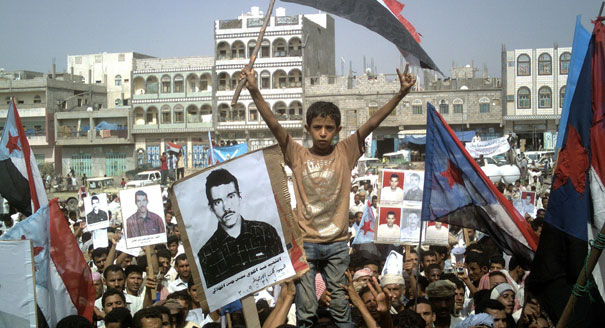
Yemen has always been on the verge of crisis. Throughout its history the country has never known complete stability, and governance has always bordered on chaotic. However, the situation is now rapidly deteriorating, with potentially devastating results.
Source: Jane's Intelligence Review

Yemen is facing a confluence of interconnected security challenges that threatens to swamp the central government. A looming economic crisis, renewed civil war in the north, a mounting southern secessionist movement and a resurgent Al-Qaeda organisation threaten to overwhelm Sanaa's capacity to manage multiple crises.
Unlike earlier individual challenges, such as unification in 1990 or the 1994 civil war, the problems now facing the country are multiple and interconnected, each one posing serious threats to Yemen's future. Any single event could lead to a further erosion of central government authority in Yemen and destabilisation of the region. For example, a major humanitarian crisis, perhaps triggered by severe famine or crop failure, could result in a large refugee emergency in which the government would be unable to provide even rudimentary relief services.

Former Associate, Middle East Program
Boucek was an associate in the Carnegie Middle East Program where his research focused on security challenges in the Arabian Peninsula and Northern Africa.
Recent Work
Christopher Boucek

Christopher Boucek, Karim Sadjadpour
Carnegie does not take institutional positions on public policy issues; the views represented herein are those of the author(s) and do not necessarily reflect the views of Carnegie, its staff, or its trustees.

Before the next wave of EU enlargement takes place, the union needs to grapple with thorny questions of how power is distributed among its members.


Emil Sondaj Hansen, Ditte Brasso Sørensen

The new U.S.–Denmark–Greenland agreement will help Washington exert political, economic, and financial dominance under the guise of security. Yet, it acknowledged Copenhagen’s and Nuuk’s sovereignty on the island.

Marc Pierini

A summer of escalation in the Black Sea has hurt Ukraine economically and is exacerbating world food security. A truce is needed—as is a broader reframing of Europe’s Ukraine strategy.

Thomas de Waal

Are Germany’s economic, industrial, and political struggles becoming a liability for the EU’s ability to rise to the geopolitical moment?

Rym Momtaz, ed.

European states control several Overseas Countries and Territories around the world that carry strategic, economic, and environmental weight. As great powers challenge the rules-based order, defending them is a geopolitical imperative for Europe.
Marc Pierini