

Article
Henri J. Barkey
{
  "authors": [
    "Henri J. Barkey"
  ],
  "type": "questionAnswer",
  "centerAffiliationAll": "dc",
  "centers": [
    "Carnegie Endowment for International Peace",
    "Carnegie Russia Eurasia Center"
  ],
  "collections": [],
  "englishNewsletterAll": "ctw",
  "nonEnglishNewsletterAll": "",
  "primaryCenter": "Carnegie Endowment for International Peace",
  "programAffiliation": "russia",
  "programs": [
    "Russia and Eurasia",
    "Middle East"
  ],
  "projects": [],
  "regions": [
    "United States",
    "Türkiye",
    "Armenia"
  ],
  "topics": [
    "Foreign Policy"
  ]
}
Source: Getty
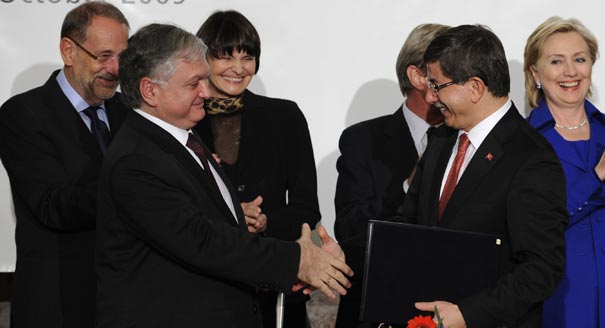
Turkey and Armenia signed historic protocols on October 10 to restore diplomatic ties and open shared borders. Although the deal must still be ratified by their respective parliaments, it marks the first step in resolving tensions stemming from the killing of Armenians under Ottoman rule in 1915.
After last-minute mediation by U.S. Secretary of State Hillary Clinton and others, Turkey and Armenia signed historic protocols on October 10 in Zurich to restore diplomatic ties and open shared borders. Although the deal must still be ratified by their respective parliaments, it marks the first step in resolving tensions stemming from the killing of Armenians under Ottoman rule in 1915. Henri Barkey describes the significance of the agreement and its regional implications.
Barkey explains that the agreements, if ratified, would be beneficial for both Turkey and Armenia. “Turkey will have removed an important source of tension with their allies in Europe and across the Atlantic. The Armenians will benefit economically, especially if they can slowly link into the oil and gas pipeline networks in the region,” says Barkey. “It is too early to tell how the region as a whole will be affected. Much depends on Azerbaijan’s reaction, and future efforts to resolve the Nagorno-Karabakh problem.
Barkey address the following questions:
What is the significance of the deal signed between Turkey and Armenia?
If ratified by the two parliaments, the agreement has the potential to set the stage for reconciliation between the two countries, for which the interpretation of history has been the primary source of dispute. In 1915, as many as one million—perhaps more—Armenians died at the hands of Ottoman Turks who, as their empire was vanishing, took drastic measures against a large minority whose allegiance to the Ottoman Empire was questionable. For Armenians around the world, this is the first genocide of the 20th century. By contrast, Turks have vigorously fought the claims of genocide, instead arguing that many deaths took place on both sides as a result of an Armenian rebellion against the Empire.
The long-standing dispute assumed greater international relevance following the collapse of the Soviet Union and the emergence of an independent Armenia on Turkey’s border. An independent Armenia gave greater impetus to the worldwide calls for recognition of the Armenian genocide. As Turkey found itself on the defensive, it devoted increasing resources to fighting what it called unproven allegations. As a result, relations between the two countries soured.
Complicating matters is the Armenian-Azerbaijani conflict over the disputed territory of Nagorno-Karabakh, an Armenian-populated enclave within Azerbaijan, a close Turkish ally. Nagorno-Karabakh has been under Armenian occupation since 1993. Turkey has supported Azerbaijan against Armenia in trying to reverse the occupation. Improved Turkish-Armenian relations could potentially lead to a lessening of tensions in the Caucasus and a resolution of the Nagorno-Karabakh conflict. Moreover, landlocked Armenia has experienced severe economic difficulties, as its border with Turkey was closed in the aftermath of the war over Nagorno-Karabakh. Armenia is isolated from the international community and dependent on Russia for support.
What does the United States gain by the resumption of ties between Turkey and Armenia?
For the United States, the issue is principally one of domestic politics. The Democratic leadership of Congress, not to mention the president and vice president, are on the record supporting the Armenian claim that the events of 1915 constituted an act of genocide, and that the United States has a moral duty to recognize the genocide in name.
The Obama administration was also cognizant of the costs of such a declaration, which would damage relations with Turkey, a NATO ally. The Turkish public would have demanded its government respond to any U.S. declaration, setting the stage for a destructive round of political retaliation. At a time when the United States is trying to extricate itself from Iraq, Turkey’s neighbor, any bad feelings could have unintended and costly repercussions. The United States needs Turkey to help stabilize Iraq, especially the Kurdish-populated regions in the north of the country.
During his trip to Turkey in April 2009, President Obama thought that an agreement between Armenia and Turkey would be signed soon. In the annual presidential statement that commemorates the events of 1915 on April 24, he refrained from using the word “genocide”—much to the chagrin of Armenian-Americans who thought he would live up to his campaign promises—because he expected a Turkish-Armenian deal would soon be possible. Yet, the Turks balked shortly after April 24.
Turkey’s hesitation provoked an intense set of negotiations between the United States, Swiss intermediaries, Turkey, and Armenia, which were ultimately successful in cementing the terms of a deal.
Who is the biggest winner? What will the deal mean for the region?
If the agreements are ratified, the Turks will be the biggest winners, because they will have removed an important source of tension with their allies in Europe and across the Atlantic. It will free Turkish diplomats of the time-consuming and angst-producing yearly attempts to fight the genocide resolutions, especially in the United States.
The Armenians will benefit economically—especially if they can slowly link into the oil and gas pipeline networks in the region—through trade with Turkey and potential new trade linkages through Turkey to the Middle East and the Balkans. Turkey would gain little economically from an opening to Armenia because of the disproportionate size of the two economies.
The United States also emerges as a winner—especially after a snafu almost derailed the signing ceremony in Zurich. At first glance, Secretary Clinton’s active involvement seems to have carried the day. It is also important to acknowledge the efforts of the Europeans, who carried the process forward. In some ways, it is a vindication of the premise that when the United States and the Europeans collaborate, they are quite capable of tackling international problems. This is a small step forward.
It is too early to tell how the region as a whole will be affected. Much depends on Azerbaijan’s response and future efforts to resolve the Nagorno-Karabakh problem. The immediate reaction of the Azerbaijani government was quite negative. This will complicate matters in the short term, as it will make the debate in Turkey, which is closely aligned with Azerbaijan, far more acrimonious.
What made the deal possible?
Two separate developments led to the signing of the agreement. First, President Obama pledged during the campaign to officially recognize the Armenian genocide, something many Armenian-Americans have demanded of the U.S. government for years. The Turkish government, which had hitherto successfully managed to avoid this outcome, realized that it was only a matter of time before a congressional resolution passed or a presidential statement was issued acknowledging the genocide. The only way to prevent either of these steps from happening was to engage Armenia and persuade Armenia to help lobby, even if indirectly, against such a statement. As long as the Armenian-Turkish border remained closed, Armenians had nothing to lose by lobbying in favor of such resolutions.
Second, Turkey wants to become a regional—if not global—power. In order to achieve this Turkey embraced a new foreign policy and called for “zero problems with its neighbors.” Armenia is one obvious exception that Turkey needs to deal with. The important factor driving the Armenians was the desire to break the country’s isolation—which creates a dependence on Russia—and improve economic conditions.
Will the agreement end the hostility between the two countries? Are there other reasons for tension between Turkey and Armenia besides the killings in 1915?
The agreement is only a first step. Armenians who live in the country appear to be less worried about issues relating to the recognition of the genocide than members of the far-flung Armenian diaspora. The agreement calls for a historical commission to investigate the events of 1915. Most Armenians do not see any need for such a commission, since they believe the evidence is indisputable, and the majority of historians agree with their version of the events. Armenians also suspect that the commission is a means to sweep the issue under the carpet for the foreseeable future.
Turks are equally passionate about the subject and unlikely to accept the conclusion that they engaged in genocide, ahead of the Nazis, and thus have their reputation sullied. Moreover, they suspect that the allegations of genocide are a ruse to make demands for territorial and financial compensation.
Reconciliation will take a long time. There are some encouraging signs. More and more Turks are taking on the establishment—people are often prosecuted in Turkey for openly calling the killings genocide—and challenging taboos on discussing the issue at home. In Armenia, many people want to move forward, break the country’s isolation, and improve the economic conditions that have motivated a large proportion of the best and brightest to emigrate.
Will the countries ratify the agreement?
The chances are pretty good that the Turkish parliament will ratify the agreement, although there will be stiff opposition from both the nationalist right and the nationalist left. One could also expect the Azerbaijani government to lobby discreetly against the agreement, as it did earlier in the year.
The agreement consists of two protocols: one sets the conditions for restoring diplomatic relations, and a second addresses the opening of the border. It is quite possible that one of the two agreements may not be ratified by the Turkish parliament because the dispute over the occupation of Nagorno-Karabakh will not have been settled. Another possibility is that the parliament may want to add a caveat or amend the agreement to make it conditional on a resolution of the Armenian-Azeri dispute.
Turkish Prime Minister Recep Tayyip Erdogan is on record saying that the border will not be opened until the Nagorno-Karabakh question is settled. He seems to have repeated this in the aftermath of the Zurich signing. Such discourse could actually do more harm than good; it may influence the voting in parliament and were the ratification to fail in whole or part, unleash new recriminations from Armenians.
How will the Armenian diaspora react to restoring diplomatic relations and reopening the border with Turkey?
Segments of the diaspora have been upset at the prospect of the historical commission and not the resumption of diplomatic relations. For the diaspora, the 1915 events constitute genocide and any discussion questioning this is unacceptable. They want the Turkish government to acknowledge the genocide. The Dashnaks, the hardline elements in Armenia and the diaspora, have been the most opposed to the effort.
The diaspora, however, is not unified; many organizations endorse Armenian-Turkish reconciliation. Still, Armenian organizations have led a multi-state, multi-year coordinated effort to ensure that democratic countries recognize the genocide. The issue of genocide recognition has been the unifying and rallying cry for many Armenians living abroad. It will be difficult to abandon it altogether and we should expect their efforts to continue, although perhaps with reduced intensity.
How will the agreement influence Armenia’s dispute with Azerbaijan over Nagorno-Karabakh?
The dispute over Nagorno-Karabakh is well entrenched. It is unlikely that the agreement will have an immediate impact in the near future, but Turkey can play a positive and constructive role, which it has been unable to do until now. The Nagorno-Karabakh question can be divided into two parts. The first is Nagorno-Karabakh itself, and it is unlikely that a deal there is imminent. However, a related issue concerns the seven areas adjacent to Nagorno-Karabakh, which Armenia occupied to solidify its hold on that region. The prospects are brighter for a deal on the adjacent areas.
How will this impact Turkey’s possible entry into the European Union?
Ankara’s relationship with Europe is complex, and no single issue holds a veto over the success of Turkey’s efforts to join the European Union. Still, there is no question that an improvement in relations with Armenia is likely to remove one of the stumbling blocks in the long run. This is especially true if it is accompanied by a relaxation on the freedom of speech, because anyone who articulates a belief validating the “genocide” is prosecuted. The next big hurdle is Cyprus and the ongoing negotiations on that front.

Former Visiting Scholar, Middle East Program
Barkey served as a member of the U.S. State Department Policy Planning Staff, working primarily on issues related to the Middle East, the Eastern Mediterranean, and intelligence from 1998 to 2000.
Recent Work
Henri J. Barkey
Henri J. Barkey
Carnegie does not take institutional positions on public policy issues; the views represented herein are those of the author(s) and do not necessarily reflect the views of Carnegie, its staff, or its trustees.

The EU can impose sanctions but struggles to enforce them without the United States. With Washington increasingly disinterested in backing European interests, the bloc must now fend for itself.


Nicu Popescu, Tiago Antunes

Russia is testing the waters of NATO’s mutual defense clause. What do strikes in Romanian territorial waters mean for the alliance’s posture toward Moscow?

Dimitar Bechev

With its public finances in shambles, the far right polling at 35 percent ahead of the 2027 presidential election, and a growing protest movement, is France’s crisis a threat to the EU’s geopolitical awakening?

Rym Momtaz, ed.

Ahead of a tough winter for Ukraine, Donald Trump’s swing back toward Russia bodes ill. But instead of panicking, Kyiv’s European allies are focusing on action.
Rym Momtaz

Funding Ukraine remains a priority for European leaders. As Russia’s war of aggression heads into another winter, two feasible options to mobilize support for Kyiv should be fast-tracked.


Vladyslav Rashkovan, Gregory P. Wilson