Tunisia appears stable, but only because of systematic media censorship and a lack of information about human-rights violations. The international community would do a real service for the country if they encouraged true reform.
Tunisia: Beyond Illusions of ChangeThe certain victory of a long-term president in a sham election is a routine occurrence in the Arab world. But Tunisia’s governance model and international outlook make it a special case, says Amel Boubekeur.
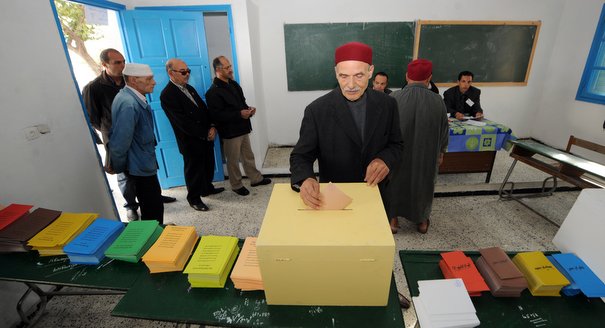
The president of Tunisia, Zine El Abidine Ben Ali, is guaranteed to be re-elected for a fifth term in the country’s presidential election on 25 October 2009. This certain outcome both reveals the authoritarianism of this north African and Arab country and underlines how far the international community continues to accept such a reality without question.
Tunisia is a distinct case within the region: it does not formally reject western democratic standards (unlike its neighbour Libya), it is committed to high standards of education and protection of women’s rights, and its open-market policies and containment of Islamist tendencies provide its European and American partners with an economically stable and secure environment. At the same time, this model of governance allows the president - operating through his party, the Democratic Constitutional Rally (RCD) - to present a benign face to the world while consolidating firm control over the country.
The pattern of elections is well-established: the opposition is allowed to run candidates, but Ben Ali (who came to power in November 1987 after declaring his successor and the modern state’s founder, Habib Bourguiba, infirm) always wins a landslide victory; in 2004 he officially received 94.5% of the votes, in 1999 it was 99.5%. The concentration of power extends to the economy. Tunisia has undergone a programme of privatisation since the late 1980s, but only those who are close to the regime enjoy control of the assets. The reality of the country exposes the hollowness of the president’s official slogans, which celebrate “change” and declare “together we meet challenges”.
A key moment in President Ben Ali’s period of rule came in 2002 with the removal of presidential term-limits (though the constitution’s upper age-limit of 75 means that Ben Ali, now 73, will have to retire at the end of his 2009-14 term). Since 2002, his challenge has been to permit the minimal degree of pluralism compatible with maintenance of complete control. For example, in relation to the legislative elections (which take place on the same day as the presidential election) a new law assigns 25% of parliamentary representation to opposition parties. This proportion can have little impact beside the RCD’s 75%, but in addition there are real questions over which of the opposition seats are occupied by “real" opposition parties and which are actually pro-Ben Ali ones in thin disguise.
There is a similar scenario in the presidential elections. A new law requires any candidate to have led his or her party for at least two years before being allowed to stand; this has prevented the Democratic Forum for Labor and Freedoms to contest the poll, leaving the Movement for Renewal as the sole representative of the “real” opposition. The “opposition” candidates of the Unionist Democratic Union and the Party of Popular Unity state that the purpose of their candidacy is only “to get people accustomed to pluralism”; they actually call for the election of Ben Ali. Even the new National Elections Observatory Committee, intended to replace (potentially dangerous) monitoring by foreign observers - consists of members of the RCD who are appointed by the president.
The position of the RCD “above” all other parties mean that Tunisian elections should be understood not as a competition but rather as a key moment when each Tunisian must choose to stand “for” or "against" the president. The RCD indeed dominates, regulates and controls Tunisian public life, backed by the police (who are intimidating potential boycotters) and civil society (trade unions and 8,500 civic associations - of a total of 9,300) have declared their support for Ben Ali). The RCD counts as many as 2.7 million Tunisians as members, in a country of 5 million voters. The fact that the (unofficial) turnout in elections is around 20%, however, reflects the fact that belonging to the party and supporting the president - in a context where other political parties are irrelevant - is the starting-point of access to state services and a certain level of economic welfare.
Tunisia’s economic development since the late 1980s has been described as a "miracle". The fruits of progress have enabled Ben Ali to secure the support both of the middle class (whose standard of living has indeed steadily improved) and of his foreign partners (whose multinational companies find advantages in Tunisia’s lower labour-costs and tax-rates).
But there is little rationality or justice in Tunisia’s approach to economic redistribution, which is mainly a vehicle for Ben Ali to reward his allies and marginalise or punish any who dare to protest. The middle-class’s consumption is encouraged even at the risk of excessive debt, as a cushion against political demands. There is tax-relief for entrepreneurs if they agree to contribute financially to the system. A national solidarity fund (called "26-26") and the Tunisian Solidarity Bank cater to the needs of the poor and the unemployed, though both programmes are in fact financed by obligatory contributions from citizens and companies. The president is the only one who can decide how and to whom these funds should be allocated, which explains why they are often distributed by local cells of the RCD.
Those who criticise the regime are de facto excluded from the Tunisian “miracle”. The salaries of journalists who work for independent (that is, other than pro-government) publications are very low. Men wearing beards and women wearing veils (that is, Islamists) are banned from working in public institutions. The southern region, which is less touristic as the north and traditionally more hostile to Ben Ali, receives little or nothing in the way of infrastructural support or social services. In 2008, peaceful protests by workers of the southern mining region of Gafsa against their working conditions were violently repressed by the authorities; eighteen trade unionists involved in demonstrations were imprisoned for terms of up to ten years.
The growth of these two decades has helped sustain a consensus in which many Tunisians welcomed economic development while accepting limits on fundamental freedoms. The impact of the global economic crisis and the worsening of Tunisian economic governance may undermine this. The unemployment rate for new graduates is now officially 43%, and foreign investors are beginning to worry about rising corruption and the opacity of the financial system.
The way the system works makes it hard to address these concerns. Those with connections to the president’s family have become more directly involved in economic decision-making; as a result, traditional allies of the regime (such as the pro-Ben Ali business class) have been increasingly marginalised.
The growing intervention of the president’s family members in state decisions raises the unresolved question of his succession. The prospect of Leila Ben Ali (the president’s omnipresent wife) or Sakhr Materi (his son-in-law, a 28-year-old businessman who has been elected to the RCD’s central committee) leading them leaves many Tunisians unenthusiastic.
Zine El Abidine Ben Ali has consistently supported the policies of the United States and the European Union in the region: free-market zones, control of illegal immigration, anti- terrorism. Tunis is host to the French-led Union For the Mediterranean and the Middle East Partnership Initiative. But these international actors have never used their privileged relations in order to press for substantial changes in the country, but rather indulged Ben Ali’s one-man rule.
Tunisia appears stable, but only because of systematic media censorship and lack of information about human-rights violations. The international community would do a real service to the country’s improvement if they encouraged true reform. This would require the creation of neutral state institutions where the exclusive patronage of the RCD would be abandoned, participation by civil society in national and international public debates without fear of police reprisals, and a public realm where accurate information is circulated.
Tunisia is in its way a perfect example of the semi-authoritarian regimes that have emerged in the Arab world in the 2000s. But the fact that Ben Ali’s power relies more on a police state than on the military makes it possible that international actors engage in a genuine dialogue directly with the president - perhaps more than in any other Arab country. The new tools and ideas of democracy-promotion could find in Tunisia an appropriate channel.
If nothing is done, the president’s current prerogatives will be transferred to a network of clans lacking any coherent political project for the country. The result will be to threaten Tunisia’s much-vaunted stability. The promise of change has to be made real if this fate is to be avoided and Tunisians achieve the progress they deserve.
Boubekeur was an associate scholar at the Carnegie Middle East Center. Her research focuses on Maghreb country politics, Euro–Arab relations, and Islam in Europe.
Carnegie does not take institutional positions on public policy issues; the views represented herein are those of the author(s) and do not necessarily reflect the views of Carnegie, its staff, or its trustees.
A notable degree of participative democracy has firmly arrived in Europe. But to have more far-reaching impact, democratic deliberation needs to move into a radically new phase.
As the EU confronts profound challenges, several leaders have called for fundamental reform to the union’s model—but only modest, superficial changes have resulted. What if Europe really could be reimagined from zero today: What should such a redesigned European order look like?
The EU’s new migration policy is not suited to today’s realities. With climate change increasingly becoming a driver of displacement, Europe needs to rethink its deterrence-focused approach.
Europe seems to have accepted its sidelining in the Middle East. The EU must reassert its support for the international rules-based order and step up engagement.