

Commentary
Evan A. Feigenbaum
{
  "authors": [
    "Evan A. Feigenbaum"
  ],
  "type": "legacyinthemedia",
  "centerAffiliationAll": "dc",
  "centers": [
    "Carnegie Endowment for International Peace"
  ],
  "collections": [],
  "englishNewsletterAll": "asia",
  "nonEnglishNewsletterAll": "",
  "primaryCenter": "Carnegie Endowment for International Peace",
  "programAffiliation": "AP",
  "programs": [
    "Asia"
  ],
  "projects": [],
  "regions": [
    "North America",
    "United States",
    "East Asia",
    "Southeast Asia"
  ],
  "topics": [
    "Foreign Policy"
  ]
}
Source: Getty
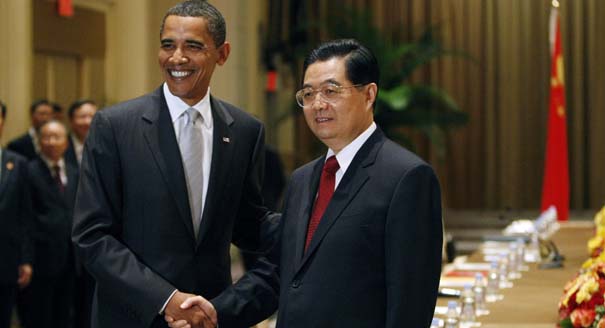
Asia's emergence as a principal center of economic and strategic power requires a new engagement by the United States—one that moves beyond the traditional "hub and spokes" approach.
Source: Council on Foreign Relations

As Asia's economic and strategic weight has grown, Asians have sought to build multilateral frameworks capable of effectively channeling the region's energies. But for more than a decade, the United States has mostly watched from the sidelines as proposals multiply and the region organizes itself into an alphabet soup of new multilateral groups.
The Obama administration has an opportunity to help define new roles for the United States in this changing Asia. But to sustain its position in the region, Washington will need to move beyond its traditional "hub and spokes" approach to Asia--with the United States as the hub, bilateral alliances as the spokes, and multilateral institutions largely at the margins of U.S. policy. Otherwise, the United States will pay increasing costs to its interests, credibility, and influence.
In this Council Special Report, commissioned by CFR's International Institutions and Global Governance program, Evan A. Feigenbaum and Robert A. Manning examine Asia's regional architecture and consider what it means for the United States. They identify shortcomings in the region's existing multilateral mix and contend that the United States must increase its involvement in shaping Asian institutions in order to advance U.S. strategic interests and protect the competitiveness of American firms.
The authors outline six principles for U.S. policy toward Asia as a whole and recommend particular policies toward Northeast and Southeast Asia. Among other steps, they urge the United States to maintain a strong presence at Asian meetings; avoid intractable security issues and focus instead on topics ripe for cooperation; make use of ad hoc groupings as well as formal ones; vigorously pursue regional and global trade liberalization efforts; and view some Asian institutions that exclude the United States as acceptable, just as with the European Union.
The report also presents thoughtful recommendations for how Washington can influence the multilateral landscape in ways beneficial to American interests. The result is a document with important implications for U.S. policy toward a region that promises to play a central role in shaping the coming era of history.

Vice President for Studies
Evan A. Feigenbaum is vice president for studies at the Carnegie Endowment for International Peace, where he oversees work at its offices in Washington, New Delhi, and Singapore on a dynamic region encompassing both East Asia and South Asia. He served twice as Deputy Assistant Secretary of State and advised two Secretaries of State and a former Treasury Secretary on Asia.
Recent Work
Evan A. Feigenbaum
Evan A. Feigenbaum
Carnegie does not take institutional positions on public policy issues; the views represented herein are those of the author(s) and do not necessarily reflect the views of Carnegie, its staff, or its trustees.

The new U.S.–Denmark–Greenland agreement will help Washington exert political, economic, and financial dominance under the guise of security. Yet, it acknowledged Copenhagen’s and Nuuk’s sovereignty on the island.

Marc Pierini

A summer of escalation in the Black Sea has hurt Ukraine economically and is exacerbating world food security. A truce is needed—as is a broader reframing of Europe’s Ukraine strategy.

Thomas de Waal

Are Germany’s economic, industrial, and political struggles becoming a liability for the EU’s ability to rise to the geopolitical moment?

Rym Momtaz, ed.

European Commission President Ursula von der Leyen is about to give her annual address on the state of the EU. Here’s what she won’t—but should—say.
Rym Momtaz

Radical-right parties are expected to do well in upcoming elections in four of the EU's biggest member states. If successful, they could prevent the union from addressing key challenges ahead.

Stefan Lehne