

In The Media
Michele Dunne, Robert Kagan
{
  "authors": [
    "Robert Kagan"
  ],
  "type": "legacyinthemedia",
  "centerAffiliationAll": "",
  "centers": [
    "Carnegie Endowment for International Peace"
  ],
  "collections": [],
  "englishNewsletterAll": "",
  "nonEnglishNewsletterAll": "",
  "primaryCenter": "Carnegie Endowment for International Peace",
  "programAffiliation": "",
  "programs": [],
  "projects": [],
  "regions": [
    "North America",
    "United States",
    "South Asia",
    "Afghanistan"
  ],
  "topics": [
    "Political Reform",
    "Security",
    "Military",
    "Foreign Policy"
  ]
}
Source: Getty
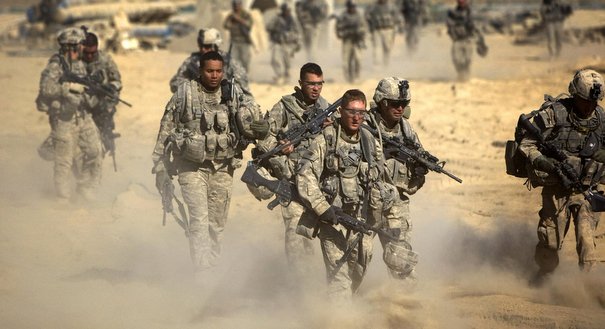
Obama's decision to send more troops to Afghanistan, like Bush's 2007 decision to increase troop levels in Iraq, stems from a feeling of personal responsibility toward the war effort.
Source: The Washington Post

There is a new doctrine out there that seems to enjoy enormous cache among the smart foreign policy set: fight wars until they get hard, then quit. Vice President Biden seems to be a leading proponent of this approach. While a member of the Senate Foreign Relations Committee, Biden backed the Iraq War and spent the first few years after 2003 rightly calling on the Bush administration to send more troops. But when Bush finally wriggled himself free from the disastrous strategies of Donald Rumsfeld, Biden declared the situation hopeless and called instead for breaking up Iraq into three pieces. He then proceeded to oppose the very troop increase he had so long, and so courageously, fought for. And, of course, in opposing the surge, he had the whole foreign policy establishment on his side, epitomized by the wise people of the Baker-Hamilton commission.
Many Bush supporters like to point to that president’s enormous courage in turning against the prevailing winds, disregarding not only the advice of the foreign policy establishment but of many of his own top advisers and much of the Republican party, which in early 2007 was perfectly prepared to quit Iraq to save their political skins.
But now we see President Obama doing much the same thing, turning against a majority in his own party, resisting the counsel of Biden and the wise men to head for the exits from a war that they had long supported.
It seems to me that Obama deserves even more credit for courage than Bush did, for he has risked much more. By the time Bush decided to support the surge in Iraq in early 2007, his presidency was over and discredited, brought down in large part by his own disastrous decision not to send the right number of troops in 2003, 2004, 2005 or 2006. Obama has had to make this decision with most of his presidency still ahead of him. Bush had nothing to lose. Obama could lose everything.
So what explains two presidents who could not be more different making the same lonely decision? I suspect that it is because they, and they alone, have to bear responsibility for losing. Congress is brilliant at never taking responsibility. Its members always voted for the war before they voted against it -- in Vietnam, in Iraq and in Afghanistan. The foreign policy establishment and intellectual world are much the same. They fully supported intervention in Vietnam, mostly supported intervention in Iraq and fully supported the war in Afghanistan -- until the wars got hard, or embarrassing and difficult to defend in polite company. Then they bailed, desperately trying to cover their tracks along the way, and offering reassuring images of what losing would look like. Somehow they never mention the helicopters taking off from the roofs of abandoned American embassies; the rout of Afghans, Iraqis or Vietnamese who made the mistake of trusting America’s word; or the collapse of America’s reputation as a serious world power.
Since presidents and military commanders have to take responsibility for losing, they are less inclined than congressmen and pundits to paint losing in rosy hues.
So we can thank goodness that the buck really does stop somewhere, and that the people we elect to the presidency, whatever their failings, do not want to be the ones who presided over American defeat in battle. No doubt they have a keen understanding that, while they might be applauded for losing in the salons of Washington and New York, the American public would not look on defeat so kindly. That is why I am not as worried as some of my colleagues about the July 2011 date Obama set for the beginning of American withdrawal. If we and our Afghan and allied partners are succeeding at that point, the timing may make sense. If we aren’t, it won’t. It will not be any easier for Obama to embrace defeat in 18 months than it is today.
Perhaps this same deep American refusal to accept losing gracefully will also check the foreign policy establishment’s rush to embrace American decline. The Obama administration’s ranks are filled with people, fresh from the academy and the think tanks, who talk about the need to manage American decline, and even boast about how much more sophisticated they are than the Bush people on this score. They do say all this off the record, however. Perhaps they know that many Americans would not applaud them for their sophistication. Let’s hope the man in the Oval Office knows it, too.
Former Senior Associate
Kagan, author of the recent book, The Return of History and the End of Dreams (Knopf 2008), writes a monthly column on world affairs for the Washington Post and is a contributing editor at both the Weekly Standard and the New Republic.
Recent Work

Michele Dunne, Robert Kagan
Robert Kagan, Michele Dunne
Carnegie does not take institutional positions on public policy issues; the views represented herein are those of the author(s) and do not necessarily reflect the views of Carnegie, its staff, or its trustees.

Are Germany’s economic, industrial, and political struggles becoming a liability for the EU’s ability to rise to the geopolitical moment?

Rym Momtaz, ed.

European Commission President Ursula von der Leyen is about to give her annual address on the state of the EU. Here’s what she won’t—but should—say.
Rym Momtaz

Radical-right parties are expected to do well in upcoming elections in four of the EU's biggest member states. If successful, they could prevent the union from addressing key challenges ahead.

Stefan Lehne

The aftermath of the Ceuta crisis shows Europe has drawn the wrong lessons. Rather than doubling down on failed migration policies, the EU needs to address the underlying roots of such episodes.

Richard Youngs

Canadian Prime Minister Mark Carney has twice inspired praise for standing up to U.S. President Donald Trump: at the 2026 World Economic Forum in Davos and on Canada-U.S. trade negotiations. Is Carney showing a third way better than the EU has in dealing with the Trump administration?
Rym Momtaz, ed.