
Donald Trump has repeatedly bashed NATO and European allies, threatening to annex Canada and Greenland and deploring their lack of enthusiasm for his war of choice in Iran. Is this latest round of abuse the final straw?
Rym Momtaz, ed.
{
"authors": [
"Christopher Boucek",
"David Donadio"
],
"type": "legacyinthemedia",
"centerAffiliationAll": "dc",
"centers": [
"Carnegie Endowment for International Peace",
"Carnegie Europe",
"Malcolm H. Kerr Carnegie Middle East Center"
],
"collections": [],
"englishNewsletterAll": "menaTransitions",
"nonEnglishNewsletterAll": "",
"primaryCenter": "Carnegie Endowment for International Peace",
"programAffiliation": "MEP",
"programs": [
"Middle East"
],
"projects": [],
"regions": [
"Middle East",
"Yemen",
"Gulf"
],
"topics": [
"Security",
"Political Reform",
"Economy"
]
}Source: Getty
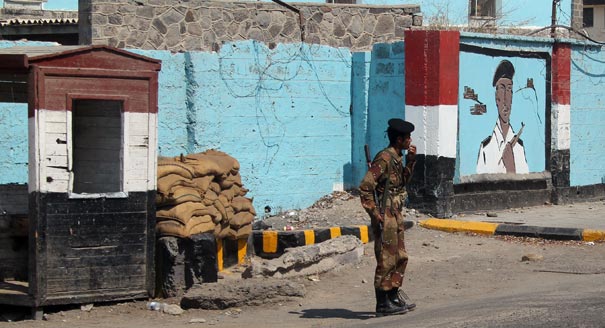
Al-Qaeda is not the only factor threatening Yemen’s stability. Water shortages, collapsing oil supplies, war, refugees, pirates, and poverty all put the country at risk of becoming a failed state.
Source: The Atlantic
It’s also now clear that Yemen’s government lacks the capacity to exert full control over much of its territory. This has created a refuge from which al-Qaeda can mount terrorist attacks across the country—and increasingly across the wider world.
At the heart of all these problems is Yemen’s looming economic collapse. Already the poorest country in the Arab world, Yemen is rapidly depleting its oil reserves and lacks any options for creating a sustainable post-oil economy. Unemployment is estimated at 35 percent, higher than what the U.S. faced during the Great Depression.

Accelerating the economic decline is a protracted civil war in the north between Shia insurgents and the Sana’a-based government. The war has caused a refugee crisis and extensive damage to infrastructure, and its costs will result in a major budget deficit next year. (The government is already burning through roughly $200 million in foreign-currency reserves per month.) Even if that war subsides, the worsening economy will likely inflame a roiling secessionist movement in the south. Yemen has often teetered on the brink of collapse, but it has never faced so many interconnected challenges at once. And the stakes have never been greater.
Former Associate, Middle East Program
Boucek was an associate in the Carnegie Middle East Program where his research focused on security challenges in the Arabian Peninsula and Northern Africa.
David Donadio
Former Editorial Services Manager
Carnegie does not take institutional positions on public policy issues; the views represented herein are those of the author(s) and do not necessarily reflect the views of Carnegie, its staff, or its trustees.
Donald Trump has repeatedly bashed NATO and European allies, threatening to annex Canada and Greenland and deploring their lack of enthusiasm for his war of choice in Iran. Is this latest round of abuse the final straw?
Rym Momtaz, ed.
The U.S.-sponsored TRIPP deal is driving the Armenia-Azerbaijan peace process forward. But foreign and domestic hurdles remain before connectivity and economic interdependence can open up the South Caucasus.
Thomas de Waal, Areg Kochinyan, Zaur Shiriyev
Donald Trump has demanded that European allies send ships to the Strait of Hormuz while his war of choice in Iran rages on. He has constantly berated NATO while the alliance’s secretary-general has emphatically supported him.
Rym Momtaz, ed.
The war in Ukraine is costing Russia its leverage overseas. Across the South Caucasus and Middle East, this presents an opportunity for Europe to pick up the pieces and claim its own sphere of influence.
William Dixon, Maksym Beznosiuk
Economic growth is at the heart of a dilemma between planetary and international security.
Olivia Lazard