

Paper
Matthew Rojansky
{
  "authors": [
    "Matthew Rojansky"
  ],
  "type": "legacyinthemedia",
  "centerAffiliationAll": "dc",
  "centers": [
    "Carnegie Endowment for International Peace",
    "Carnegie Russia Eurasia Center"
  ],
  "collections": [],
  "englishNewsletterAll": "ctw",
  "nonEnglishNewsletterAll": "",
  "primaryCenter": "Carnegie Endowment for International Peace",
  "programAffiliation": "russia",
  "programs": [
    "Russia and Eurasia"
  ],
  "projects": [],
  "regions": [
    "North America",
    "United States",
    "Caucasus",
    "Russia"
  ],
  "topics": [
    "Security",
    "Foreign Policy"
  ]
}
Source: Getty
Both the United States and Russia face the threat of global terrorism, and they should work together and share intelligence in order to respond to terrorist threats.
Source: Russia Today: The Alyona Show
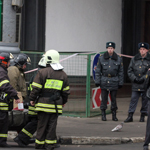
Two female suicide bombers set off explosives at two different Moscow metro stations. The deadly blasts killed 39 people and injured 87. U.S. President Barack Obama released an immediate response to the events, sharing his condolences and stating that the American people stand united with Russia against terrorism.
Matthew Rojansky participated in a live discussion on Russia Today about how the global threat of terrorism can bring two countries together. The United States and Russia both face terrorism at similar levels, asserted Rojansky, but in different ways: the problem manifested in Russia is a domestic threat, whereas the United States is facing a threat that largely comes from the outside. These terrorists are united by the same basic ideology of Islamic fundamentalism, and Rojansky believes that the two countries can learn from each other and work together, to respond to threats of terrorist attack. The basis and the willpower for high-level contact are there, he concluded, but there might be some remaining issues as to what kind of intelligence the two superpowers can share.
Former Deputy Director, Russia and Eurasia Program
Rojansky, formerly executive director of the Partnership for a Secure America, is an expert on U.S. and Russian national security and nuclear-weapon policies.
Recent Work
Matthew Rojansky
Matthew Rojansky
Carnegie does not take institutional positions on public policy issues; the views represented herein are those of the author(s) and do not necessarily reflect the views of Carnegie, its staff, or its trustees.

The aftermath of the Ceuta crisis shows Europe has drawn the wrong lessons. Rather than doubling down on failed migration policies, the EU needs to address the underlying roots of such episodes.

Richard Youngs

Canadian Prime Minister Mark Carney has twice inspired praise for standing up to U.S. President Donald Trump: at the 2026 World Economic Forum in Davos and on Canada-U.S. trade negotiations. Is Carney showing a third way better than the EU has in dealing with the Trump administration?

Rym Momtaz, ed.

The EU’s responses to two recent incidents expose the gulf between European perceptions and capabilities. Unless the union can bridge that gap, it will never become a real geostrategic power.
Rym Momtaz

European states control several Overseas Countries and Territories around the world that carry strategic, economic, and environmental weight. As great powers challenge the rules-based order, defending them is a geopolitical imperative for Europe.

Marc Pierini

In supporting Europe’s far-right, MAGA and Russia both want the same thing: a weaker EU. Europe must defend itself without abandoning the openness these forces exploit.

Armida van Rij