

Commentary
With its public finances in shambles, the far right polling at 35 percent ahead of the 2027 presidential election, and a growing protest movement, is France’s crisis a threat to the EU’s geopolitical awakening?
Rym Momtaz, ed.
{
  "authors": [],
  "type": "other",
  "centerAffiliationAll": "dc",
  "centers": [
    "Carnegie Endowment for International Peace",
    "Carnegie Europe",
    "Carnegie Russia Eurasia Center"
  ],
  "collections": [],
  "englishNewsletterAll": "ctw",
  "nonEnglishNewsletterAll": "",
  "primaryCenter": "Carnegie Endowment for International Peace",
  "programAffiliation": "russia",
  "programs": [
    "Russia and Eurasia"
  ],
  "projects": [],
  "regions": [
    "Russia",
    "Western Europe",
    "Europe",
    "Caucasus"
  ],
  "topics": [
    "Foreign Policy"
  ]
}
Source: Getty
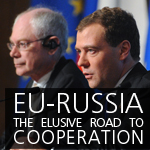
Despite optimistic rhetoric of partnership and strategic cooperation, the recent EU–Russia summit ended without any significant agreements and relations between Moscow and Brussels have entered a period of stagnation.
Despite optimistic rhetoric of partnership and strategic cooperation, the recent EU–Russia summit ended without any significant agreements. Relations between Moscow and Brussels have entered a period of stagnation, marking time as policy makers on both sides grapple with their own domestic and international challenges and weigh the costs and benefits of further integration.
In a new series of commentaries, Carnegie experts from Moscow, Brussels, and Washington take stock of the relationship, assess the challenges and opportunities for both sides, and provide a clearer view of what is—what is not—possible for EU–Russian relations.

The need for a strong relationship between Moscow and Brussels is clear, as are the tasks at hand. So, too, are the roadblocks. Europe faces administrative and political barriers to a common policy on Russia, and Russia remains unwilling to undertake reforms that would make it fully compatible with the EU. Among their greatest challenges will be adding the “Union” to Russian–European relations—almost all progress has been made in cities other than Brussels.

Driven by changing market conditions, increasing costs of production, and a real commitment to efficiency, Russia stands to gain much from increased collaboration with Europe. But for real progress to be made, both sides need to develop a clearer conception of their own energy security and the price they are willing to pay for it.

Russia’s drive to boost efficiency and diversification and move towards a knowledge-based economy, coupled with a recognition that foreign investment will be crucial to success, could open the door to a true “Partnership for Modernization” with Europe. But Moscow’s unwillingness to trust market forces and continued insistence on top-down economic policies make true partnership almost impossible.

Russia wants Europe’s technological resources to maintain its current economic and political system going, but Europe wants institutional harmonization and integration built on Russia’s eventual democratization. If Europe wants to achieve that, it will have to find ways—including easing visa requirements—to bypass the Kremlin and integrate directly with Russian citizens and businesses.
Carnegie does not take institutional positions on public policy issues; the views represented herein are those of the author(s) and do not necessarily reflect the views of Carnegie, its staff, or its trustees.

With its public finances in shambles, the far right polling at 35 percent ahead of the 2027 presidential election, and a growing protest movement, is France’s crisis a threat to the EU’s geopolitical awakening?

Rym Momtaz, ed.

Ahead of a tough winter for Ukraine, Donald Trump’s swing back toward Russia bodes ill. But instead of panicking, Kyiv’s European allies are focusing on action.
Rym Momtaz

Funding Ukraine remains a priority for European leaders. As Russia’s war of aggression heads into another winter, two feasible options to mobilize support for Kyiv should be fast-tracked.


Vladyslav Rashkovan, Gregory P. Wilson

While the EU and European governments are embracing the much-lauded middle-power moment, this entails three difficult conundrums.

Richard Youngs

Europe is facing rising populism internally as well as external pressures from Russia, China, Turkey, and the United States.

Dimitar Bechev