

Commentary
Maria Lipman
{
  "authors": [
    "Maria Lipman"
  ],
  "type": "legacyinthemedia",
  "centerAffiliationAll": "",
  "centers": [
    "Carnegie Endowment for International Peace",
    "Carnegie Europe",
    "Carnegie Russia Eurasia Center"
  ],
  "collections": [],
  "englishNewsletterAll": "",
  "nonEnglishNewsletterAll": "",
  "primaryCenter": "Carnegie Russia Eurasia Center",
  "programAffiliation": "",
  "programs": [],
  "projects": [],
  "regions": [
    "Caucasus",
    "Russia"
  ],
  "topics": [
    "Political Reform"
  ]
}
Source: Getty
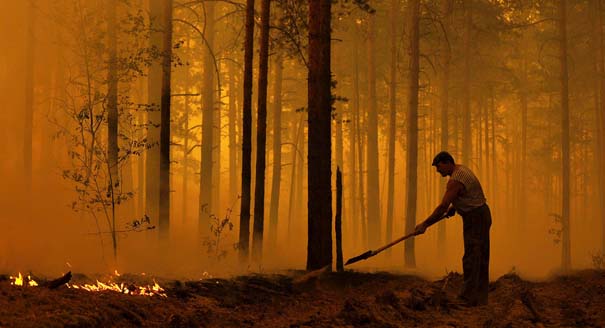
The young urban Russians who took part in wildfire rescue efforts after the authorities proved inefficient and unprepared are the genuine force for modernization and democratization in the country.
Source: Foreign Policy

The Kursk was the first major crisis of Putin's presidency. A great deal more befell Russia in the following years -- but never again did television challenge Putin so directly. Never in his presidency did he publicly face an unfriendly question from a Russian reporter. By the end of his first tenure, national TV channels had been firmly taken under control. Today both Putin, now the prime minister, and Dmitry Medvedev, the president, are assured of positive coverage at the top of the news shows on all three major national channels, whose audience far exceeds that of all other media.
This summer, as devastating fires enveloped central Russia, burning whole villages to the ground, Putin couldn't complain about national television coverage. The news shows were focused on the leaders in charge, Medvedev was seen giving orders and dressing down state officials, and Putin was at the scene of the disaster. The prime minister looked confident and composed, reassuring those who lost their homes and property, promising generous government relief. To reinforce the image of a powerful leader, strong in both spirit and body, television produced footage of Putin flying an amphibious plane and throwing water upon the burning forests.
Meanwhile, the actual governance of Russia has hardly improved. When the Kursk sank, it turned out that Russia did not have the adequate rescue gear. A decade later, the country's fire-fighting equipment is badly insufficient. The sheer length and the peak temperatures of the current heat wave may be unprecedented, but there's nothing new about a hot summer leading to peat and forest fires; the latest occurred in 2002. And yet the fires caught Russia unawares and demonstrated outrageous inefficiency and unpreparedness of both local and federal authorities. Fire and emergency services appeared to be undertrained and underequipped, the communications and information systems are weak, and the general management often unreliable. This is not what millions of television viewers saw in the news shows, but the media outlets not controlled by the government have reported endless stories of official incompetence: shocked villagers who had waited to be evacuated until fire caught their homes -- and then ran for their lives while some of their neighbors died in the fires; firefighters dispatched to fire sites without maps or even basic supplies such as food or gasoline; there was even a shortage of shovels, and only four water-throwing planes, like the one used for Putin's television stint, were found in the vast Russian expanse (the United States has 150 of these; Canada about 100).
The current ruling group values centralized control above all else; under Putin's stewardship, governors are no longer elected by their constituencies, mayors are increasingly appointed, and the separation of powers between branches of the state has long been reduced to mere formality. But the resulting disempowerment of all centers of autonomous authority is exactly what breeds the negligence and irresponsibility. The bungled operation of government agencies and the dysfunctional infrastructure should come as no surprise in a political order in which tools of public accountability are inexistent.
The only encouraging sign amid the devastating fires and the government failures was the generous effort of people from Moscow and other cities close to the fire zone who quickly organized to make up for the government's inefficiency. They collected money, food, clothes, bed linen, kitchenware, and medicines; they packed their cars with these supplies and delivered them to the fire victims. As they realized that not just the victims but also the firefighters needed help, they purchased the missing fire equipment. They promptly organized websites to let rescuers know where to go and what to bring. Some donated space where supplies were collected; others provided informal and friendly instructions for those looking to help out.
There's a broader trend at work here. Russians may have little interest in political participation, since policymaking has been thoroughly monopolized by a closed circle at the top. But some forms of nonpolitical activism have been on the rise. One of them is private charity, which has fast expanded in recent years. Its scope and the amount of cash collected for patients, especially children in need of expensive medical treatment, is quite impressive. To give just one example out of many, a charity associated with the leading Russian nongovernment daily Kommersant gathered about 150 million rubles (about $5 million) for the costly treatment of sick children over the first 7 months of this year.
What makes today's response to the fires so special is not just the generosity, but people's ability to organize quickly and efficiently, to gain the necessary knowledge and information, and to communicate them to others. That's an outstanding achievement in an environment that strongly discourages public initiative.
Most people who took part in the rescue effort are young urban Russians, the educated professionals and entrepreneurs who have learned to rely on themselves and are at ease with the world of new media and global communications. They are the genuine modernization force in Russia, where the Kremlin preaches modernization but consistently tramples on the public's autonomy.
This new urban class currently accounts for about 15 or 20 percent of the Russian people. They mostly hold the government in contempt, but stay out of politics because in an environment where political choice is replaced by centralized control there are no avenues for their voices to be heard (more than 80 percent of the Russian people reliably tell pollsters that they have no influence on political developments).
The public rescue effort may be quite impressive, yet one shouldn't expect it to suddenly change Russia's domestic environment or transform the rescuers into community organizers or political activists. But the emergence of this class holds a promise -- in the longer run -- for Russia's political modernization and democratization from below.
Former Scholar in Residence, Society and Regions Program, Editor in Chief, Pro et Contra, Moscow Center
Lipman was the editor in chief of the Pro et Contra journal, published by the Carnegie Moscow Center. She was also the expert of the Carnegie Moscow Center’s Society and Regions Program.
Recent Work
Maria Lipman
Maria Lipman
Carnegie does not take institutional positions on public policy issues; the views represented herein are those of the author(s) and do not necessarily reflect the views of Carnegie, its staff, or its trustees.

The EU can impose sanctions but struggles to enforce them without the United States. With Washington increasingly disinterested in backing European interests, the bloc must now fend for itself.


Nicu Popescu, Tiago Antunes

Russia is testing the waters of NATO’s mutual defense clause. What do strikes in Romanian territorial waters mean for the alliance’s posture toward Moscow?

Dimitar Bechev

Europe is facing rising populism internally as well as external pressures from Russia, China, Turkey, and the United States.
Dimitar Bechev

A notable degree of participative democracy has firmly arrived in Europe. But to have more far-reaching impact, democratic deliberation needs to move into a radically new phase.

Richard Youngs

Before the next wave of EU enlargement takes place, the union needs to grapple with thorny questions of how power is distributed among its members.


Emil Sondaj Hansen, Ditte Brasso Sørensen