

Paper
Ashley J. Tellis
{
  "authors": [
    "Ashley J. Tellis"
  ],
  "type": "legacyinthemedia",
  "centerAffiliationAll": "dc",
  "centers": [
    "Carnegie Endowment for International Peace",
    "Carnegie Europe"
  ],
  "collections": [],
  "englishNewsletterAll": "ctw",
  "nonEnglishNewsletterAll": "",
  "primaryCenter": "Carnegie Endowment for International Peace",
  "programAffiliation": "NPP",
  "programs": [
    "Nuclear Policy",
    "South Asia"
  ],
  "projects": [],
  "regions": [
    "South Asia",
    "Pakistan",
    "East Asia",
    "China",
    "Asia"
  ],
  "topics": [
    "Foreign Policy",
    "Nuclear Policy",
    "Nuclear Energy"
  ]
}
Source: Getty
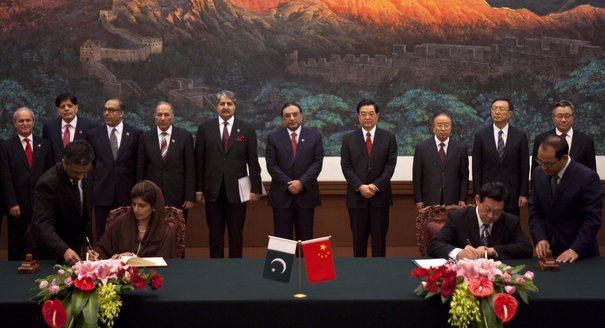
China’s plans to sell new nuclear reactors to Pakistan are fundamentally different from the U.S.-India nuclear deal. Determined opposition from the United States can convince Beijing to reconsider.
Source: Wall Street Journal

Some claim that Washington's ability to discourage Beijing from moving forward is compromised by America's 2008 civilian-nuclear cooperation agreement with India. Like Pakistan, India has not signed the Nonproliferation Treaty, and treating India differently, many observers feel, weakens Washington's hand in opposing China's efforts. It has even been argued that if the U.S.-India agreement never went through, China's current proposal to sell nuclear reactors would likely not have occurred.
These claims, however, do not stand up. The U.S.-India nuclear initiative, which I helped to negotiate when I was a State Department official, is different from the Sino-Pakistani deal. While leaders in the U.S. and India publicly debated the terms of their agreement before signing it, authorities in China have been silent about the conditions of its sale. China joined the Nuclear Suppliers Group—the international body that oversees nuclear trade—in 2004, but during the most recent meeting Chinese officials declined to answer essential questions about whether a contract with Pakistan was in place, when the agreement was finalized and its exact terms.
Beijing also risks reneging on its NSG obligations, which say China cannot sell nuclear reactors to a non-nuclear-weapon state that does not have full scope safeguards. China privately claims that the prospective sale to Pakistan is covered by a bilateral nuclear collaboration deal agreed to before China joined the NSG—even though Beijing failed to mention the possibility of the additional reactors when it joined the group.
And finally, China has not sought an exemption from the NSG for its nuclear trade with Pakistan. While the Bush administration spent four years reaching out to NSG members to secure their support, China has made no such effort. Beijing appears willing to sidestep the NSG and go it alone. It is also hard to argue that the U.S.-India agreement led directly to the Sino-Pakistani sale when Beijing has been looking to sell nuclear material to Pakistan for more than a decade—long before the U.S.-India agreement was even conceived.
Whether China ultimately proceeds with the transaction will greatly depend on Washington's reaction to the prospective sale. For all of Beijing's supposed nonchalance, its leaders have been responsive in the past to both American and international pressure on proliferation issues.
In the past, U.S. administrations have successfully protested the sale. During the Bush administration, for example, Washington both demarched China formally and questioned it informally, warning Beijing about its concerns and cautioning China not to violate NSG rules. Washington also pressed Islamabad simultaneously. In each instance, no Chinese reactor sale to Pakistan occurred.
While the U.S. initially hesitated to press China on the issue—reportedly the administration did not want to displease either China or Pakistan given their strategic importance on critical issues—the Obama administration is becoming more resolute.
The administration must become even more adamant. Determined U.S. opposition to China's planned sale would not only make Beijing more cautious in pushing ahead with the sale, but also strengthen resistance from other NSG members, most of whom are already apprehensive about Beijing's efforts to circumvent the existing guidelines. China's expanding civilian nuclear power program increasingly depends on international cooperation for its success and this will make Beijing more cautious with proceeding as it will fear losing access to imported fuel and new technology.
By sending clear and tough messages to China, encouraging U.S. nonproliferation partners to do the same—both bilaterally and multilaterally—and reserving the implicit threat to withhold the forms of cooperation that China desires, Washington can convince Beijing to reconsider its planned sale of reactors to Pakistan.
Former Senior Fellow
Ashley J. Tellis was a senior fellow at the Carnegie Endowment for International Peace.
Recent Work
Ashley J. Tellis
Ashley J. Tellis
Carnegie does not take institutional positions on public policy issues; the views represented herein are those of the author(s) and do not necessarily reflect the views of Carnegie, its staff, or its trustees.

The new U.S.–Denmark–Greenland agreement will help Washington exert political, economic, and financial dominance under the guise of security. Yet, it acknowledged Copenhagen’s and Nuuk’s sovereignty on the island.

Marc Pierini

A summer of escalation in the Black Sea has hurt Ukraine economically and is exacerbating world food security. A truce is needed—as is a broader reframing of Europe’s Ukraine strategy.

Thomas de Waal

Are Germany’s economic, industrial, and political struggles becoming a liability for the EU’s ability to rise to the geopolitical moment?

Rym Momtaz, ed.

European Commission President Ursula von der Leyen is about to give her annual address on the state of the EU. Here’s what she won’t—but should—say.
Rym Momtaz

The aftermath of the Ceuta crisis shows Europe has drawn the wrong lessons. Rather than doubling down on failed migration policies, the EU needs to address the underlying roots of such episodes.

Richard Youngs