• Research
  • Strategic Europe
  • About
  • Experts
Carnegie Europe logoCarnegie lettermark logo
EUUkraine
  • Donate
{
  "authors": [
    "Tiffany Ng"
  ],
  "type": "other",
  "centerAffiliationAll": "dc",
  "centers": [
    "Carnegie Endowment for International Peace"
  ],
  "collections": [],
  "englishNewsletterAll": "asia",
  "nonEnglishNewsletterAll": "",
  "primaryCenter": "Carnegie Endowment for International Peace",
  "programAffiliation": "AP",
  "programs": [
    "Asia"
  ],
  "projects": [],
  "regions": [
    "South Asia",
    "Afghanistan",
    "East Asia",
    "China"
  ],
  "topics": [
    "Economy",
    "Security"
  ]
}
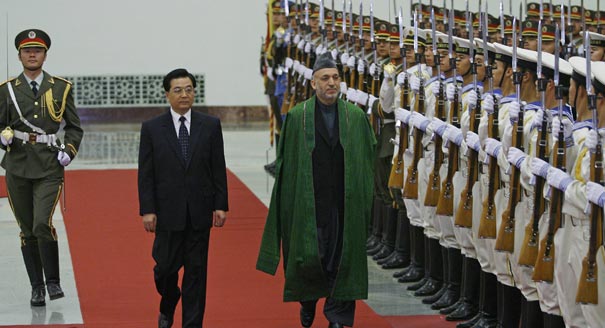
Source: Getty

Other

China’s Role in Shaping the Future of Afghanistan

China's economic investment in Afghanistan provides an opportunity for Afghan development that could help stabilize the country—an outcome that would benefit not only Afghanistan and China, but also the United States.

Link Copied
By Tiffany Ng
Published on Sep 1, 2010

  • China has steadily increased its economic aid and investment in Afghanistan, most notably with a $3.5 billion deal to develop the Aynak copper mine. At the same time, it plays a very limited security role and has refused any direct military involvement.
  • Western commentators have eyed China’s approach to Afghanistan with suspicion and resentment, accusing China of “free-riding” and snapping up investment deals at the expense of the United States, which is paying dearly in blood and treasure.
  • While the United States and China share the goal of a stable and prosperous Afghanistan, fundamental differences in their basic strategies exist. China does not want to pressure Pakistan, nor does it want to align itself too closely with the United States, for fear of exacerbating the terrorist threat to itself or facilitating a long-term American presence in the region. By maintaining its distance and even-handed diplomacy, Beijing is positioning itself to work with whoever controls Kabul.
  • China has the potential to make important contributions to Afghan stability. State-owned Chinese corporations are uniquely risk-tolerant and can help pave the way for future investments. The Chinese also enjoy a more positive relationship with Afghans, making their investments less likely to be targeted for attack by insurgents. These investments can stimulate economic growth that aid money alone cannot.
  • U.S. policy makers should work with Afghanistan to ensure that such investment benefits the local people. Given China’s reluctance to openly cooperate with the United States in Afghanistan, Washington should help Kabul to effectively manage and maximize the positive impact of China’s involvement in Afghanistan through better aid coordination, transparency, and training.

About the Author

Tiffany Ng

Former Junior Fellow, Asia Program

Tiffany Ng
Former Junior Fellow, Asia Program
EconomySecuritySouth AsiaAfghanistanEast AsiaChina

Carnegie does not take institutional positions on public policy issues; the views represented herein are those of the author(s) and do not necessarily reflect the views of Carnegie, its staff, or its trustees.

More Work from Carnegie Europe

  • Commentary
    Strategic Europe
    Europe and the Arab Gulf Must Come Together

    The war in Iran proves the United States is now a destabilizing actor for Europe and the Arab Gulf. From protect their economies and energy supplies to safeguarding their territorial integrity, both regions have much to gain from forming a new kind of partnership together.

      • Rym Momtaz

      Rym Momtaz

  • Commentary
    Strategic Europe
    Taking the Pulse: Is France’s New Nuclear Doctrine Ambitious Enough?

    French President Emmanuel Macron has unveiled his country’s new nuclear doctrine. Are the changes he has made enough to reassure France’s European partners in the current geopolitical context?

      • Rym Momtaz

      Rym Momtaz, ed.

  • Commentary
    The Iran War’s Dangerous Fallout for Europe

    The drone strike on the British air base in Akrotiri brings Europe’s proximity to the conflict in Iran into sharp relief. In the fog of war, old tensions in the Eastern Mediterranean risk being reignited, and regional stakeholders must avoid escalation.

      Marc Pierini

  • Trump United Nations multilateralism institutions 2236462680
    Article
    Resetting Cyber Relations with the United States

    For years, the United States anchored global cyber diplomacy. As Washington rethinks its leadership role, the launch of the UN’s Cyber Global Mechanism may test how allies adjust their engagement.

      • Christopher Painter

      Patryk Pawlak, Chris Painter

  • Commentary
    Strategic Europe
    Europe on Iran: Gone with the Wind

    Europe’s reaction to the war in Iran has been disunited and meek, a far cry from its previously leading role in diplomacy with Tehran. To avoid being condemned to the sidelines while escalation continues, Brussels needs to stand up for international law.

      Pierre Vimont

Get more news and analysis from
Carnegie Europe
Carnegie Europe logo, white
Rue du Congrès, 151000 Brussels, Belgium
  • Research
  • Strategic Europe
  • About
  • Experts
  • Projects
  • Events
  • Contact
  • Careers
  • Privacy
  • For Media
  • Gender Equality Plan
Get more news and analysis from
Carnegie Europe
© 2026 Carnegie Endowment for International Peace. All rights reserved.