

In The Media
Minxin Pei
{
  "authors": [
    "Minxin Pei"
  ],
  "type": "legacyinthemedia",
  "centerAffiliationAll": "dc",
  "centers": [
    "Carnegie Endowment for International Peace",
    "Carnegie Russia Eurasia Center",
    "Carnegie China"
  ],
  "collections": [],
  "englishNewsletterAll": "asia",
  "nonEnglishNewsletterAll": "",
  "primaryCenter": "Carnegie China",
  "programAffiliation": "AP",
  "programs": [
    "Asia"
  ],
  "projects": [
    "Eurasia in Transition"
  ],
  "regions": [
    "East Asia",
    "China"
  ],
  "topics": [
    "Political Reform",
    "Economy",
    "Domestic Politics"
  ]
}
Source: Getty
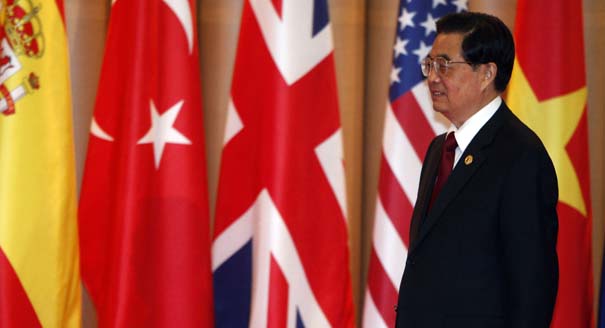
A troubling perception gap exists between Chinese citizens, who feel their country is discriminated against in the international arena, and Western observers, who harbor suspicions of Beijing’s intentions.
Source: Financial Times

Within China, however, popular perception of Beijing’s international behaviour is almost the exact opposite. Most ordinary people believe the Chinese government is, if anything, not assertive enough. They see their leaders as spineless and western criticisms of Chinese behaviour as unfair and hypocritical.
Take, for example, two well-publicised issues: the tussle over China’s exchange rate policy and the Sino-Japanese row over disputed islands in the East China Sea. The predominant perception within China is that America is unfairly blaming China for its own economic woes and bullying China to adopt a policy change that would only hurt the Chinese economy without reviving America’s growth. In the case of the Sino-Japanese dispute, most Chinese believe the west has unfairly sided with Japan.
Such divergence is not unprecedented. But it is hard to recall an era when western views of China’s international stance were diametrically opposed to those of the Chinese themselves. The most obvious reason is the rising nationalism within China, fuelled both by state-sponsored patriotic education and by the Communist party’s control of the media that has precluded objective coverage and analysis of China’s disputes with the west. While most ordinary Chinese distrust the official media’s coverage of domestic issues, they are far more credulous of the government’s versions of China’s conduct abroad. Ironically, the Chinese government is pursuing a strategy that attempts to achieve the impossible: bolstering its nationalist credentials while maintaining a flexible foreign policy. On the one hand, the ruling Communist party is eager to show that it has made China a respected world power. On the other hand, Chinese leaders want to stick to a pragmatic foreign policy that avoids costly and needless conflicts with the west. The tensions inherent in this strategy are making it increasingly untenable.
Further exacerbating the gap in perceptions is that China is, indeed, held to a different standard. In its dealings with the world in general, and the west in particular, China suffers from two handicaps: its power and the nature of its regime. Like other great powers, China is judged by a much higher standard. It is expected to use restraint under all circumstances (particularly in dealing with less powerful countries) and to assume greater international responsibilities. But unlike democratic powers, China also pays an implicit but substantial authoritarian penalty. Because the democratic west views authoritarian regimes as illegitimate, China’s international behaviour is seen through far more sceptical and distrustful prisms in the west. As a result, whenever China is featured in an international dispute, western sympathies naturally flow to China’s opponents. To western politicians and opinion-makers, such ideological bias is second-nature. But to an average Chinese, such differentiated treatment engenders outrage. Few states are subject to such a triple standard.
Left unattended, this growing and troubling perception gap can only lead to rising tensions, even conflict. It makes it all the more difficult to gain Chinese co-operation on matters vital to global security and prosperity. For example, China will face growing western pressure to prevent North Korea, Beijing’s strategic buffer, from expanding its nuclear programme and engaging in further aggression against South Korea. But with rising distrust and acrimony between China and the west, China may choose to do nothing just to show that the west cannot bash it and beg at the same time.
Narrowing this perception gap requires efforts on both sides. On balance, Beijing can do much more. It must allow more objective reporting on Chinese foreign policy and stop fanning nationalism. Western politicians and opinion-makers should exercise greater tact in criticising China (even when such criticisms are justified) and strive to see the issues from the Chinese perspective. Such modest steps may not fully close the perception gap, but there are few realistic alternatives.
Former Adjunct Senior Associate, Asia Program
Pei is Tom and Margot Pritzker ‘72 Professor of Government and the director of the Keck Center for International and Strategic Studies at Claremont McKenna College.
Recent Work
Minxin Pei
Minxin Pei
Carnegie does not take institutional positions on public policy issues; the views represented herein are those of the author(s) and do not necessarily reflect the views of Carnegie, its staff, or its trustees.

In supporting Europe’s far-right, MAGA and Russia both want the same thing: a weaker EU. Europe must defend itself without abandoning the openness these forces exploit.

Armida van Rij

The hybrid warfare landscape is evolving rapidly, leaving policymakers without clear strategies. To better inform their work in addressing emerging challenges, governments must dig deeper into the underlying dynamics at play.


Raluca Csernatoni, Alicia Wanless

As the EU confronts profound challenges, several leaders have called for fundamental reform to the union’s model—but only modest, superficial changes have resulted. What if Europe really could be reimagined from zero today: What should such a redesigned European order look like?

Richard Youngs, ed.

As geopolitical rivalry weaponizes global supply chains, the EU’s true vulnerability lies in emerging-risk imports. For these goods, suppliers are growing more concentrated, substitution more difficult, and political risk is looming.

Sinan Ülgen

The EU is putting together a new security strategy to meet today’s myriad challenges. But for any proposal to be effective, the union needs to grapple with its identity and ambitions.

Pierre Vimont