• Research
  • Strategic Europe
  • About
  • Experts
Carnegie Europe logoCarnegie lettermark logo
EUUkraine
  • Donate
{
  "authors": [
    "Michele Dunne"
  ],
  "type": "legacyinthemedia",
  "centerAffiliationAll": "dc",
  "centers": [
    "Carnegie Endowment for International Peace",
    "Malcolm H. Kerr Carnegie Middle East Center"
  ],
  "collections": [
    "Arab Awakening"
  ],
  "englishNewsletterAll": "menaTransitions",
  "nonEnglishNewsletterAll": "",
  "primaryCenter": "Carnegie Endowment for International Peace",
  "programAffiliation": "MEP",
  "programs": [
    "Middle East"
  ],
  "projects": [],
  "regions": [
    "Middle East",
    "Israel",
    "Egypt",
    "Palestine"
  ],
  "topics": [
    "Political Reform",
    "Security"
  ]
}
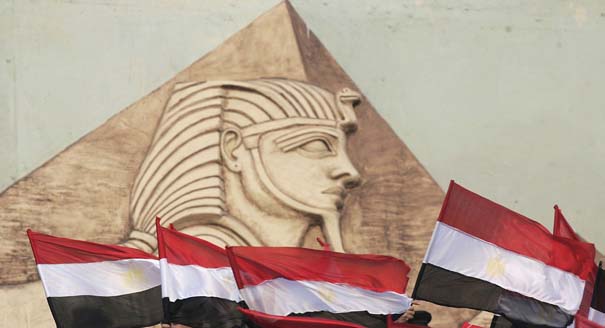
Source: Getty

In The Media

Egypt's Declining Influence

A major change in the Egyptian government might affect Egypt’s policy toward Gaza and its role in the Arab League, but it is unlikely to have a significant impact on the Israeli-Palestinian peace process.

Link Copied
By Michele Dunne
Published on Feb 1, 2011

Source: New York Times

Egypt's Declining InfluenceEgypt has become so preoccupied with its domestic affairs — potential succession after Mubarak’s thirty-year reign, economic problems, and increasingly demands for political change — that it simply is not playing the kind of extensive regional role it once did.

Egypt did provide a channel of communication to the Palestinians at times when the United States would not speak to certain parties, first to Palestinian President Yasser Arafat and later to Hamas. But the effectiveness of Egyptian diplomacy has been declining for some time.
 
While Mubarak was close to Arafat, he is less close to Mahmoud Abbas and does not serve as much as an outside adviser to him. Egyptian efforts to broker an agreement between Fatah and Hamas have not been successful.
 
Much of this is not really Egypt’s fault; the peace process is largely out of its hands at the moment. The current Israeli government is not interested in reaching an agreement with the Palestinians. And the Palestinians are so divided amongst themselves that it is very difficult for them to be flexible. And frankly the United States and Israel stand in the way of reaching a Fatah-Hamas agreement.
 
If there is a major change in the Egyptian government, the main peace process issues to be concerned about are a change in Egypt’s policy toward Gaza and its role in the Arab League. A new leadership probably would be more responsive to Egyptian public opinion and accordingly less cooperative with Israel in terms of restricting goods going into Gaza — although it will probably still restrict Palestinians coming out of Gaza into the Sinai because that is critical to Egyptian national security.
 
A new government also might not be as cooperative with the United States in terms of managing the Arab League and the positions it takes on Arab-Israeli issues.

About the Author

Michele Dunne

Former Nonresident Scholar, Middle East Program

Michele Dunne was a nonresident scholar in Carnegie’s Middle East Program, where her research focuses on political and economic change in Arab countries, particularly Egypt, as well as U.S. policy in the Middle East.

    Recent Work

  • Research
    Islamic Institutions in Arab States: Mapping the Dynamics of Control, Co-option, and Contention
      • +6

      Yasmine Farouk, Nathan J. Brown, Maysaa Shuja Al-Deen, …

  • Research
    From Hardware to Holism: Rebalancing America’s Security Engagement With Arab States
      • +8

      Robert Springborg, Emile Hokayem, Becca Wasser, …

Michele Dunne
Former Nonresident Scholar, Middle East Program
Michele Dunne
Political ReformSecurityMiddle EastIsraelEgyptPalestine

Carnegie does not take institutional positions on public policy issues; the views represented herein are those of the author(s) and do not necessarily reflect the views of Carnegie, its staff, or its trustees.
More Work from Carnegie Europe

  • Commentary
    Strategic Europe
    Russia’s Imperial Retreat Is Europe’s Strategic Opportunity

    The war in Ukraine is costing Russia its leverage overseas. Across the South Caucasus and Middle East, this presents an opportunity for Europe to pick up the pieces and claim its own sphere of influence.


      William Dixon, Maksym Beznosiuk

  • Commentary
    Strategic Europe
    Europe and the Arab Gulf Must Come Together

    The war in Iran proves the United States is now a destabilizing actor for Europe and the Arab Gulf. From protect their economies and energy supplies to safeguarding their territorial integrity, both regions have much to gain from forming a new kind of partnership together.

      • Rym Momtaz

      Rym Momtaz

  • Commentary
    Strategic Europe
    Taking the Pulse: Is France’s New Nuclear Doctrine Ambitious Enough?

    French President Emmanuel Macron has unveiled his country’s new nuclear doctrine. Are the changes he has made enough to reassure France’s European partners in the current geopolitical context?

      • Rym Momtaz

      Rym Momtaz, ed.

  • Commentary
    The Iran War’s Dangerous Fallout for Europe

    The drone strike on the British air base in Akrotiri brings Europe’s proximity to the conflict in Iran into sharp relief. In the fog of war, old tensions in the Eastern Mediterranean risk being reignited, and regional stakeholders must avoid escalation.

      Marc Pierini

  • Commentary
    Strategic Europe
    The EU Needs a Third Way in Iran

    European reactions to the war in Iran have lost sight of wider political dynamics. The EU must position itself for the next phase of the crisis without giving up on its principles.

      Richard Youngs

Get more news and analysis from
Carnegie Europe
Carnegie Europe logo, white
Rue du Congrès, 151000 Brussels, Belgium
  • Research
  • Strategic Europe
  • About
  • Experts
  • Projects
  • Events
  • Contact
  • Careers
  • Privacy
  • For Media
  • Gender Equality Plan
Get more news and analysis from
Carnegie Europe
© 2026 Carnegie Endowment for International Peace. All rights reserved.