

Research
- +10
Rosa Balfour, Frances Z. Brown, Yasmine Farouk, …
{
  "authors": [
    "Moisés Naím"
  ],
  "type": "legacyinthemedia",
  "centerAffiliationAll": "dc",
  "centers": [
    "Carnegie Endowment for International Peace",
    "Malcolm H. Kerr Carnegie Middle East Center"
  ],
  "collections": [
    "Arab Awakening"
  ],
  "englishNewsletterAll": "menaTransitions",
  "nonEnglishNewsletterAll": "",
  "primaryCenter": "Carnegie Endowment for International Peace",
  "programAffiliation": "MEP",
  "programs": [
    "Middle East"
  ],
  "projects": [],
  "regions": [
    "North America",
    "United States",
    "Middle East",
    "North Africa",
    "Libya",
    "Syria",
    "Levant",
    "Maghreb"
  ],
  "topics": [
    "Political Reform",
    "Security",
    "Military",
    "Foreign Policy"
  ]
}
Source: Getty
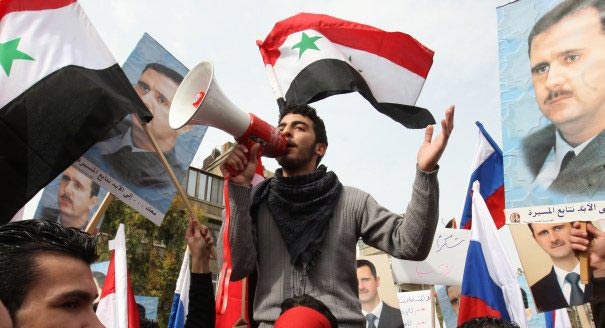
Five critical factors—none of which have to do with oil—explain why the United States and Europe are putting so much effort into bringing down Muammar Qaddafi in Libya and are so cautious in dealing with Bashar al-Assad in Syria.
Source: Huffington Post

Let's start with an explanation that is as common as it is wrong: oil. Libya has a lot more of it than Syria and therefore the real reason for the military aggression against Libya is to take over its oil fields. The problem with this view is that if the West wanted reliable access to Libyan oil, Gaddafi was a far safer bet than the chaos and uncertainty resulting from NATO's armed intervention. Western oil companies operated without any major problems with Gaddafi and it is safe to assume that from their perspective there was no need for such radical regime change.
A second common way to dismiss the question is that this is just one more instance of American hypocrisy: Washington is no stranger to double standards and contradictions in its international relations. This response, however, is not very useful as it doesn't help us to understand the causes behind these contradictions.
So, why protect the butcher of Damascus instead of giving him the same treatment as his Libyan colleague? The humanitarian reasons that justified the attack on Gaddafi are equally--if not more--valid in the case of Syria.
The genocidal brutality of the Assad family is as remarkable as the almost suicidal bravery of ordinary Syrians. For two months, they have faced tanks and bullets on the streets with no weapon other than their desire for change. Demonstrators have been massacred and tortured, their families thrown into prison, and yet they have not gone away. Even in the cities devastated by the atrocities of the army and the civilian militias (the dreaded 'Shabeeah') and declared by Damascus to be under government control, people return to the streets to protest. Only to be shot at again.
While this is happening, the reaction of the United States and Europe is--to say the least--anemic. Again: why? Here are five answers.
First: Syria's military is far stronger than Libya's. Syria has one of the largest, best equipped, and trained armed forces in the Middle East. It also has chemical and biological weapons and its paramilitary forces are among the largest in the world. In contrast, Gaddafi kept the Libyan military fragmented, ill equipped, and poorly trained.
Second: War fatigue. Libya exhausted the little appetite left in the United States to engage in wars that are not justified by clear threats to its vital interests. Syrian dissidents are suffering the consequences of the long and costly wars in Afghanistan and Iraq and the recent raid on Libya. U.S. military support for remote causes will henceforth be more limited and selective. And, as far as wars are concerned, Europe won't act without Washington. This leaves the heroic Syrian dissidents all on their own.
Third: Thorny neighbors. Libya has Egypt on one side and Tunisa on the other--the jewels of the Arab Spring. Syria borders with one of the world's most volatile mixture of countries: Lebanon, Israel, Iraq, Jordan, and Turkey.
Fourth: No allies. Gaddafi has no friends and even his own children wanted to marginalize him. In an unprecedented move, the Arab League supported the establishment of a strictly enforced no-fly zone in Libya. In contrast, Bashar al-Assad has powerful allies inside and outside the region--starting with Iran (and, therefore, Hezbollah and Hamas). It is not even clear if Benjamin Netanyahu and the Israeli government would welcome a chaotic transition of power in Syria. Even Vogue magazine was smitten with this family and wrote a sycophantic article about Asma Assad, "the freshest and most magnetic of first ladies" endowed with "dark-brown eyes, wavy chin-length brown hair, long neck, an energetic grace." It's hard to bomb someone like that.
Fifth: Who to Support? Recently, two senior White House officials told the New York Times that the government's weak response to the events in Syria is in part due to the lack of interlocutors among the opposition. They just don't know who to contact. And another senior U.S. official--who requested anonymity--told me that in his estimate the chaos and carnage following the demise of the Assad regime would be far worse than what it has been so far in any of the other Arab countries undergoing a political transition.
Maybe. But the brave Syrians who continue to take to the streets do not seem to care. They want the dictator to go. At any price.

Distinguished Fellow
Moisés Naím is a distinguished fellow at the Carnegie Endowment for International Peace, a best-selling author, and an internationally syndicated columnist.
Recent Work



Rosa Balfour, Frances Z. Brown, Yasmine Farouk, …
Moisés Naím
Carnegie does not take institutional positions on public policy issues; the views represented herein are those of the author(s) and do not necessarily reflect the views of Carnegie, its staff, or its trustees.

Are Germany’s economic, industrial, and political struggles becoming a liability for the EU’s ability to rise to the geopolitical moment?

Rym Momtaz, ed.

European Commission President Ursula von der Leyen is about to give her annual address on the state of the EU. Here’s what she won’t—but should—say.
Rym Momtaz

Radical-right parties are expected to do well in upcoming elections in four of the EU's biggest member states. If successful, they could prevent the union from addressing key challenges ahead.

Stefan Lehne

The aftermath of the Ceuta crisis shows Europe has drawn the wrong lessons. Rather than doubling down on failed migration policies, the EU needs to address the underlying roots of such episodes.

Richard Youngs

Canadian Prime Minister Mark Carney has twice inspired praise for standing up to U.S. President Donald Trump: at the 2026 World Economic Forum in Davos and on Canada-U.S. trade negotiations. Is Carney showing a third way better than the EU has in dealing with the Trump administration?
Rym Momtaz, ed.