

Article
Thomas de Waal
{
  "authors": [
    "Thomas de Waal"
  ],
  "type": "legacyinthemedia",
  "centerAffiliationAll": "dc",
  "centers": [
    "Carnegie Endowment for International Peace",
    "Carnegie Europe",
    "Carnegie Russia Eurasia Center"
  ],
  "collections": [],
  "englishNewsletterAll": "ctw",
  "nonEnglishNewsletterAll": "",
  "primaryCenter": "Carnegie Europe",
  "programAffiliation": "russia",
  "programs": [
    "Russia and Eurasia"
  ],
  "projects": [],
  "regions": [
    "Caucasus",
    "Russia"
  ],
  "topics": [
    "Political Reform",
    "Democracy"
  ]
}
Source: Getty
The mysterious assassinations of prominent politicians and journalists over the past fifteen years suggest that Russian state security may still be involved in politically-motivated crimes, even if they are not directly ordered by the country’s leaders.
Source: National Interest

Boris Yeltsin defanged this establishment, but he did not dismantle it. The KGB was renamed (several times) but never purged and its career officers continued to work there. But the world in which they operate had changed forever.
Turkey provides a fascinating parallel story. The story of Turkey’s last decade has been that of Prime Minister Recep Tayyip Erdoğan’s mission to humble the country’s military establishment, which had in its time humbled a series of civilian governments. That story reached a climax this August as Erdoğan forced the mass resignation of the entire military leadership. But Turkey’s outer security structures are the outer core of something deeper. Modern Turkey also has its shadowy military-security hinterland known as the “deep state,” a group of fanatical individuals devoted to upholding an almost sacred conception of the Kemalist state order and getting rid of any liberals, Marxists or Islamists who threaten it. The “deep state” is associated with the army and intelligence service but too shadowy and extreme for those links to be traceable. It still strikes on occasion, as with the awful assassination of Istanbul Armenian newspaper editor Hrant Dink in 2007, after which there were media reports that Dink’s teenage killer had been protected by police officers and evidence covered up.
Something similar seems to have happened in post-Soviet Russia. In Soviet times the KGB was the heart of the state. The agency’s symbol depicted it as the “sword and shield” of the state with license to monitor and scrutinize the activities of every citizen in the name of protecting the security the USSR. Its successor organizations never recovered even a fraction of that role after the Soviet collapse. Vladimir Putin is a KGB man with authoritarian instinct, but in historical terms the differences between his rule and that of his Soviet predecessors are far greater than the similarities. He presides over a society hugely more democratic than the Soviet Union. Travel to the West? Own property? Go to church? Read subversive literature? Pozhaluista. Former KGB chief Yury Andropov would be turning in his grave.
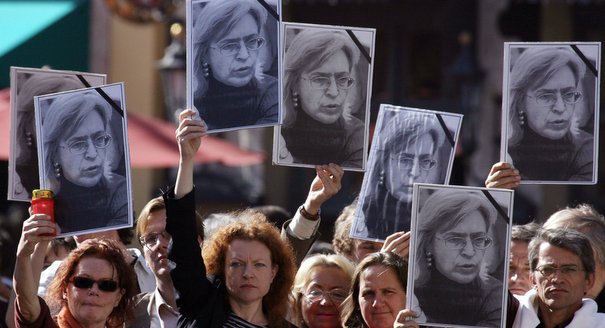
Instead, something very like a “Russian deep state” has emerged, whose manifestations rock the news from time to time. The assassinations of two outstanding liberal politicians, Galina Starovoitova in 1998 and Sergei Yushenkov in 2003, and the probable poisoning of a third, Yury Shchekochikin, also in 2003 (the circumstances of his death are less clear), are attributable to shadowy figures from the security establishment, perhaps acting autonomously but with a nod and a wink from friends closer to government. Something similar may have happened with the killing of Alexander Litvinenko in London and Anna Politkovskaya in Moscow in 2006. What all these murders of very different personalities have in common is that all the victims were outspoken critics of the Russian state establishment and, although in some cases convictions have been made, only the direct perpetrators have ever been identified, not those who ordered the killings.
The pattern continues. Reading about the murky case of Yevgeny Borisov, a Russian military intelligence officer based in Abkhazia and alleged to have planted a series of explosive devices around Georgia, I reached two conclusions. One was that the evidence for Russian culpability in the incidents was compelling. The other was that it was unlikely that President Dmitry Medvedev or Prime Minister Vladimir Putin would be so stupid as to order these small, nasty and counterproductive operations. If they wanted to hurt Georgia, there are much more effective ways of doing so. These acts caused mercifully little damage in Georgia and a lot of political damage to Russia in Washington.
The problem that KGB veteran Vladimir Putin has helped cultivate twenty years after the August putsch is not one that Andropov or Vladimir Kryuchkov would recognize, but it is still toxic for the Russian state. It is a culture of impunity in which illegal activity and assassinations are possible, even if they are not directly ordered from the top.

Senior Fellow, Carnegie Europe
Thomas de Waal is a senior fellow at Carnegie Europe, specializing in Eastern Europe and the Caucasus.
Recent Work
Thomas de Waal
Thomas de Waal
Carnegie does not take institutional positions on public policy issues; the views represented herein are those of the author(s) and do not necessarily reflect the views of Carnegie, its staff, or its trustees.

European Commission President Ursula von der Leyen is about to give her annual address on the state of the EU. Here’s what she won’t—but should—say.

Rym Momtaz

Radical-right parties are expected to do well in upcoming elections in four of the EU's biggest member states. If successful, they could prevent the union from addressing key challenges ahead.

Stefan Lehne

An overwhelming victory by a far-right-wing party in a small state in eastern Germany will have major repercussions for Chancellor Friedrich Merz’s coalition.

Judy Dempsey

The EU’s responses to two recent incidents expose the gulf between European perceptions and capabilities. Unless the union can bridge that gap, it will never become a real geostrategic power.
Rym Momtaz

European states control several Overseas Countries and Territories around the world that carry strategic, economic, and environmental weight. As great powers challenge the rules-based order, defending them is a geopolitical imperative for Europe.

Marc Pierini