• Research
  • Strategic Europe
  • About
  • Experts
Carnegie Europe logoCarnegie lettermark logo
EUUkraine
  • Donate
{
  "authors": [
    "Uri Dadush",
    "Kati Suominen"
  ],
  "type": "legacyinthemedia",
  "centerAffiliationAll": "",
  "centers": [
    "Carnegie Endowment for International Peace"
  ],
  "collections": [],
  "englishNewsletterAll": "",
  "nonEnglishNewsletterAll": "",
  "primaryCenter": "Carnegie Endowment for International Peace",
  "programAffiliation": "",
  "programs": [],
  "projects": [],
  "regions": [
    "United States",
    "China",
    "North America"
  ],
  "topics": [
    "Economy",
    "Trade"
  ]
}
Source: Getty

In The Media

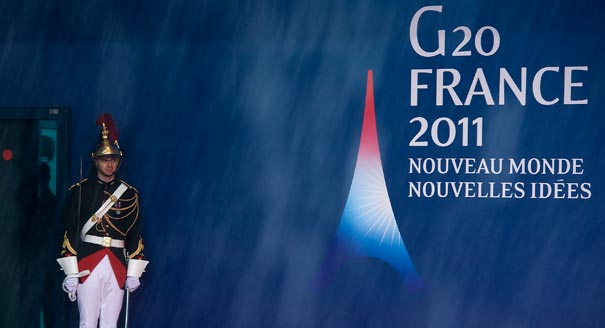
Is There Life for the G20 Beyond the Global Financial Crisis?

In 2008, the G20 proved to be an effective forum for coordinating action to stem the global financial crisis. But now that the storm has passed, it remains to be seen if the G20 is capable of assuming leadership on key economic governance issues.

Link Copied
By Uri Dadush and Kati Suominen
Published on Jan 31, 2012

Source: Journal of Globalization and Development

The G20 summit of heads of state, a creature born of the financial crisis, has appointed itself as the preeminent forum for global economic policymaking. Notwithstanding its original design to curb food price volatility, reform the global monetary system, and improve the working of the G20 itself, the group’s latest summit in Cannes, France in November 2011 was hijacked by the prolonged Eurozone financial crisis. An enormous source of turbulence in the world economy, Europe’s problems are the world’s problems and should be on the G20 agenda. But the Euro crisis also diverted the G20’s focus from its long-term imperative: ensuring sustained global economic growth. Instead, the outcome of the summit was inconclusive, vague, and thus modest: the group agreed in principle to increase the resources of the International Monetary Fund to respond to Europe’s woes; China modestly strengthened its pledge to move towards exchange flexibility to assuage critics of its currency manipulation; and the leaders yet again expressed their commitment to the Doha trade round.

The French summit epitomizes the difficulties in making sweeping yet specific decisions in a large, diverse group of nations with divergent interests. Comprising ten emerging markets, nine advanced economies, and the EU, the G20 reflects the reality of a world economy where developing and advanced countries are starting to have roughly equal economic weight. By including the largest emerging markets, it has the potential to fill a large gap in global economic governance that its predecessors – the G4 launched by US Treasury Secretary George Schultz in 1973, and the subsequent permutations, G5, G7 club of rich countries, and the G8, which also included Russia – were not built to bridge. The G7 helped the liberal democracies prevail in the Cold War and worked to enhance global macroeconomic stability, while the G8 sought to engage Russia after the collapse of the Soviet bloc. But with the onslaught of economic globalization and the rise of emerging economies, both groups are outdated as venues for global policy coordination. The G20, on the other hand, looks and feels like a 21st century forum.

About the Authors

Uri Dadush

Former Senior Associate, International Economics Program

Dadush was a senior associate at the Carnegie Endowment for International Peace. He focuses on trends in the global economy and is currently tracking developments in the eurozone crisis.

Kati Suominen

German Marshall Fund

Authors

Uri Dadush
Former Senior Associate, International Economics Program
Uri Dadush
Kati Suominen
German Marshall Fund
EconomyTradeUnited StatesChinaNorth America

Carnegie does not take institutional positions on public policy issues; the views represented herein are those of the author(s) and do not necessarily reflect the views of Carnegie, its staff, or its trustees.

More Work from Carnegie Europe

  • Commentary
    Strategic Europe
    Letter from the Editor: Europe Takes Two Steps Forward But One Step Back

    As we close out another season of Strategic Europe, it is worth taking stock of the deep shifts underway.

      • Rym Momtaz

      Rym Momtaz

  • Paper
    Assessing Information Ecosystems: How Governments Can Get Ahead of Hybrid Threats

    The hybrid warfare landscape is evolving rapidly, leaving policymakers without clear strategies. To better inform their work in addressing emerging challenges, governments must dig deeper into the underlying dynamics at play.


      Raluca Csernatoni, Alicia Wanless

  • Commentary
    Strategic Europe
    Why Europe Must Take Charge of its Russia Diplomacy Now

    Trump is distracted and Ukraine wants Europe to step up. The continent’s leaders must find their voice and assert it in talks with Russia.

      Alissa de Carbonnel

  • Commentary
    Strategic Europe
    Taking the Pulse: Enough with the Annual NATO Summits, Already?

    Over the past ten years, NATO has held almost as many summits as it did during the entirety of the Cold War. Are they still useful, or is it time to stop holding annual meetings?

      • Rym Momtaz

      Rym Momtaz, ed.

  • Commentary
    Strategic Europe
    European Sycophancy Worked on Trump

    Nearly a year and a half after Europeans leaned into sucking up to Trump, the strategy has produced some benefits when it comes to Ukraine.

      • Rym Momtaz

      Rym Momtaz

Get more news and analysis from
Carnegie Europe
Carnegie Europe logo, white
Rue du Congrès, 151000 Brussels, Belgium
  • Research
  • Strategic Europe
  • About
  • Experts
  • Projects
  • Events
  • Contact
  • Careers
  • Privacy
  • For Media
  • Gender Equality Plan
Get more news and analysis from
Carnegie Europe
© 2026 Carnegie Endowment for International Peace. All rights reserved.