• Research
  • Strategic Europe
  • About
  • Experts
Carnegie Europe logoCarnegie lettermark logo
EUUkraine
  • Donate
{
  "authors": [
    "Matthew Rojansky"
  ],
  "type": "legacyinthemedia",
  "centerAffiliationAll": "dc",
  "centers": [
    "Carnegie Endowment for International Peace"
  ],
  "collections": [],
  "englishNewsletterAll": "ctw",
  "nonEnglishNewsletterAll": "",
  "primaryCenter": "Carnegie Endowment for International Peace",
  "programAffiliation": "russia",
  "programs": [
    "Russia and Eurasia"
  ],
  "projects": [],
  "regions": [
    "Eastern Europe",
    "Belarus"
  ],
  "topics": [
    "Political Reform",
    "Democracy"
  ]
}
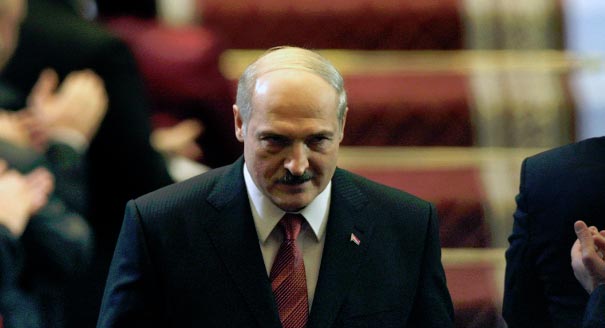
Source: Getty

In The Media

Europe Closes the Door on Belarus

With the latest round of sanctions and the decision to recall ambassadors from Minsk, the European Union has effectively closed the door on Belarus.

Link Copied
By Matthew Rojansky
Published on Feb 29, 2012

Source: Voice of Russia

Since the controversial re-election of Belarusian President Alexander Lukashenka in December 2010—and the accompanying crackdown on many protestors and opposition candidates—relations between Belarus and the European Union have deteriorated. In an interview with Voice of Russia, Carnegie’s Matthew Rojansky argued that the latest round of European Union sanctions on Belarus and the decision to recall EU member states’ ambassadors from Minsk clearly signal that “Europe has closed the door” on Belarus. Although European Union officials—most notably Polish Foreign Minister Sikorski – have traditionally adopted a “soft power approach” toward Belarus, Rojansky noted that Lukashenka has rejected the carrot of European integration and “really spat in their faces.” Rojansky described the pattern in relations between Belarus and the West as one in which “Belarus escalates and the West responds.” As a result, “Lukashenka made himself totally vulnerable and totally exposed to Moscow because he has no friends left in the West,” Rojansky concluded.

About the Author

Matthew Rojansky

Former Deputy Director, Russia and Eurasia Program

Rojansky, formerly executive director of the Partnership for a Secure America, is an expert on U.S. and Russian national security and nuclear-weapon policies.

    Recent Work

  • Paper
    An Opportunity for Ambition: Ukraine’s OSCE Chairmanship

      Matthew Rojansky

  • In The Media
    Presiding Over the OSCE: Challenges and Opportunities

      Matthew Rojansky

Matthew Rojansky
Former Deputy Director, Russia and Eurasia Program
Matthew Rojansky
Political ReformDemocracyEastern EuropeBelarus

Carnegie does not take institutional positions on public policy issues; the views represented herein are those of the author(s) and do not necessarily reflect the views of Carnegie, its staff, or its trustees.

More Work from Carnegie Europe

  • Commentary
    Is the Radical-Right Threat Existential or Overstated?

    Amid increased polarization and the influence of disinformation, radical-right parties are once again gaining traction across Europe. With landmark elections on the horizon in several countries, are the EU’s geostrategic vision and fundamental values under existential threat?

      Catherine Fieschi, Cas Mudde

  • Commentary
    Strategic Europe
    The EU Needs a Third Way in Iran

    European reactions to the war in Iran have lost sight of wider political dynamics. The EU must position itself for the next phase of the crisis without giving up on its principles.

      Richard Youngs

  • Research
    New Approaches to Defending Global Civil Society

    New thinking is needed on how global civil society can be protected. In an era of major-power rivalry, competitive geopolitics, and security primacy, civil society is in danger of getting squeezed – in some countries, almost entirely out of existence.

      Richard Youngs, ed., Elene Panchulidze, ed.

  • Commentary
    Strategic Europe
    How Europe Can Survive the AI Labor Transition

    Integrating AI into the workplace will increase job insecurity, fundamentally reshaping labor markets. To anticipate and manage this transition, the EU must build public trust, provide training infrastructures, and establish social protections.

      Amanda Coakley

  • Commentary
    Strategic Europe
    Can Europe Still Matter in Syria?

    Europe’s interests in Syria extend beyond migration management, yet the EU trails behind other players in the country’s post-Assad reconstruction. To boost its influence in Damascus, the union must upgrade its commitment to ensuring regional stability.

      Bianka Speidl, Hanga Horváth-Sántha

Get more news and analysis from
Carnegie Europe
Carnegie Europe logo, white
Rue du Congrès, 151000 Brussels, Belgium
  • Research
  • Strategic Europe
  • About
  • Experts
  • Projects
  • Events
  • Contact
  • Careers
  • Privacy
  • For Media
  • Gender Equality Plan
Get more news and analysis from
Carnegie Europe
© 2026 Carnegie Endowment for International Peace. All rights reserved.