

Research
- +10
Rosa Balfour, Frances Z. Brown, Yasmine Farouk, …
{
  "authors": [
    "Moisés Naím"
  ],
  "type": "legacyinthemedia",
  "centerAffiliationAll": "dc",
  "centers": [
    "Carnegie Endowment for International Peace",
    "Carnegie Europe",
    "Malcolm H. Kerr Carnegie Middle East Center"
  ],
  "collections": [],
  "englishNewsletterAll": "menaTransitions",
  "nonEnglishNewsletterAll": "",
  "primaryCenter": "Carnegie Endowment for International Peace",
  "programAffiliation": "MEP",
  "programs": [
    "Middle East"
  ],
  "projects": [],
  "regions": [
    "Middle East",
    "Syria",
    "Levant"
  ],
  "topics": [
    "Political Reform",
    "Security",
    "Foreign Policy"
  ]
}
Source: Getty
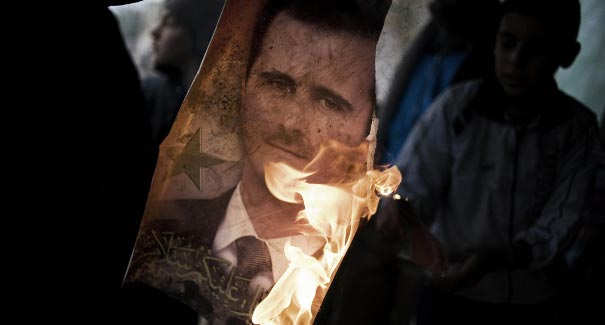
While the world’s democracies have discussed the options for bringing a stop to the slaughter in Syria, far less time has been spent identifying the options that remain for Assad himself.
Source: El País

2. Negotiate. The problem is, who with? The opposition is an ever-changing amalgam of different groups whose only commonality is their total commitment to getting rid of Assad. He could try talking to the outside world: the UN; the Arab League; the European Union; the United States… In return for international mediation Assad could promise to implement a series of political reforms that would involve giving up part of his power. But it would be naïve to imagine that the outside world would believe him and that they would not impose stringent demands and guarantees. What’s more, not even Assad himself believes this is an option anymore. He knows that giving up a little power means significantly increasing the likelihood of losing it all (see Hosni Mubarak). Gaddafi’s stubborn refusal to make concessions was based on the same understanding of power. But, surely the Syrian leader has asked himself, if Gaddafi had known where his intransigence would lead him, would he have clung on to power as he did? In the end, Gaddafi and his sons desperately sought a way to negotiate a ceasefire that would allow them to hold on to some form of power. But by then it was too late. The lesson to be learned from Libya is that negotiations have to start before defeat. The lessons of Egypt, Tunisia and Yemen is that authoritarian regimes do not share “a little” of their power: in that part of the world it’s all or nothing.
3. Exile. Surely it is better than death. Or jail. The Mubarak, Hussein, and Gaddafi families, among others, understand this. The Assad family is also likely to have thought about this. But where could they go? The International Criminal Court awaits them in Europe, and hundreds of organizations have documented the regimes' atrocities. Iran is a possibility, as are China and Russia. The challenge, then, becomes who else to include in the exile-bound airplane? Assad’s brother is in charge of the regime’s apparatus of repression, while his sister is a vocal exponent of the hard line. Then there are the generals, the heads of the security services, along with other collaborators and their families. One of the more plausible rumors doing the rounds at the moment is that in the event that he should opt for exile, Assad’s collaborators have already created a well-organized network to make it hard for him to travel anywhere without including many others.
The end of the blood-spattered Syrian dynasty approaches, but nobody knows whether it will be a question of days, weeks, or months. Assad has only few, and poor, options left. And while it is true that the great leaders create new ways to move forward that nobody else could have imagined, Assad is anything but a great leader. Perhaps all that is left open to him is to hope that his wife, who prior to the recent killing Paris Match described as “an element of light in a country filled with shade” can discover a shining path that will save thousands of lives, including that of her husband.

Distinguished Fellow
Moisés Naím is a distinguished fellow at the Carnegie Endowment for International Peace, a best-selling author, and an internationally syndicated columnist.
Recent Work



Rosa Balfour, Frances Z. Brown, Yasmine Farouk, …
Moisés Naím
Carnegie does not take institutional positions on public policy issues; the views represented herein are those of the author(s) and do not necessarily reflect the views of Carnegie, its staff, or its trustees.

The EU can impose sanctions but struggles to enforce them without the United States. With Washington increasingly disinterested in backing European interests, the bloc must now fend for itself.


Nicu Popescu, Tiago Antunes

Russia is testing the waters of NATO’s mutual defense clause. What do strikes in Romanian territorial waters mean for the alliance’s posture toward Moscow?

Dimitar Bechev

With its public finances in shambles, the far right polling at 35 percent ahead of the 2027 presidential election, and a growing protest movement, is France’s crisis a threat to the EU’s geopolitical awakening?

Rym Momtaz, ed.

Ahead of a tough winter for Ukraine, Donald Trump’s swing back toward Russia bodes ill. But instead of panicking, Kyiv’s European allies are focusing on action.
Rym Momtaz

Funding Ukraine remains a priority for European leaders. As Russia’s war of aggression heads into another winter, two feasible options to mobilize support for Kyiv should be fast-tracked.


Vladyslav Rashkovan, Gregory P. Wilson