

Commentary
Dmitri Trenin
{
  "authors": [
    "Dmitri Trenin"
  ],
  "type": "legacyinthemedia",
  "centerAffiliationAll": "",
  "centers": [
    "Carnegie Endowment for International Peace",
    "Carnegie China",
    "Carnegie Russia Eurasia Center"
  ],
  "collections": [
    "China’s Foreign Relations",
    "U.S.-China Relations"
  ],
  "englishNewsletterAll": "",
  "nonEnglishNewsletterAll": "",
  "primaryCenter": "Carnegie Endowment for International Peace",
  "programAffiliation": "",
  "programs": [],
  "projects": [
    "Eurasia in Transition"
  ],
  "regions": [
    "East Asia",
    "China",
    "Caucasus",
    "Russia",
    "North America",
    "United States"
  ],
  "topics": [
    "Foreign Policy"
  ]
}
Source: Getty
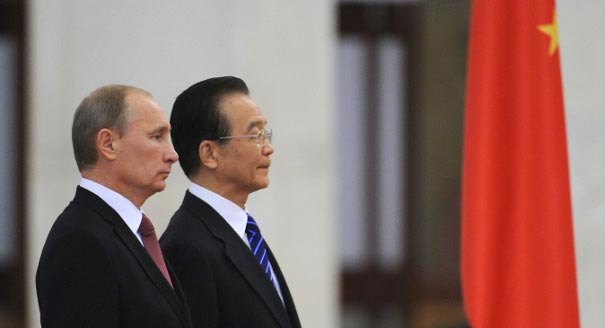
As China's power continues to grow, Russians need to rediscover themselves as a Euro-Pacific nation and strengthen ties to East Asia in order to avoid becoming Beijing's junior partner.
Source: Public Service Europe

The remarkable thing is that, given the enormity of the change and its swiftness, Moscow and Beijing managed to end their 30-year-long Cold War in 1989 and moved toward a generally peaceful and collaborative arrangement. The thorny border issue, a fulcrum of tension in the past, has been resolved. And the border itself has been largely demilitarised. China has become Russia's biggest foreign trade partner, ahead of Germany. Russian arms sales over the past 20 years have helped the PLA to narrow the gap with the world's top militaries. With a number of smaller Central Asian states, China and Russia have formed the Shanghai Cooperation Organisation, which helps mitigate their regional rivalry and functions as a platform for dialogue involving much of continental Asia. Finally, on the global arena, Moscow and Beijing speak the language of multilateralism and insist on the sanctity of national sovereignty - and the principle of non-interference in domestic affairs. ...
Full text of the article in Public Service Europe
Former Director, Carnegie Moscow Center
Trenin was director of the Carnegie Moscow Center from 2008 to early 2022.
Recent Work
Dmitri Trenin
Dmitri Trenin
Carnegie does not take institutional positions on public policy issues; the views represented herein are those of the author(s) and do not necessarily reflect the views of Carnegie, its staff, or its trustees.

The European Commissioner for Trade is headed to China. But after President Xi’s bridge-building visit to Washington, can a more isolated EU overcome Beijing’s stranglehold on critical raw materials? Who will blink first?

Rym Momtaz, ed.

European NATO countries are wrestling with the possibility of U.S. disengagement from the alliance. With the continent’s security increasingly uncertain, governments must restore the credibility of their collective defense.



Hans-Dieter Lucas, Adam Thomson, Pierre Vimont

The new U.S.–Denmark–Greenland agreement will help Washington exert political, economic, and financial dominance under the guise of security. Yet, it acknowledged Copenhagen’s and Nuuk’s sovereignty on the island.

Marc Pierini

A summer of escalation in the Black Sea has hurt Ukraine economically and is exacerbating world food security. A truce is needed—as is a broader reframing of Europe’s Ukraine strategy.

Thomas de Waal

Are Germany’s economic, industrial, and political struggles becoming a liability for the EU’s ability to rise to the geopolitical moment?
Rym Momtaz, ed.