

Paper
Matthew Rojansky
{
  "authors": [
    "Matthew Rojansky"
  ],
  "type": "questionAnswer",
  "centerAffiliationAll": "dc",
  "centers": [
    "Carnegie Endowment for International Peace",
    "Carnegie Europe",
    "Carnegie Russia Eurasia Center"
  ],
  "collections": [],
  "englishNewsletterAll": "ctw",
  "nonEnglishNewsletterAll": "",
  "primaryCenter": "Carnegie Endowment for International Peace",
  "programAffiliation": "russia",
  "programs": [
    "Russia and Eurasia"
  ],
  "projects": [],
  "regions": [
    "Eastern Europe",
    "Ukraine",
    "Europe"
  ],
  "topics": [
    "Political Reform",
    "Democracy",
    "Economy",
    "Trade"
  ]
}
Source: Getty
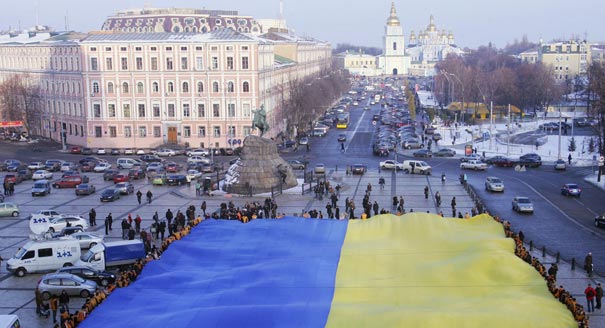
Despite a highly educated and skilled workforce and natural resources, Ukraine continues to struggle with sustained economic growth.
Ukraine is a large and important European country but one that still struggles with its Soviet legacy and other barriers to development. In a Q&A, Matthew Rojansky examines Ukraine’s domestic reform initiatives and foreign policy priorities. Rojansky says that despite a highly educated and skilled workforce and considerable natural resources, the country continues to struggle to sustain economic growth. And while Ukraine has opportunities to play a leading role in Euro-Atlantic security, it has not yet defined a compelling vision for its own role in the region and the world.
Yes, Ukraine matters. It is the largest country, by area, that is physically within Europe entirely, and it is the largest economy that is neither part of the EU nor part of NATO nor part of Russia’s Eurasian Economic Community. This is in a sense a country that is trapped in the gray area’s in-between, and yet it’s an enormous economy. And there is potential—it is a country with 45-46 million people who have a great educational background, are hard workers, and are entrepreneurial. It’s got 70 percent of the so-called black earth, the most fertile soil in Europe. So, Ukraine is a powerhouse no matter how you cut the cake and yet it is not really integrated yet.
The paradox of reform in Ukraine is that no reform that is driven by the government is ever going to be enough. There is a kind of chicken and egg problem, which is that the people of the country determine whether reform can succeed and whether corruption can be eliminated because it takes two to tango.
It’s not only the official who asks for the bribe but it’s the business person or the citizen or the person who is stopped in traffic who pays the bribe. And I think to start changing that culture, it should start with things like exchanges and getting more young Ukrainians into Western Europe and into the United States so that they have different expectations. Or even sending them to places like Georgia, where corruption has been tackled relatively effectively, or at least the process has started.
But the much deeper change, of course, is going to happen by building institutions and promoting the rules of institutions and the rule of law over the rule of individuals. And that’s a process. It takes time. I think this government has done a little bit of it and previous governments have done a little bit of it. But there hasn’t really been a sea change moment in Ukraine yet. We are still waiting.
Ukraine’s relative economic success over the past several years, and then if you look back at the decade before that, has been kind of an artifact of unique circumstances. Either there’s been a good harvest and so Ukraine has done well, or global steel prices have gone up and with Ukraine being a big steel producer, it has done well. Or if you go back ten years, it was that European banks were finally starting to pay attention to Ukraine and so all of a sudden there was all this credit and people who had never borrowed were now borrowing and then spending, and so Ukraine was doing well.
And the thing is, after a while, you run out of these artifacts. Ukraine starts to look like a regular country, and then it has problems that regular countries have. And so I think it’s going to have to look for much more normalized and integrated solutions. And those are going to depend on institutional restructuring, institutional reform, balancing the budget, fiscal consolidation—all of the hard stuff. Austerity, that terrible buzzword that Europe is afraid of these days, is particularly hard when you’re going into a parliamentary election like Ukraine at the end of 2012.
It’s hard to see how that success story really accelerates between now and 2012 and 2013. And Yanukovych, the president of Ukraine, is in a sort of political pressure cooker, feeling pressure from all sides.
Ukraine, being the incoming Organization for Security and Co-operation in Europe (OSCE) chair, is actually already involved in the so-called troika of the previous chair, the current chair, and the incoming chair. So it should already be playing a role in terms of managing the security space of the OSCE. But the whole purpose of the OSCE is to acknowledge the fact that security comes in multiple forms. You have human security, economic security, and then traditional political-military security. And so I think Ukraine has to demonstrate that it understands that sort of multi-dimensionality of security, but also that it has a unique comparative advantage.
And what is that? As I mentioned earlier, Ukraine is in the in the gray space. It is not a NATO member. But it also not part of Russia, or Russian-led security alliances. So it has a unique perspective to understand what it means to be a non-bloc country in the Euro-Atlantic space, and that should give it a special incentive to make the Euro-Atlantic system as a whole—the system that includes Russia on the one hand, but also North America and traditional NATO allies on the other—a more meaningful system to strengthening Euro-Atlantic security.
It also has a real incentive to deal with protracted conflicts. The conflict in Transnistria is more Ukraine’s problem, quite frankly, than anyone else’s. Certainly it’s Moldova’s problem, it’s a breakaway territory of Moldova. But Ukraine is the other party on the other border, and Ukraine is going to be saddled with the problem if Moldova enters Europe. Moldova’s on the path to enter Europe without Transnistria. Because the Transnistrians will look to their immediate neighbor, their former Soviet neighbor, and say you have to help us out. And so the Ukrainians have a real incentive to move forward on Transnistria.
And then lastly, there are these sort of twenty-first century challenges, where actually Ukraine has much greater capacity but greater challenges than many other countries.
Trafficking. The northern coast of the Black Sea, that’s Ukrainian territory, and the Black Sea is the major highway between the Middle East and the instability of the Arab world today and the greater AfPak region. That whole region, that’s how it flows up into Europe. And Ukraine is right there at the entry point.
Global health pandemics. Ukraine has massive health capabilities but they’re crumbling and from the Soviet-era. And it has a population that’s very vulnerable to drug-resistant tuberculosis and other epidemics.
And then cyber. Ukraine has actually been the source of both a number of major global cyber-attacks, but also the solutions. The government can draw upon very technically-skilled Ukrainians to try and deal with the problems of cyber-insecurity, and I think it needs to do a more effective job of bringing Ukraine into a globally integrated system in that respect.
Former Deputy Director, Russia and Eurasia Program
Rojansky, formerly executive director of the Partnership for a Secure America, is an expert on U.S. and Russian national security and nuclear-weapon policies.
Recent Work
Matthew Rojansky
Matthew Rojansky
Carnegie does not take institutional positions on public policy issues; the views represented herein are those of the author(s) and do not necessarily reflect the views of Carnegie, its staff, or its trustees.

Before the next wave of EU enlargement takes place, the union needs to grapple with thorny questions of how power is distributed among its members.


Emil Sondaj Hansen, Ditte Brasso Sørensen

The new U.S.–Denmark–Greenland agreement will help Washington exert political, economic, and financial dominance under the guise of security. Yet, it acknowledged Copenhagen’s and Nuuk’s sovereignty on the island.

Marc Pierini

A summer of escalation in the Black Sea has hurt Ukraine economically and is exacerbating world food security. A truce is needed—as is a broader reframing of Europe’s Ukraine strategy.

Thomas de Waal

Are Germany’s economic, industrial, and political struggles becoming a liability for the EU’s ability to rise to the geopolitical moment?

Rym Momtaz, ed.

European Commission President Ursula von der Leyen is about to give her annual address on the state of the EU. Here’s what she won’t—but should—say.
Rym Momtaz