

Commentary
Judy Dempsey
{
  "authors": [
    "Judy Dempsey"
  ],
  "type": "legacyinthemedia",
  "centerAffiliationAll": "",
  "centers": [
    "Carnegie Endowment for International Peace",
    "Carnegie Europe"
  ],
  "collections": [
    "Transatlantic Cooperation"
  ],
  "englishNewsletterAll": "",
  "nonEnglishNewsletterAll": "",
  "primaryCenter": "Carnegie Europe",
  "programAffiliation": "",
  "programs": [],
  "projects": [],
  "regions": [
    "Middle East",
    "Asia",
    "Europe",
    "North America"
  ],
  "topics": [
    "Foreign Policy"
  ]
}
Source: Getty
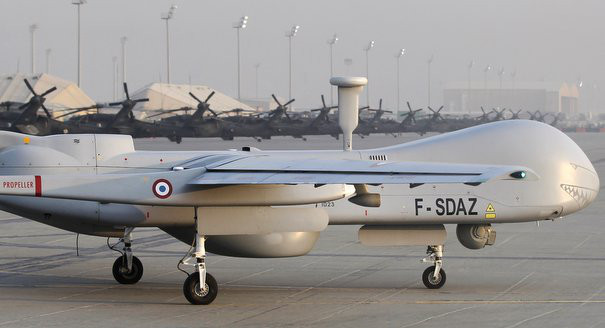
European leaders feel uneasy with the United States' frequent use of unmanned drones to target what it says are terrorism suspects, but many officials are reluctant to speak out about their doubts.
Source: New York Times

Only the online news edition of the German public television broadcaster ARD carried the story.
According to their reporter, Mr. de Maizière said he thought it was unwise to have U.S. commanders direct such attacks from their base in the United States.
Repeated requests to the reservists’ association for a full transcript of the speech went unanswered. Nor did the Defense Ministry publish the remarks.Mr. de Maizière is not the only politician in Europe to feel uneasy with the United States’ frequent use of unmanned drones to target what it says are terrorism suspects in Afghanistan, Pakistan and Yemen. But many are reluctant to speak out about their doubts. The German chancellor, Angela Merkel; the E.U. foreign policy chief, Catherine Ashton; and the new French president, François Hollande, are among the many officials unwilling to publicly criticize the practice of remote control, targeted killings.
Of course we should be asking questions about the use of the drones in the context of international law,” said Reinhard Bütikofer, a Greens party leader and German legislator in the European Parliament.
There is a kind of moral detachment from the issue because, in the case of Germany, we don’t have armed drones so the legal context is rarely questioned,” he added.
Even when several German nationals — accused of being militants who had undergone training in terrorist camps in Pakistan — were killed in a U.S. drone attack in Pakistan in 2010, the German government played down the incident.
In an official reply to queries by opposition parties in the German Parliament, the government said on nearly every count that either it had no reliable information or that the information it did have was confidential.
In contrast, the Obama administration has had to start explaining the issue of drone attacks as human rights organizations, security experts and the military have begun asking the White House to justify their legality. John O. Brennan, the president’s counterterrorism chief, gave a major speech on the issue in April. He said that the targeted attacks did not breach international law because the United States has been acting in self-defense since the terrorist attacks in New York and Washington on Sept. 11, 2001.
Mr. Brennan added that the White House was doing everything possible to balance security and transparency.
Legal experts say, however, that most of the targeted killings are carried out by the C.I.A. The agency is not subject to the same transparency or accountability as the military would be.
The laws of war do not prohibit intelligence agencies from taking part in combat operations,” said James Ross, legal adviser to Human Rights Watch. “But states are obligated to investigate credible allegations of war crimes and actually provide redress for victims of unlawful attacks, and that is difficult in the case of intelligence agencies.
Apart from the legal issues, the Obama administration has also been accused of leaking details from secret drone attacks to reap political mileage during the presidential election campaign.
Republicans sharply criticized the White House’s announcement last week that Al Qaeda’s deputy leader, Abu Yahya al-Libi, had been killed during a drone attack in Pakistan.
Analysts suggest that European governments prefer to turn a blind eye to the drone attacks because they see the Islamist militants targeted by the United States as a danger to Europe, too. Having this threat eliminated outweighs what qualms they may have about the method employed.
E.U. countries have their own interests in tacitly condoning these tactics,” said Nathalie Van Raemdonck, a guest researcher at the Istituto Affari Internazionali, an independent research center in Rome. “Since they are not involved in any such operations, they cannot be accused of playing any role in targeted killings. The Europeans are content with letting the U.S. do their dirty work.
European governments, however, are not united on this issue. Britain has armed drones in Afghanistan, and other European countries also employ them for surveillance purposes so the issue of targeted killings does not directly concern them. Government officials point to this to explain their silence.
Analysts say this approach is short-sighted. The United States intends to arm Italian surveillance drones in Afghanistan beginning next year. France has plans for military drones for reconnaissance and attack missions. NATO is trying to get member states to finance surveillance drones that eventually may also be armed.
Even more importantly, China, Russia and other non-Western countries are also working on developing armed drones.
This could lead to a free-for-all situation unless standards for the use of these weapons are agreed upon, legal experts say. It is time, said Mr. Bütikofer, the European Parliament lawmaker, for Europe to break its silence.
This article was originally published in the New York Times.

Nonresident Senior Fellow, Carnegie Europe
Judy Dempsey is a nonresident senior fellow at Carnegie Europe
Recent Work
Judy Dempsey
Judy Dempsey
Carnegie does not take institutional positions on public policy issues; the views represented herein are those of the author(s) and do not necessarily reflect the views of Carnegie, its staff, or its trustees.

The aftermath of the Ceuta crisis shows Europe has drawn the wrong lessons. Rather than doubling down on failed migration policies, the EU needs to address the underlying roots of such episodes.

Richard Youngs

An overwhelming victory by a far-right-wing party in a small state in eastern Germany will have major repercussions for Chancellor Friedrich Merz’s coalition.
Judy Dempsey

Canadian Prime Minister Mark Carney has twice inspired praise for standing up to U.S. President Donald Trump: at the 2026 World Economic Forum in Davos and on Canada-U.S. trade negotiations. Is Carney showing a third way better than the EU has in dealing with the Trump administration?

Rym Momtaz, ed.

The EU’s responses to two recent incidents expose the gulf between European perceptions and capabilities. Unless the union can bridge that gap, it will never become a real geostrategic power.
Rym Momtaz

European states control several Overseas Countries and Territories around the world that carry strategic, economic, and environmental weight. As great powers challenge the rules-based order, defending them is a geopolitical imperative for Europe.

Marc Pierini