

Commentary
Judy Dempsey
{
  "authors": [
    "Judy Dempsey"
  ],
  "type": "legacyinthemedia",
  "centerAffiliationAll": "",
  "centers": [
    "Carnegie Endowment for International Peace",
    "Carnegie Europe"
  ],
  "collections": [],
  "englishNewsletterAll": "",
  "nonEnglishNewsletterAll": "",
  "primaryCenter": "Carnegie Europe",
  "programAffiliation": "",
  "programs": [],
  "projects": [],
  "regions": [
    "Europe"
  ],
  "topics": [
    "Foreign Policy"
  ]
}
Source: Getty
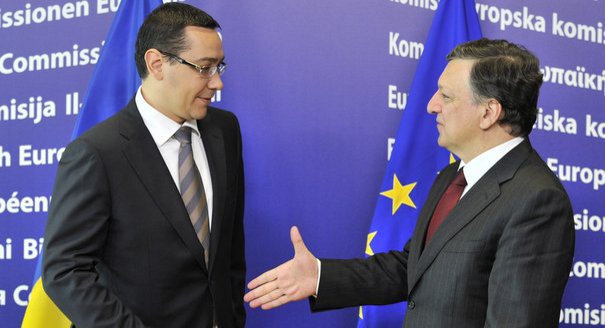
What can realistically be done to persuade the governments of Romania and Bulgaria to embrace long-term commitments to establishing the rule of law and fighting corruption?
Source: New York Times

But what can realistically be done to persuade the two governments to embrace long-term commitments to establishing the rule of law and fighting corruption?
As I explain in my latest Page Two column, Bulgaria and Romania were allowed to join the Union in 2007, though these problems were evident then — and reported by the E.U. — because of the belief that joining the Union would encourage the reformers while exclusion would hurt efforts to modernize the countries.But now the European Commission has a responsibility to act. It can do several things. It might withhold the special structural and development funds that amount to several hundred million euros. It has already delayed both countries’ access to the Schengen accord that would allow their citizens to cross most European Union borders without passports.
The ultimate sanction would be to suspend the voting rights of Bulgaria and Romania. In practice it would mean that neither country would be able to vote along with the other E.U. member states on issues that affect them.
It would, however, be extremely difficult for the member states to reach agreement on suspending voting rights.
But if the E.U. is true to its word about upholding democracy, the rule of law and human rights, then the option to suspend voting rights should be taken seriously.
Doing so would also send a signal to countries applying to join the bloc, such as Serbia, that the E.U. is not going to allow its strategy of enlargement to be tainted by corruption.
Indeed, if anything, say analysts, the unfinished transitions in Bulgaria and Romania point to the difficulties the E.U. will encounter when dealing with other Balkan candidate countries.

Nonresident Senior Fellow, Carnegie Europe
Judy Dempsey is a nonresident senior fellow at Carnegie Europe
Recent Work
Judy Dempsey
Judy Dempsey
Carnegie does not take institutional positions on public policy issues; the views represented herein are those of the author(s) and do not necessarily reflect the views of Carnegie, its staff, or its trustees.

Are Germany’s economic, industrial, and political struggles becoming a liability for the EU’s ability to rise to the geopolitical moment?

Rym Momtaz, ed.

European Commission President Ursula von der Leyen is about to give her annual address on the state of the EU. Here’s what she won’t—but should—say.
Rym Momtaz

Radical-right parties are expected to do well in upcoming elections in four of the EU's biggest member states. If successful, they could prevent the union from addressing key challenges ahead.

Stefan Lehne

The aftermath of the Ceuta crisis shows Europe has drawn the wrong lessons. Rather than doubling down on failed migration policies, the EU needs to address the underlying roots of such episodes.

Richard Youngs

An overwhelming victory by a far-right-wing party in a small state in eastern Germany will have major repercussions for Chancellor Friedrich Merz’s coalition.
Judy Dempsey