

Commentary
Yukon Huang, Isaac B. Kardon, Matt Sheehan
{
  "authors": [
    "Yukon Huang"
  ],
  "type": "legacyinthemedia",
  "centerAffiliationAll": "",
  "centers": [
    "Carnegie Endowment for International Peace",
    "Carnegie China"
  ],
  "collections": [
    "China’s Foreign Relations",
    "U.S.-China Relations"
  ],
  "englishNewsletterAll": "",
  "nonEnglishNewsletterAll": "",
  "primaryCenter": "Carnegie China",
  "programAffiliation": "",
  "programs": [],
  "projects": [],
  "regions": [
    "North America",
    "United States",
    "East Asia",
    "China"
  ],
  "topics": [
    "Economy",
    "Trade",
    "Foreign Policy"
  ]
}
Source: Getty
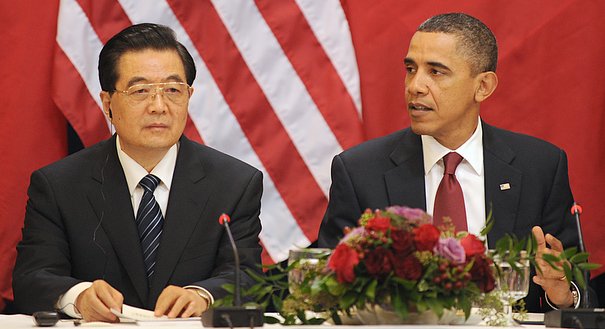
With global demand seemingly in free fall, will the United States and China turn to foreign direct investment as a possible cushion?
Source: Op-Eds/ Articles
With global demand seemingly in free fall, both the US and China see increased foreign direct investment as a possible cushion. But despite the US and China having the world’s largest bilateral trade flows, Foreign Direct Investment flows between the two are surprisingly negligible.
During the so-called US – China Strategic and Economic Dialogue, a meeting of respective honchos from both countries, the most heated discussions involve China complaining about US security restrictions on direct investment and America arguing that China is too fixated on promoting “indigenous innovation.” Differences in culture certainly play a role as well, but mismatched motivations in intentions pose an even greater challenge.
Contrary to popular belief, the US accounts for only a few percent of FDI into China. This is puzzling given the prominent role that such investments played in jumpstarting China’s economy, making it among the top two destinations globally, second only to the US. FDI from European countries also has been much higher than from the US, mirroring their stronger export presence in higher end machinery and consumer products compared with the US whose top two export lines are food grains and recycled waste products, which do not warrant supportive FDI.
American affiliates in China also played a surprisingly minor role in mediating the contentious export growth of Chinese-made but American-branded products. US companies have found that retailing is more profitable than production. Thus most of the high valued components are produced elsewhere and only assembled in China, and even then often by overseas firms such as Foxconn (Taiwanese) in the case of Apple. In areas where prominent US brands stand out—fast food and hotel chains—the major costs are on the books of local partners while US multinationals benefit from franchise fees.
These days, American firms entering China are primarily driven by the desire to tap a huge consumer market. But Beijing does not need more capital; it wants technology that is unavailable locally.
No wonder US FDI in China is so trivial.
And going the other direction, even though China’s outward direct investment only became significant recently, a mere 1 per cent so far has gone to the US. Can America create a more receptive climate for China’s inflows given the hostility experienced by Japan decades ago when it was already a US ally?
Chinese companies seeking opportunities abroad are now primarily motivated by the search for resources with showcase examples in Africa and Latin America and a notable victim of politics being Cnooc’s pursuit of Unocal in the United States. That failure contrasts with the Cnooc’s attempted $15bn acquisition of Nexen’s oil and gas assets, which if approved by the Canadian Government could represent a landmark shift in how Canada views the US and China.
Collaboration on clean energy technologies offers such an opportunity. China’s rise to dominance in the manufacturing of solar energy equipment and wind turbines reflects its push to make clean energy a growth industry. Combining state support with acquired technical advances, the resulting scale economies have reduced energy costs to a fraction of what they were only recently.
From the US perspective, however, China’s emergence is yet another example of not playing by the rules. Public attention is dominated by the anti-subsidy cases filed against China by a small group of US clean energy manufacturers even though they run counter to the wishes of the larger numbers involved in distribution.
The politically charged scrutiny of bankrupt Solyndra’s access to US loan guarantees confirms that the clean energy business is risky. But given the environmental and energy security benefits, most countries provide subsidies. Without the technical improvements and volumes to lower costs, commercially viable approaches will remain unrealised. As the two biggest carbon emitters globally, the US and China have the most to gain.
Beneath all the sparring, however, investors from both countries are starting to make deals. China concentrates in relatively low margin hardware and assembly while American firms focus on niche, higher valued-added upstream production or more profitable downstream installation. Rising labour costs in China combined with the benefits of proximity to technology centers and more sophisticated markets are starting to generate proposals to produce more in the US. This provides an option similar to the relocation of Japanese auto plants to the US which helped to ameliorate tensions.
With US funding for clean energy drying up and pressures to develop lower cost approaches mounting, both sides should channel their political capital into encouraging mutually beneficial arrangements rather than entering into protectionist battles.
This article was originally published in Financial Times.

Senior Fellow, Asia Program
Huang is a senior fellow in the Carnegie Asia Program where his research focuses on China’s economy and its regional and global impact.
Recent Work


Yukon Huang, Isaac B. Kardon, Matt Sheehan
Yukon Huang, Genevieve Slosberg
Carnegie does not take institutional positions on public policy issues; the views represented herein are those of the author(s) and do not necessarily reflect the views of Carnegie, its staff, or its trustees.

European Commission President Ursula von der Leyen is about to give her annual address on the state of the EU. Here’s what she won’t—but should—say.

Rym Momtaz

Radical-right parties are expected to do well in upcoming elections in four of the EU's biggest member states. If successful, they could prevent the union from addressing key challenges ahead.

Stefan Lehne

The aftermath of the Ceuta crisis shows Europe has drawn the wrong lessons. Rather than doubling down on failed migration policies, the EU needs to address the underlying roots of such episodes.

Richard Youngs

Canadian Prime Minister Mark Carney has twice inspired praise for standing up to U.S. President Donald Trump: at the 2026 World Economic Forum in Davos and on Canada-U.S. trade negotiations. Is Carney showing a third way better than the EU has in dealing with the Trump administration?
Rym Momtaz, ed.

The EU’s responses to two recent incidents expose the gulf between European perceptions and capabilities. Unless the union can bridge that gap, it will never become a real geostrategic power.
Rym Momtaz