

• Research
  • Strategic Europe
  • About
  • Experts
Carnegie Europe logoCarnegie lettermark logo
EUUkraine
  • Donate
{
  "authors": [
    "Nathan J. Brown",
    "Mokhtar Awad"
  ],
  "type": "legacyinthemedia",
  "centerAffiliationAll": "dc",
  "centers": [
    "Carnegie Endowment for International Peace",
    "Malcolm H. Kerr Carnegie Middle East Center"
  ],
  "collections": [
    "Arab Awakening"
  ],
  "englishNewsletterAll": "menaTransitions",
  "nonEnglishNewsletterAll": "",
  "primaryCenter": "Carnegie Endowment for International Peace",
  "programAffiliation": "MEP",
  "programs": [
    "Middle East"
  ],
  "projects": [],
  "regions": [
    "North Africa",
    "Egypt"
  ],
  "topics": [
    "Political Reform"
  ]
}

Source: Getty

In The Media

Violent Protests, Judge Shortages Plague Egypt's Referendum

Rallies and protests centered on Egypt's constitutional referendum turned violent as the struggle for the political future of Egypt continues.

Link Copied
By Nathan J. Brown and Mokhtar Awad
Published on Dec 14, 2012

Source: NewsHour

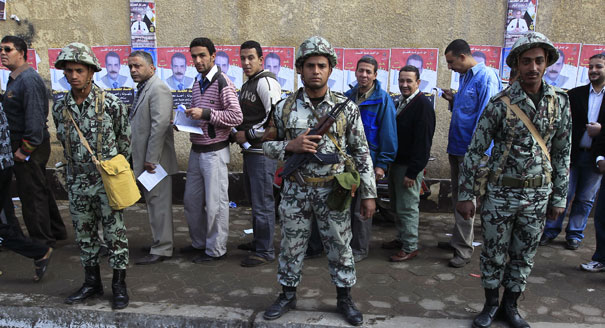
Rallies for and against Egyptian President Mohammed Morsi got violent in Alexandria Friday on the eve of a referendum on a constitution drafted mainly by his Muslim Brotherhood party.

The voting was split into two rounds -- this Saturday and Dec. 22 -- to ensure enough judges would be available to supervise polling sites after many decided to go on strike.

Nathan Brown, professor of political science and international affairs at George Washington University, and Mokhtar Awad, junior fellow at the Carnegie Endowment for International Peace, discussed the discontent in Egypt. They answered the following questions in a joint email:

What is it about the constitution that the opposition doesn't like?

Their original complaints were about the process -- that it was written by an assembly that was dominated by Islamists. They have other procedural complaints as well -- the speed of the drafting and the short time between the drafting and the referendum. They are beginning to develop criticism of the content as well-they say the draft is too presidential, offers weak protections for basic rights, and enshrines conservative religious principles in law. These criticisms have some foundation, though some are exaggerated.

Why did they decide to urge a "no" vote rather than a boycott?

This was a big topic of debate. They have been pressured by some to come up with a positive agenda rather than just a negative one; they may also be drawing back from seeming to want to delegitimate the entire system. They hope that a narrow win will but enough pressure on Morsi domestically and internationally that it will stop emerging authoritarian tendencies. They also may hope to get practice for parliamentary elections that follow in two months should the constitution be approved.

In general, why has each step been problematic in Egypt?

The process was badly designed at the beginning with the military taking full control over the process and mismanaging it rather than setting up a consensual transition leadership. Egypt has been run by a series of constitutional declarations since the suspension of the 1971 constitution, the first of which was a 63 article constitutional declaration issued on March 30, 2011 to govern the provisional period-it mostly included articles from the 1971 constitution, including articles amended by the March 19, 2011 referendum. The March 30, 2011 constitutional declaration was a complicated and problematic document and helped set the stage for an opaque and legally confusing transitional period.

This article originally appeared on PBS' NewsHour.

About the Authors

Nathan J. Brown

Nonresident Senior Fellow, Middle East Program

Nathan J. Brown, a professor of political science and international affairs at George Washington University, is a distinguished scholar and author of nine books on Arab politics and governance, as well as editor of five books.

Mokhtar Awad

Former Junior Fellow, Middle East Program

Authors

Nathan J. Brown
Nonresident Senior Fellow, Middle East Program
Nathan J. Brown
Mokhtar Awad
Former Junior Fellow, Middle East Program
Political ReformNorth AfricaEgypt

Carnegie does not take institutional positions on public policy issues; the views represented herein are those of the author(s) and do not necessarily reflect the views of Carnegie, its staff, or its trustees.

More Work from Carnegie Europe

  • Commentary
    Strategic Europe
    The EU Needs a Third Way in Iran

    European reactions to the war in Iran have lost sight of wider political dynamics. The EU must position itself for the next phase of the crisis without giving up on its principles.

      Richard Youngs

  • Commentary
    Strategic Europe
    Can Europe Still Matter in Syria?

    Europe’s interests in Syria extend beyond migration management, yet the EU trails behind other players in the country’s post-Assad reconstruction. To boost its influence in Damascus, the union must upgrade its commitment to ensuring regional stability.

      Bianka Speidl, Hanga Horváth-Sántha

  • Commentary
    Strategic Europe
    Europolis, Where Europe Ends

    A prophetic Romanian novel about a town at the mouth of the Danube carries a warning: Europe decays when it stops looking outward. In a world of increasing insularity, the EU should heed its warning.

      Thomas de Waal

  • Commentary
    Strategic Europe
    Taking the Pulse: What Issue Is Europe Ignoring at Its Peril in 2026?

    2026 has started in crisis, as the actions of unpredictable leaders shape an increasingly volatile global environment. To shift from crisis response to strategic foresight, what under-the-radar issues should the EU prepare for in the coming year?

      Thomas de Waal

  • Commentary
    Can Europe and Africa Mend Fences?

    Despite the strategic importance of relations between the EU and the African Union, deep divisions remain between the blocs. At their upcoming summit, both partners should strive to build a mutually beneficial cooperation.

      Marta Martinelli

Get more news and analysis from
Carnegie Europe
Carnegie Europe logo, white
Rue du Congrès, 151000 Brussels, Belgium
  • Research
  • Strategic Europe
  • About
  • Experts
  • Projects
  • Events
  • Contact
  • Careers
  • Privacy
  • For Media
  • Gender Equality Plan
Get more news and analysis from
Carnegie Europe
© 2026 Carnegie Endowment for International Peace. All rights reserved.