

Q&A
Suzanne Maloney, Aaron David Miller, Karim Sadjadpour
{
  "authors": [
    "Karim Sadjadpour"
  ],
  "type": "legacyinthemedia",
  "centerAffiliationAll": "dc",
  "centers": [
    "Carnegie Endowment for International Peace",
    "Malcolm H. Kerr Carnegie Middle East Center"
  ],
  "collections": [
    "Iranian Proliferation"
  ],
  "englishNewsletterAll": "menaTransitions",
  "nonEnglishNewsletterAll": "",
  "primaryCenter": "Carnegie Endowment for International Peace",
  "programAffiliation": "MEP",
  "programs": [
    "Middle East"
  ],
  "projects": [],
  "regions": [
    "Middle East",
    "Iran",
    "Gulf"
  ],
  "topics": [
    "Political Reform",
    "Foreign Policy",
    "Nuclear Policy"
  ]
}
Source: Getty
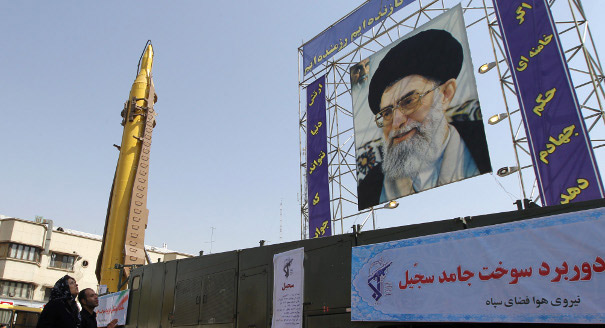
Despite the increasing economic pressure induced by Western sanctions, Ayatollah Khamenei has demonstrated little willingness to engage in substantive negotiations regarding the Iranian nuclear program.
Source: PBS NewsHour
JEFFREY BROWN: For more, I'm joined by Karim Sadjadpour, a senior associate in the Middle East Program at the Carnegie Endowment for International Peace.
Welcome back.
KARIM SADJADPOUR, Carnegie Endowment for International Peace: Thanks for having me.
JEFFREY BROWN: Were those -- are these mixed signals from Iran, or is it pretty clear today?
KARIM SADJADPOUR: Well, I think the perennial challenge we have had in our dealing with Iran is that those Iranians who want to talk to American can't deliver and those Iranians who can deliver don't want to talk to America.And the person who needs to deliver in this case is the supreme leader, Ali Khamenei. And he's been someone who has been incredibly consistent for the last 24 years, since he became supreme leader.
JEFFREY BROWN: He's been consistent, you're saying?
KARIM SADJADPOUR: Incredibly consistent, on almost a weekly basis since 1989 expressing his contempt and mistrust for the United States.
JEFFREY BROWN: What about the overture by Joe Biden? Surprise or a feeler? How much do we know about the U.S. attempt here?
KARIM SADJADPOUR: Well, this Obama administration between President Obama, Joe Biden, Secretary of State John Kerry, potential Secretary of Defense Chuck Hagel, I would argue, is the most pro-Iran engagement U.S. national security Cabinet since the 1979 revolution.
This is an administration which desperately does want to do a deal with Iran to defuse the nuclear issue and to gradually reduce our footprint in the Middle East. They certainly don't want to the go to war. And I'm not sure if Ayatollah Khamenei understands that this is going to be the best deal he's going to get from the United States.
JEFFREY BROWN: Well, the demands of the U.S. and others seems fairly clear and the push for further sanctions goes on. We will go into that in a minute.
The Iranians say they want the sanctions lifted first. So have you heard anything that suggests it's a sort of vicious cycle in that regard?
KARIM SADJADPOUR: This has also been a perennial challenge that -- the synchronizing negotiations, who takes the first step, who makes the first overture, but it's not within the realm of possibilities that the U.S. Congress or President Obama is going to remove sanctions before the negotiations start.
And I do see the two sides still being quite far away before any resolution can be reached.
JEFFREY BROWN: You do? You don't see any particular way around it at the moment?
KARIM SADJADPOUR: The way I look at these negotiations is that the best-case scenario is that we have another round of negotiations, and I see these -- talking with ...
JEFFREY BROWN: You mean the multilateral negotiations?
KARIM SADJADPOUR: Exactly.
I mean, the utility I see of talking to Iran isn't to resolve our differences. I think that's unlikely. But it's to prevent what is now a cold war from deteriorating into a hot war.
JEFFREY BROWN: Now, tell us more about the new sanctions that were announced yesterday. What are they aimed at?
KARIM SADJADPOUR: Well, Iran is facing unprecedented sanctions, both in terms of its depth and its breadth, meaning you have Central Bank sanctions, U.S. central -- sanctions against Iran's Central Bank. And you have remarkable multilateral buy-in.
Europeans have stopped buying Iranian oil. Countries like Japan, China, India that were once big traders with Iran have had reduced economic contacts. And the sanctions which were implemented yesterday, what has happened is that Iran has had a much more difficult time producing and exporting oil. And oil is 80 percent of its export revenue.
The sanctions which took effect yesterday make it much more difficult for Iran to get paid for the oil it does export. So over the last several years, their oil revenue has dropped more than 50 percent. Inflation has skyrocketed. Their currency has tail spinned.
But we still haven't seen that economic malaise have an impact on the supreme leader's nuclear calculations.
JEFFREY BROWN: Well, that's the next question, of course, is, what can be said about the impact that the sanctions are having at this point?
KARIM SADJADPOUR: The sanctions certainly have had an adverse effect on the population. People are having difficulty getting access to medicine. The quality of life for most people has dropped precipitously.
But, again, the intent of sanctions is to try to subject Iran to enough pressure, so the leader will feel what I would describe as existential angst that either he has to do a nuclear deal or the regime itself could be in peril.
And there's no signs that he's feeling that. Now, the challenge also with Ayatollah Khamenei is that he's a man who hasn't left the country since 1989. He's surrounded himself with these sycophants who don't necessarily give him full information. So it's unclear whether he will appreciate the full magnitude of the situation he's in.
And this, by the way, isn't necessarily unique to Khamenei. I think being a dictator is a very lonely vocation. And that's why oftentimes, dictatorships don't bend. They end up breaking.
JEFFREY BROWN: All right, Karim Sadjadpour, thanks for the update.
KARIM SADJADPOUR: Thanks Jeff.

Senior Fellow, Middle East Program
Karim Sadjadpour is a senior fellow at the Carnegie Endowment for International Peace, where he focuses on Iran and U.S. foreign policy toward the Middle East.
Recent Work


Suzanne Maloney, Aaron David Miller, Karim Sadjadpour

Aaron David Miller, Karim Sadjadpour, Robin Wright
Carnegie does not take institutional positions on public policy issues; the views represented herein are those of the author(s) and do not necessarily reflect the views of Carnegie, its staff, or its trustees.

Canadian Prime Minister Mark Carney has twice inspired praise for standing up to U.S. President Donald Trump: at the 2026 World Economic Forum in Davos and on Canada-U.S. trade negotiations. Is Carney showing a third way better than the EU has in dealing with the Trump administration?

Rym Momtaz, ed.

The EU’s responses to two recent incidents expose the gulf between European perceptions and capabilities. Unless the union can bridge that gap, it will never become a real geostrategic power.
Rym Momtaz

European states control several Overseas Countries and Territories around the world that carry strategic, economic, and environmental weight. As great powers challenge the rules-based order, defending them is a geopolitical imperative for Europe.

Marc Pierini

As we close out another season of Strategic Europe, it is worth taking stock of the deep shifts underway.
Rym Momtaz
The EU had to compromise to adopt a twenty-first sanctions package against Russia, exposing growing cracks in the union’s resolve. Is this latest, weaker round worth it to keep pressure on Moscow?
Rym Momtaz, ed.