

Q&A
Matt Ferchen
{
  "authors": [
    "Matt Ferchen"
  ],
  "type": "legacyinthemedia",
  "centerAffiliationAll": "",
  "centers": [
    "Carnegie Endowment for International Peace",
    "Carnegie China"
  ],
  "collections": [
    "China and the Developing World",
    "China’s Foreign Relations"
  ],
  "englishNewsletterAll": "",
  "nonEnglishNewsletterAll": "",
  "primaryCenter": "Carnegie China",
  "programAffiliation": "",
  "programs": [],
  "projects": [],
  "regions": [
    "North America",
    "South America",
    "East Asia",
    "China"
  ],
  "topics": [
    "Economy"
  ]
}
Source: Getty
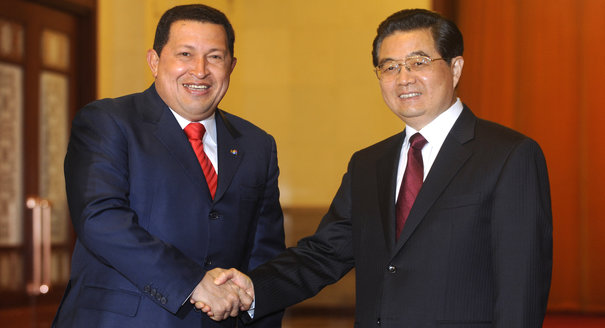
After a decade-long partnership, Hugo Chávez’s withdrawal from Venezuelan politics has led many to question what the future may hold for Chinese investments and companies in the country.
Source: Latin America Advisor
Inter-American Dialogue: India’s Reliance Industries is reportedly still considering investments totaling more than $2 billion in Venezuela’s oil industry, despite uncertainty about the future of President Hugo Chávez’s leadership. Private investors have driven up demand for PDVSA bonds on the bet that the sector will open up, while some of Venezuela’s allies, including China, are withholding additional funding until the political situation becomes clear. What does Chávez’s absence mean for the country’s oil sector? If Chávez steps down, how would that affect energy relations with China and other state partners? Is China too heavily invested in the country? Are there bright spots for private companies and investors?
Matt Ferchen: Venezuela, China faces its first major crisis management test in over a decade of booming ties with Latin America. China’s unprecedented build-up of oil-related finance and investment in Venezuela has overlapped with Hugo Chávez’s rise to almost complete domination of Venezuelan politics and economics. Chávez was eager to have China as a “socialist” ally, including as an alternative source of oil demand so that Venezuela could diversify exports away from reliance on the United States. The Chinese government has been reluctant to cooperate with Chávez’s anti-American rhetoric, but its state-owned banks, oil companies and construction firms have more than compensated for cautious diplomacy with bold, some might say reckless, financial initiatives in Venezuela. Now that Chávez’s treatment for cancer in Cuba has thrown Venezuelan politics into a slow-motion crisis, China and its firms face tough economic and diplomatic challenges. On the economic front, while the China Development Bank claims that its nearly $40 billion in loans are insulated from Venezuelan political risk, such public confidence obscures a much deeper anxiety about how a post-Chávez government will treat Chinese banks, oil firms and other companies. Ultimately, through its state-owned firms’ behavior, China has come to be seen by many inside and outside of Venezuela as an ally of Chávez and this leaves China economically and diplomatically exposed to the vicissitudes of post-Chávez politics. A post-Chávez government will almost certainly seek to alter some elements of the political and economic relationship with China. However, it is instability—the not knowing what will come after Chávez—that is the deepest cause of anxiety for Chinese officials and firms. Having aligned themselves with the absolute leader of Venezuela, China’s crisis management skills will be tested by a potentially leaderless Venezuela.

Former Nonresident Scholar, Carnegie-Tsinghua Center for Global Policy
Ferchen specializes in China’s political-economic relations with emerging economies. At the Carnegie–Tsinghua Center for Global Policy, he ran a program on China’s economic and political relations with the developing world, including Latin America.
Recent Work
Matt Ferchen
Matt Ferchen, Anarkalee Perera
Carnegie does not take institutional positions on public policy issues; the views represented herein are those of the author(s) and do not necessarily reflect the views of Carnegie, its staff, or its trustees.

As geopolitical rivalry weaponizes global supply chains, the EU’s true vulnerability lies in emerging-risk imports. For these goods, suppliers are growing more concentrated, substitution more difficult, and political risk is looming.

Sinan Ülgen
The EU is putting together a new security strategy to meet today’s myriad challenges. But for any proposal to be effective, the union needs to grapple with its identity and ambitions.

Pierre Vimont
Amid uncertainty caused by the Iran war, the global drive for nonproliferation has stalled. With Europe diplomatically marginalized and countries reassessing their nuclear options, efforts to curb the spread of nuclear weapons risk becoming irrelevant.

Jane Darby Menton
Between the United States’ market-driven approach and China's state-led industrial strategy, Europe is reckoning with how it can remain competitive in the global economy. But is Europe in danger of becoming a U.S. or China colony?
Noah Barkin, Anu Bradford
The U.S.-sponsored TRIPP deal is driving the Armenia-Azerbaijan peace process forward. But foreign and domestic hurdles remain before connectivity and economic interdependence can open up the South Caucasus.


Thomas de Waal, Areg Kochinyan, Zaur Shiriyev