

Research
- +10
Rosa Balfour, Frances Z. Brown, Yasmine Farouk, …
{
  "authors": [
    "Moisés Naím"
  ],
  "type": "legacyinthemedia",
  "centerAffiliationAll": "",
  "centers": [
    "Carnegie Endowment for International Peace"
  ],
  "collections": [],
  "englishNewsletterAll": "",
  "nonEnglishNewsletterAll": "",
  "primaryCenter": "Carnegie Endowment for International Peace",
  "programAffiliation": "",
  "programs": [],
  "projects": [],
  "regions": [
    "North America",
    "South America",
    "Southern, Eastern, and Western Africa",
    "South Asia",
    "India",
    "East Asia",
    "China",
    "Russia"
  ],
  "topics": [
    "Economy",
    "Global Governance"
  ]
}
Source: Getty
Power has become more fleeting and transient, with a number of different kinds of constraints limiting the abilities of those in power, whether countries, corporations, churches, or armies.
Source: BBC World News America
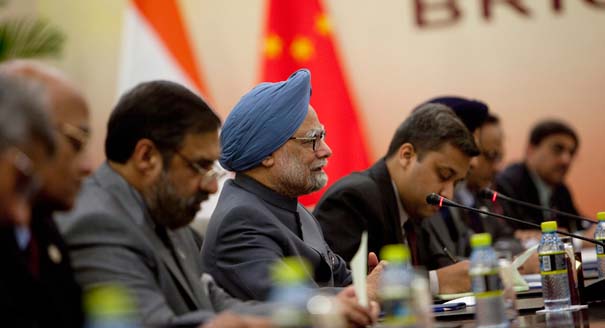
Speaking on BBC World News America, Carnegie's Moisés Naím discussed the implications of how power has recently become more dispersed and thus more difficult to use. With new competitors entering the arena, there is an underlying threat to the significance and power of existing actors. In his new book, The End of Power, Naím explains that power is easier to get, harder to wield, and faster to lose. Power has become more fleeting and transient, with a number of different kinds of constraints limiting the abilities of those in power, whether countries, corporations, churches, or armies, Naím said. The BRICS-- Brazil, Russia, India, China, and South Africa-- are an example of how new countries are challenging the traditional power structure. These five large, fast-growing economies share great economic performance, yet they face the same corrosion of power that the big powers, such as the United States and Europe, have also experienced, said Naím.
This interview was originally broadcast on BBC World News America.

Distinguished Fellow
Moisés Naím is a distinguished fellow at the Carnegie Endowment for International Peace, a best-selling author, and an internationally syndicated columnist.
Recent Work



Rosa Balfour, Frances Z. Brown, Yasmine Farouk, …
Moisés Naím
Carnegie does not take institutional positions on public policy issues; the views represented herein are those of the author(s) and do not necessarily reflect the views of Carnegie, its staff, or its trustees.

The EU’s responses to two recent incidents expose the gulf between European perceptions and capabilities. Unless the union can bridge that gap, it will never become a real geostrategic power.

Rym Momtaz

European states control several Overseas Countries and Territories around the world that carry strategic, economic, and environmental weight. As great powers challenge the rules-based order, defending them is a geopolitical imperative for Europe.

Marc Pierini

In supporting Europe’s far-right, MAGA and Russia both want the same thing: a weaker EU. Europe must defend itself without abandoning the openness these forces exploit.

Armida van Rij

As we close out another season of Strategic Europe, it is worth taking stock of the deep shifts underway.
Rym Momtaz

The hybrid warfare landscape is evolving rapidly, leaving policymakers without clear strategies. To better inform their work in addressing emerging challenges, governments must dig deeper into the underlying dynamics at play.


Raluca Csernatoni, Alicia Wanless