

Commentary
Judy Dempsey
{
  "authors": [
    "Judy Dempsey"
  ],
  "type": "legacyinthemedia",
  "centerAffiliationAll": "dc",
  "centers": [
    "Carnegie Endowment for International Peace",
    "Carnegie Europe",
    "Carnegie Russia Eurasia Center"
  ],
  "collections": [
    "Europe’s Eastern Neighborhood"
  ],
  "englishNewsletterAll": "ctw",
  "nonEnglishNewsletterAll": "",
  "primaryCenter": "Carnegie Europe",
  "programAffiliation": "russia",
  "programs": [
    "Russia and Eurasia"
  ],
  "projects": [
    "Eurasia in Transition"
  ],
  "regions": [
    "Asia",
    "Russia",
    "South Asia",
    "Afghanistan",
    "Central Asia"
  ],
  "topics": [
    "Security"
  ]
}
Source: Getty
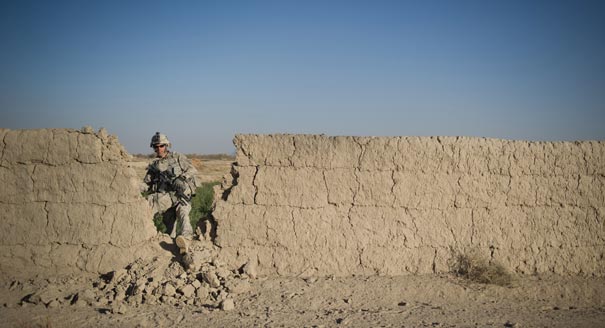
Russia has no intentions of getting involved again in Afghanistan. Yet Central Asian republics now fear instability on their borders as NATO’s 100,000-strong presence ends.
Source: New York Times
As the United States winds down its combat mission in Afghanistan, Russia is looking on, not with Schadenfreude but with extreme concern.
Russia knows what it is like to leave a country that it could not bend to its political will.
When Soviet troops invaded Afghanistan in 1979, the Kremlin had no inkling about how long, costly and unpopular this war would turn out to be.
By the time Soviet leader Mikhail Gorbachev decided to end the occupation in 1989, over 15,000 Soviet troops and over one million Afghans had died in the fighting.Now it is President Barack Obama’s turn to bring home the remaining 68,000 troops by the end of 2014, the subject of my latest Letter from Europe.
Mr. Obama made clear in his State of the Union address that “America’s commitment to a unified and sovereign Afghanistan will endure, but the nature of our commitment will change.”
The American presence will be very small, perhaps not more than 10,000 troops. And that is what worries Russia.
Russia has no intentions of getting involved again in Afghanistan. Yet the Central Asian republics, especially Uzbekistan, now fear instability on their borders as NATO’s 100,000-strong presence ends.
“The rulers of the former Soviet republics neighboring on Afghanistan are really scared,” wrote Mikhail Rostovsky in a fascinating short analysis in Moskovsky Komsomolets, a Russian daily newspaper. “They want Russia to be beside them and hold their hands at the crucial movement.” They also want Russia to be more actively involved in Afghan affairs.
That is the last thing Russia wants. It is in no position to end the drug trade, the insurgency and the corruption, which NATO could not stop. It has no intention of putting its own footprint on the country again.
With the security vacuum left by NATO’s withdrawal, Russia’s only hope, whether naïve or not, is a new and more stable Afghan government.
“The best that can be hoped for is the emergence of a new regime in Kabul, less committed to universal values but on the other hand, more firmly standing on its own feet,” Mr. Rostovsky wrote. What an irony of history that NATO now must be wishing the same.
This article was originally published in the New York Times.

Nonresident Senior Fellow, Carnegie Europe
Judy Dempsey is a nonresident senior fellow at Carnegie Europe
Recent Work
Judy Dempsey
Judy Dempsey
Carnegie does not take institutional positions on public policy issues; the views represented herein are those of the author(s) and do not necessarily reflect the views of Carnegie, its staff, or its trustees.

Europe is facing rising populism internally as well as external pressures from Russia, China, Turkey, and the United States.

Dimitar Bechev

The new U.S.–Denmark–Greenland agreement will help Washington exert political, economic, and financial dominance under the guise of security. Yet, it acknowledged Copenhagen’s and Nuuk’s sovereignty on the island.

Marc Pierini

A summer of escalation in the Black Sea has hurt Ukraine economically and is exacerbating world food security. A truce is needed—as is a broader reframing of Europe’s Ukraine strategy.

Thomas de Waal

Are Germany’s economic, industrial, and political struggles becoming a liability for the EU’s ability to rise to the geopolitical moment?

Rym Momtaz, ed.

European Commission President Ursula von der Leyen is about to give her annual address on the state of the EU. Here’s what she won’t—but should—say.
Rym Momtaz