

Article
C. Raja Mohan, Darshana M. Baruah
{
  "authors": [
    "C. Raja Mohan"
  ],
  "type": "legacyinthemedia",
  "centerAffiliationAll": "dc",
  "centers": [
    "Carnegie Endowment for International Peace",
    "Carnegie India"
  ],
  "collections": [],
  "englishNewsletterAll": "ctw",
  "nonEnglishNewsletterAll": "",
  "primaryCenter": "Carnegie India",
  "programAffiliation": "SAP",
  "programs": [
    "South Asia"
  ],
  "projects": [],
  "regions": [
    "South Asia",
    "Afghanistan",
    "Pakistan"
  ],
  "topics": [
    "Security",
    "Military",
    "Foreign Policy"
  ]
}
Source: Getty
The West must recognize that there are reasons that the Pakistani military doesn’t want a stable Afghanistan.
Source: Indian Express
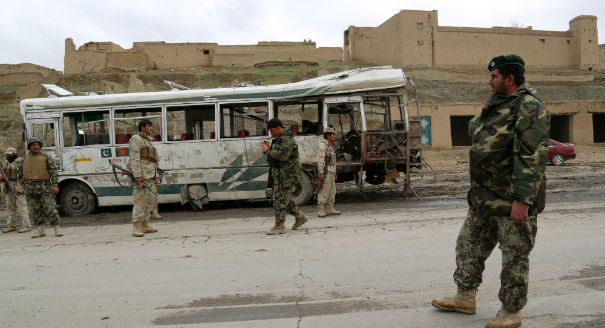
The war of words between Kabul and Rawalpindi that began a few weeks ago has escalated into a shooting match on the ground. After the Taliban overran an Afghan border post by killing 13 soldiers over the weekend, Kabul charged that Pakistan has facilitated the bold attack.
General Zahir Azimi, spokesman for the ministry of defense in Kabul, said the Taliban fighters used artillery and other heavy weapons not seen during previous attacks in the region. He added the attackers were heard speaking Urdu, rather than the Pashto normally spoken by Taliban militants.The Afghan allegation has not been confirmed by the International Security Assistance Force (ISAF) in Afghanistan, which is yet to evaluate the evidence from the incident. But those familiar with the Taliban's military victory over it rivals during 1996-97 will not be surprised. They would recall the active support of Pakistani military advisers in helping the Taliban win that war.
The Afghan unit that was wiped out in the daring assault by the Taliban is part of the Third Battalion of the Second Brigade, "one of only a handful of Afghan army battalions rated by the United States military as independent and able to operate on its own without foreign advisers," the New York Times reports.
The attack comes as the fighting season begins in Afghanistan and the international forces hand over the security responsibility to the Afghan National Army. Just days before the attack last Friday, the U.S. media was reporting how confident the Third Battalion is about coping with the insurgency based on Pakistani soil.
In targeting this particular battalion, the Taliban aim is to demoralize the Afghan troops as the international forces begin to withdraw. It also signals the determination of the Taliban, backed by Pakistan, to step up the military offensive in Afghanistan.
The disputed Durand Line that separates Afghanistan and Pakistan is back in view this week, when Karzai on Sunday ordered his security forces to dismantle what he called an illegal construction of a border gate and other military installations inside Afghan territory by Pakistan.
Pakistan views the Durand Line drawn in 1893 by the British Raj as the legitimate international boundary with Afghanistan. But no government in Kabul since the partition of the subcontinent has been willing to recognize the legitimacy of this line drawn arbitrarily through the Pashtun heartland.
Karzai's angry statement followed a meeting of the Afghan National Security Council on Sunday. Karzai also sought clarification from the ISAF on whether it assisted Pakistan in building the facilities. Karzai's accusation was followed by protests in Jalalabad by university students against Pakistan. By late Monday, however, Pakistan put out the word that the dispute has been resolved "amicably." An official statement from Rawalpindi said an Afghan delegation led by Director General Military Operations Major General Afzal Aman had discussed and amicably resolved the issues with his Pakistani counterpart.
The rapid build-up of the crisis and its apparently quick resolution underline the complex dynamic shaping the relationship between Kabul and Rawalpindi at a time when the Pashtun regions across the Durand Line are aflame.
The latest developments underline the incredulity of the recent Western hype about Pakistan's change of heart towards Afghanistan and Rawalpindi's commitment to facilitate a political reconciliation with the Taliban.
Earlier this year, British Prime Minister David Cameron organized a meeting between Karzai and Pakistani President Asif Ali Zardari at his country home outside London. Under British nudging, the two sides declared that a framework for peace settlement will be negotiated within six months. That statement was never credible given the fundamental contradiction between the interests of the Pakistan army and those of Karzai.
That Pakistan wants to undermine the Karzai regime and restore the Taliban to power is not surprising. After all, the Pakistan army helped create the Taliban, protected it during the dark days that followed 9/11, and launched it again as a credible force a few years ago.
If Pakistan's approach to the Taliban has been consistent, what is tragic is the West's willingness to suspend disbelief and bet that the Pakistan army will be a force for good in Afghanistan.
Former Nonresident Senior Fellow, Carnegie India
A leading analyst of India’s foreign policy, Mohan is also an expert on South Asian security, great-power relations in Asia, and arms control.
Recent Work

C. Raja Mohan, Darshana M. Baruah


Alexander Gabuev, Paul Haenle, C. Raja Mohan, …
Carnegie does not take institutional positions on public policy issues; the views represented herein are those of the author(s) and do not necessarily reflect the views of Carnegie, its staff, or its trustees.

A summer of escalation in the Black Sea has hurt Ukraine economically and is exacerbating world food security. A truce is needed—as is a broader reframing of Europe’s Ukraine strategy.

Thomas de Waal

Are Germany’s economic, industrial, and political struggles becoming a liability for the EU’s ability to rise to the geopolitical moment?

Rym Momtaz, ed.

European Commission President Ursula von der Leyen is about to give her annual address on the state of the EU. Here’s what she won’t—but should—say.
Rym Momtaz

The aftermath of the Ceuta crisis shows Europe has drawn the wrong lessons. Rather than doubling down on failed migration policies, the EU needs to address the underlying roots of such episodes.

Richard Youngs

Canadian Prime Minister Mark Carney has twice inspired praise for standing up to U.S. President Donald Trump: at the 2026 World Economic Forum in Davos and on Canada-U.S. trade negotiations. Is Carney showing a third way better than the EU has in dealing with the Trump administration?
Rym Momtaz, ed.