

Commentary
The EU can impose sanctions but struggles to enforce them without the United States. With Washington increasingly disinterested in backing European interests, the bloc must now fend for itself.
Nicu Popescu, Tiago Antunes
{
  "authors": [
    "Thomas Carothers",
    "Diane de Gramont"
  ],
  "type": "legacyinthemedia",
  "centerAffiliationAll": "dc",
  "centers": [
    "Carnegie Endowment for International Peace",
    "Carnegie China"
  ],
  "collections": [
    "China and the Developing World",
    "Democracy and Governance"
  ],
  "englishNewsletterAll": "democracy",
  "nonEnglishNewsletterAll": "",
  "primaryCenter": "Carnegie Endowment for International Peace",
  "programAffiliation": "DCG",
  "programs": [
    "Democracy, Conflict, and Governance"
  ],
  "projects": [],
  "regions": [],
  "topics": [
    "Democracy",
    "Foreign Policy",
    "Security"
  ]
}
Source: Getty
Development aid is inherently political, but that’s not necessarily a bad thing.
Source: Foreign Policy
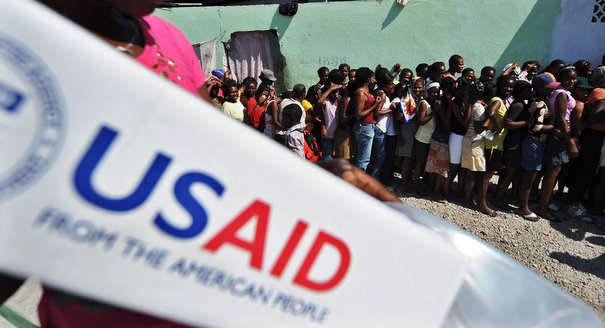
In a fiery May Day speech in La Paz, Bolivian president Evo Morales announced that he was expelling the United States Agency for International Development (USAID), accusing it of conspiring against his government. He did this despite the fact that USAID shut down its democracy and governance programs in the country several years ago in response to Bolivian government objections. The Americans then pledged to work only in apparently uncontroversial areas like health and environmental conservation.
Bolivia's decision to end U.S. assistance to the country after nearly 50 years of USAID presence reflects the ideological tensions between Bolivia's first-ever indigenous-led government and Washington. But Morales isn't the only one targeting aid providers. Last September, Russia asked USAID to leave, making similar accusations of political interference. Earlier that year, the Egyptian government charged a group of Americans, Egyptians, and other employees of five Western democracy and rights organizations with illegal activity, driving almost all of the Americans out of the country.
These cases are only the most visible examples of growing pushback by governments around the world against foreign assistance they deem too political. Dozens of governments have proposed or enacted measures to limit or block foreign aid flows to domestic groups, vilified local non-governmental organizations for working with foreigners, and harassed or kicked out international NGOs.
By its very nature, foreign aid is politically sensitive. Efforts by one country to change basic elements of life in another through injections of financial and technical resources are inherently intrusive. The modern aid enterprise that emerged in the late 1950s and 1960s attempted to address this sovereignty concern by limiting their efforts in two crucial ways: they would pursue only socioeconomic objectives -- economic growth and other public goods like basic infrastructure and health care -- and they would direct their aid to governments, not to competing domestic actors.
For more than 30 years the aid community largely held to these implicit terms. But in the early 1990s aid providers moved beyond this formally apolitical framework. Frustrated with decades of poorly performing programs and unmet development objectives, donors embraced the idea that governance failures in aid-receiving countries were often at the core of disappointing socioeconomic results. Sustainable advances in education, agricultural productivity, economic growth, or other key priorities require more than technical knowledge and capital -- they need well-functioning government institutions. Focusing on governance meant focusing on politics, no matter how much aid providers initially tried to portray the concept as neutral and technical. It meant fighting corruption, confronting patronage networks, and many other politically sensitive tasks.
In the same years, the dramatic spread of democracy in the developing and post-communist worlds prompted many Western aid groups to adopt democracy as a goal. They embraced a new orthodoxy which held that democracy and socioeconomic progress go hand in hand. Donors created a whole new range of programs to support democratic transitions, from elections assistance and political party aid to civic education programs and legislative support. Western aid programs aimed at democracy and governance now total somewhere around $10 billion annually.
With these political goals came more political methods, including a sharp increase in foreign assistance to nongovernmental actors. This move initially reflected a desire to support an independent civil society as an essential element of democratization. Yet it spread further when development agencies -- including those, like the World Bank, that do not explicitly support democracy -- concluded that they could advance socioeconomic goals (such as improved public services) by empowering citizens to demand better governance.
In short, aid significantly departed from a near-exclusive focus on socioeconomic objectives and governmental partners. Recipient governments were uneasy with this change, skeptical of donors' intentions and upset with external criticism of their own political practices. Yet few governments pushed back at first. This was due to the apparent triumph of the Western political model and the lack of legitimate alternatives in the early post-Cold War period, the unusually low degree of overall geostrategic tension in that era, and the simple fact that many aid-receiving governments didn't take these new aid approaches very seriously, seeing nongovernmental groups as fairly marginal actors.
This relatively benign environment has changed. Many countries that initially appeared to be moving toward democracy have veered instead into semi-authoritarian rule and limited space for civil society organizations, such as Russia and Ethiopia, while some previously democratic countries like Venezuela have become more authoritarian. People in many countries are questioning whether Western-style democracy and governance is really the best path to rapid economic progress, looking instead to Chinese-style authoritarian capitalism or other models. Sovereignty claims are rising, not declining; the product of growing sensitivity over Western political interventionism from Iraq and Afghanistan through to Libya and beyond. And the repeated toppling of governments by citizen mobilization over the past decade -- whether the color revolutions in Ukraine and Georgia or the more recent Arab revolts -- have vividly highlighted to political leaders the potential power of once seemingly inconsequential civil society actors.
The recent volley from La Paz is thus not a random skirmish but a harbinger of what will likely be more such conflicts to come. The United States and other donor governments that have adopted more political goals and methods in their aid over the past twenty years now face a fundamental choice: whether to stick to their convictions about the importance of melding the political and economic elements of development or instead retreat to more limited approaches and aspirations.
While some may be tempted to argue that aid should pull back from politics and focus only on basics such as healthcare or primary education, such an approach is neither feasible nor wise. Almost all major aid organizations, both bilateral and multilateral, have established a range of politically-oriented aid programs and accumulated considerable knowledge about how to make a positive political difference, whether explicitly framed as democratic progress or as more accountable and participatory governance. Donors pursue these objectives not just because they believe that democratic governance is intrinsically a good thing, but also because they consider it central to sustainable socioeconomic progress.
Building schools and providing textbooks without paying attention to a government's willingness and capacity to manage educational finances cleanly, hold teachers accountable, and ensure equal access to education is not a recipe for success. And providing support to a government without attention to its human rights record or practices of social inclusion is not likely to win durable friends, as the case of Egypt under Mubarak so vividly demonstrates. Although there are of course differences in scope and depth of the political issues that aid now addresses, the core point is that there is no clear division between "political" and "nonpolitical" aid.
In this context, aid organizations need to confront the practical challenges of becoming politically engaged and politically smart. This does not necessarily mean being more challenging of recipient governments, although it sometimes may. At its core, being politically smart is about taking seriously how all aid programs in a country fit into and affect the broader political environment. It requires investing in political analyses of recipient countries to understand the most promising entry points for developmental change and the likely political risks. It also implies designing programs that fit into local political processes, flexibly adapt to changing political conditions, and make informed decisions about whether and how to challenge local power structures. U.S. and British aid providers have developed interesting initiatives in Nigeria, Burma, the Philippines, and elsewhere to support locally rooted public-private coalitions for change that work in a sustained way in complex political environments to help bring about lasting reforms.
While these elements of politically smart development may seem like obvious steps, even just basic political understanding is startlingly undervalued within development agencies. Economists and other socioeconomic experts, who still dominate development agencies, tend not to be good at thinking and working politically. They fear that openly addressing politics will contaminate their efforts to present themselves as neutral technicians. And aid organizations, under intense pressure to prove their worth, are setting ever narrower targets, hurrying money out the door, and focusing on easily visible results. In this environment carrying out political analysis can seem like a luxury rather than a necessary prerequisite.
The shift over the last two decades by the aid community to directly address recipient country politics is rooted in fundamental insights about how development occurs and how aid programs can be effective. Arguably it is the most important advance in the overall aid paradigm in decades. The increasingly prickly international context should motivate aid providers to reaffirm their political convictions and principles, not retreat into the technocratic straitjacket of the past.

Harvey V. Fineberg Chair for Democracy Studies; Senior Fellow, Democracy, Conflict, and Governance Program
Thomas Carothers, a senior fellow in the Carnegie Endowment for International Peace’s Democracy, Conflict, and Governance Program, is a leading expert on comparative democratization and international support for democracy.
Diane de Gramont
Former Nonresident Research Analyst, Democracy and Rule of Law Program
Diane de Gramont was a nonresident research analyst in Carnegie’s Democracy and Rule of Law Program.
Carnegie does not take institutional positions on public policy issues; the views represented herein are those of the author(s) and do not necessarily reflect the views of Carnegie, its staff, or its trustees.

The EU can impose sanctions but struggles to enforce them without the United States. With Washington increasingly disinterested in backing European interests, the bloc must now fend for itself.


Nicu Popescu, Tiago Antunes

Russia is testing the waters of NATO’s mutual defense clause. What do strikes in Romanian territorial waters mean for the alliance’s posture toward Moscow?

Dimitar Bechev

With its public finances in shambles, the far right polling at 35 percent ahead of the 2027 presidential election, and a growing protest movement, is France’s crisis a threat to the EU’s geopolitical awakening?

Rym Momtaz, ed.

Ahead of a tough winter for Ukraine, Donald Trump’s swing back toward Russia bodes ill. But instead of panicking, Kyiv’s European allies are focusing on action.
Rym Momtaz

Funding Ukraine remains a priority for European leaders. As Russia’s war of aggression heads into another winter, two feasible options to mobilize support for Kyiv should be fast-tracked.


Vladyslav Rashkovan, Gregory P. Wilson