

Commentary
Michael Pettis
{
  "authors": [
    "Michael Pettis"
  ],
  "type": "legacyinthemedia",
  "centerAffiliationAll": "dc",
  "centers": [
    "Carnegie Endowment for International Peace"
  ],
  "collections": [],
  "englishNewsletterAll": "asia",
  "nonEnglishNewsletterAll": "",
  "primaryCenter": "Carnegie Endowment for International Peace",
  "programAffiliation": "AP",
  "programs": [
    "Asia"
  ],
  "projects": [],
  "regions": [
    "East Asia",
    "China"
  ],
  "topics": [
    "Economy"
  ]
}
Source: Getty
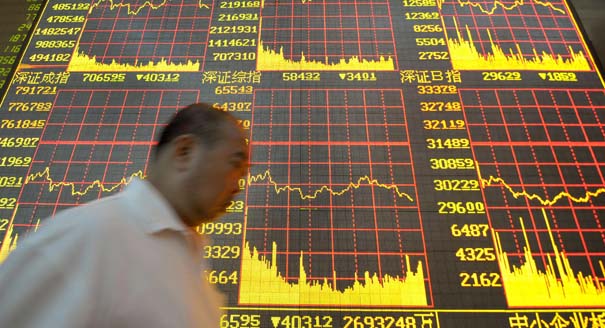
The implications of China’s slowing economy depend on how successful and orderly the rebalancing process will be in the face of domestic opposition from elites who have benefited from three decades of unbalanced growth.
Source: YaleGlobal
Imagine having predicted in 1990 that the Japanese economy, then widely expected to overtake the US within a decade or two, would grow on average by less than 1 percent a year for the next 20 years. In the unlikely case that anyone believed you, he would probably have drawn two worrisome conclusions.
First, Japan at that time was considered the world’s growth engine, and so a collapse in Japanese growth would likely throw the world into a tailspin. Second, if after several decades of robust expansion Japanese growth were suddenly to drop so dramatically, there was sure to be social and political upheaval in Japan.
Japan did grow slowly for the next 20 years, but the rest of the world did not subsequently stagnate, and the Japanese people did not rise up in anger. Today, as the Chinese economy continues to slow, the world is asking the same worried questions about China. Without a boost from the Chinese growth engine, analysts say, doesn’t the global economy risk stagnating further? Can China tolerate growth below 7 percent without suffering social unrest and perhaps even revolution?Understanding why these worries were wrong for Japan may help in understanding why they might also be wrong for China. Take the first question. Will a Chinese slowdown cause a global slowdown? Probably not. It turns out that China today, like Japan in the 1980s, is not the global engine of economic growth. It is the largest arithmetic component of global growth.
These may seem the same, but in fact are very different. What the global economy lacks today is demand, and the engine of global growth must be a source of net demand for the rest of the world. China, with its large trade surplus, clearly isn’t. What matters to the rest of the world, ultimately, is not how fast China is growing, but rather how the trade account will evolve as the economy rebalances. Some analysts might argue that China’s central bank purchases of US government bonds also have an important effect on the global economy by restraining US interest rates, but as I show in Chapter 8 of my book The Great Rebalancing: Trade, Conflict, and the Perilous Road Ahead for the World Economy (Princeton University Press, 2013), this argument is based on a fallacy. China’s export of capital matters not because it affects US interest rates but because of its impact on the trade account.
An orderly rebalancing, in which China’s savings rate declines steadily relative to investment, implies a contracting trade surplus that will add net demand to the world. A disorderly rebalancing might imply an explosion in the trade surplus that would weaken an already struggling global economy. Whether slowing Chinese growth is good or bad overall for the world, in other words, depends on how it affects China’s balance of trade, and this depends on how swiftly and forcefully Beijing is able to constrain credit growth and rebalance the economy.
There are at least three other ways in which China’s rebalancing affects the world: First, China’s disproportionate demand for hard commodities, five to ten times its GDP share compared to the rest of the world, is a consequence of the country’s excessive reliance on investment to generate growth. A rebalancing China means much lower investment growth, which in turn implies a dramatic drop in Chinese demand for hard commodities. This will hurt countries whose growth depends on high commodity prices, but it will help net commodity importers.
Second, China became the world’s manufacturing workshop at least in part because the very mechanisms that led to unbalanced growth also increased export competitiveness – especially its undervalued currency, artificially low interest rates, and lagging wage growth. As China rebalances, by definition its export competiveness will erode, and this will be positive for manufacturers, especially in other developing countries.
Third, Chinese rebalancing means a partial transfer of demand from investment-related spending to consumption-related spending. A reduction in economic growth will have a disproportionately large impact on reducing investment growth, and a disproportionately small impact on reducing consumption growth. German exporters of capital goods, for example, will suffer much more than German exporters of consumer goods.
How a Chinese slowdown affects the global economy, in other words, depends crucially on how China rebalances. The seeming determination of Premier Li Keqiang to come to grips with debt and force a rebalancing even if that brings, as it must, a sharp slowdown in economic growth bodes well for an orderly rebalancing which will benefit most of the world.
What about the social impact of slower Chinese growth – can ordinary Chinese tolerate growth rates much below 7 percent? The same process that determines the impact of slower Chinese growth on the rest of the world will also determine how it will affect ordinary Chinese.
Slower growth after 1990 did not outrage ordinary Japanese largely because it did not result in equivalent contraction in their economic prospects. The average Japanese household, like households everywhere, doesn’t care about changes in its per capita GDP. It cares about real changes in its disposable income. As Japan was forced to rebalance its economy after 1990, one of the implications was, by definition, that household income and household consumption grew as a share of overall GDP, just as it must in China. After many years in which household income growth lagged the high GDP rates of the 1980s, it began to exceed the much lower GDP growth rates of the next decade, and this was magnified by the twin forces of deflation and a declining population.
The growth rate of income for the average Japanese household, in other words, slowed much less than GDP growth rates after 1990. As a result, the shocking collapse in GDP growth was not reflected in an equally shocking collapse in household income growth. Japanese households were not so badly hurt by Japan’s apparent economic stagnation because the slowdown occurred in conjunction with an orderly rebalancing of the economy.
Depending on how Beijing manages its own economic adjustment, the same can happen in China. There should be little doubt that China’s GDP growth rates will continue to drop, and to levels well below the 6 to 7 percent that most analysts now suggest as a worst-case scenario for China. In fact it’s hard to see how a rebalancing China is consistent with GDP growth rates on average much above 3 to 4 percent.
By definition, a rebalancing China means that household income must grow much faster than GDP. This will not be easy and will require significant transfers from the state sector to shore up the social safety net, boost household wages and raise deposit rates. But if the rebalancing is managed well, GDP growth rates of 3 to 4 percent can be consistent with household income growth rates of 6 to 7 percent. This is far from being a disaster for ordinary Chinese.
China’s economy will continue to slow dramatically over the next few years. Of this there should be little doubt. The implications, however, are not as obvious as many think. They depend on how successful and orderly the rebalancing process will be in the face of tremendous domestic opposition from elites who have benefitted spectacularly from three decades of unbalanced growth. An orderly rebalancing in China will be positive for overall global growth – although not positive for every country – and positive for ordinary Chinese, if not for the elite. What matters are the decisions Beijing takes over the next year to direct the pace of China’s rebalancing.

Nonresident Senior Fellow, Carnegie China
Michael Pettis is a nonresident senior fellow at the Carnegie Endowment for International Peace. An expert on China’s economy, Pettis is professor of finance at Peking University’s Guanghua School of Management, where he specializes in Chinese financial markets.
Recent Work
Michael Pettis
Michael Pettis
As geopolitical rivalry weaponizes global supply chains, the EU’s true vulnerability lies in emerging-risk imports. For these goods, suppliers are growing more concentrated, substitution more difficult, and political risk is looming.

Sinan Ülgen

The EU is putting together a new security strategy to meet today’s myriad challenges. But for any proposal to be effective, the union needs to grapple with its identity and ambitions.

Pierre Vimont
Amid uncertainty caused by the Iran war, the global drive for nonproliferation has stalled. With Europe diplomatically marginalized and countries reassessing their nuclear options, efforts to curb the spread of nuclear weapons risk becoming irrelevant.

Jane Darby Menton
Between the United States’ market-driven approach and China's state-led industrial strategy, Europe is reckoning with how it can remain competitive in the global economy. But is Europe in danger of becoming a U.S. or China colony?


Noah Barkin, Anu Bradford

The U.S.-sponsored TRIPP deal is driving the Armenia-Azerbaijan peace process forward. But foreign and domestic hurdles remain before connectivity and economic interdependence can open up the South Caucasus.



Thomas de Waal, Areg Kochinyan, Zaur Shiriyev