

Article
C. Raja Mohan, Darshana M. Baruah
{
  "authors": [
    "C. Raja Mohan"
  ],
  "type": "legacyinthemedia",
  "centerAffiliationAll": "dc",
  "centers": [
    "Carnegie Endowment for International Peace",
    "Carnegie China",
    "Carnegie India",
    "Carnegie Russia Eurasia Center"
  ],
  "collections": [
    "China’s Foreign Relations",
    "China and the Developing World"
  ],
  "englishNewsletterAll": "ctw",
  "nonEnglishNewsletterAll": "",
  "primaryCenter": "Carnegie India",
  "programAffiliation": "SAP",
  "programs": [
    "South Asia"
  ],
  "projects": [
    "Eurasia in Transition"
  ],
  "regions": [
    "North America",
    "United States",
    "East Asia",
    "China"
  ],
  "topics": [
    "Security",
    "Military",
    "Foreign Policy"
  ]
}
Source: Getty
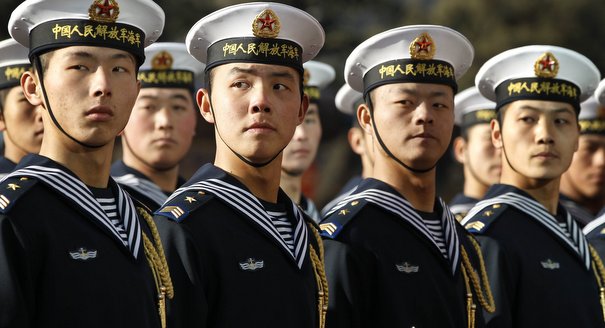
Even as China becomes a maritime power to reckon with, Beijing has no desire to give up on its continental aspirations.
Source: Indian Express
The rapid modernisation of the Chinese navy and the American plans to rebalance its military forces to the Pacific have drawn the world's attention to Asia's maritime affairs in recent years. Even as China becomes a maritime power to reckon with, Beijing has no desire to give up on its continental aspirations. Chinese President Xi Jinping's continuing tour of Central Asia this past week showcased the nation's rise at the heart of the Eurasian landmass.
Most great powers of the past had either a continental or maritime orientation. Great Britain and America have been mainly maritime powers. Russia and Germany, on the other hand, were essentially continental powers. Could China be the first to break this classic divide? The logic of geography, massive accumulation of financial resources, an advanced industrial base and an extraordinary will to power may have created the conditions for China to be a great power, at once maritime and continental.
Historically, Chinese empires were focused on defeating overland invaders. Over the last two centuries, the external threats to Chinese security came by sea. While Beijing wants to secure the Pacific littoral to the east, China's rise has run into resistance from Asia's maritime powers like Japan and the U.S. On its Western periphery in inner Asia, though, China now has a near free hand.Russia, the traditionally dominant power in Central Asia, is reluctant to contest China's rise. The American interest in the region has been episodic and could diminish further after the withdrawal of US troops from Afghanistan by the end of 2014. India, a potential power in inner Asia, is burdened by a perennial conflict with Pakistan that blocks its access to the region. Favourable regional circumstances, coupled with Beijing's purposeful policies, have dramatically raised China's weight in Central Asia within a generation. China is well on its way to becoming the most important external power on the subcontinent's northwestern marches.
At the heart of Beijing's march to the west has been an expansive logic that seeks to integrate China's western provinces like Xinjiang and Tibet with Central Asia, southwest Asia and the subcontinent. That Central Asia is rich in hydrocarbon resources, which Beijing so badly needs, has lent urgency to a programme focused on transborder connectivity and evacuating oil and gas from inner Asia to China's industrial heartland in the east. Beijing's economic theorem on the benefits of regional integration had two political corollaries: stabilising China's sensitive, far-flung frontiers through rapid development, and gaining strategic influence across borders.
As he swings through Central Asia, President Xi has every reason to celebrate the many triumphs of China's march to the west, plug some of the gaps and articulate a strategy to consolidate its emerging primacy in the region. This precisely is what Xi did as he stopped in Turkmenistan on his way to the G-20 summit in Russia last week, and travelled to Kazakhstan and Uzbekistan on his way back. He concluded the Central Asian tour by joining a summit of regional leaders in Bishkek, Kyrgyzstan.
During the trip, Xi saw the Chinese companies sign contracts worth billions of dollars in these countries, announced the construction of new pipelines, outlined plans to deepen transport connectivity within the region and across it between China and Europe, and promoted the use of Chinese currency for international transactions in the region. Comparing the current Chinese plans for the region with the Silk Road that once linked China with Central Asia and the Mediterranean, Xi declared, "I can almost hear the ring of the camel bells and the wisps of smoke in the desert."
Xi's tour was not all economics. It was also about security. As he signed strategic partnership agreements in Central Asia, Xi underlined the importance of jointly combating the "three evils"— terrorism, separatism and extremism — confronting the region. Concerned about the impact of these forces on China's internal stability following the US withdrawal from Afghanistan, Xi has called for greater political cooperation between China and its neighbours.
At the Central Asian summit in Bishkek yesterday, Xi is likely to have expanded on the need for what Beijing calls a "new security concept for Eurasia". There will be worldwide interest in any new ideas from Beijing on promoting stability in and around Afghanistan after 2014.
This article was originally published in the Indian Express.
Former Nonresident Senior Fellow, Carnegie India
A leading analyst of India’s foreign policy, Mohan is also an expert on South Asian security, great-power relations in Asia, and arms control.
Recent Work

C. Raja Mohan, Darshana M. Baruah


Alexander Gabuev, Paul Haenle, C. Raja Mohan, …
Carnegie does not take institutional positions on public policy issues; the views represented herein are those of the author(s) and do not necessarily reflect the views of Carnegie, its staff, or its trustees.
The U.S.-sponsored TRIPP deal is driving the Armenia-Azerbaijan peace process forward. But foreign and domestic hurdles remain before connectivity and economic interdependence can open up the South Caucasus.



Thomas de Waal, Areg Kochinyan, Zaur Shiriyev
Donald Trump has demanded that European allies send ships to the Strait of Hormuz while his war of choice in Iran rages on. He has constantly berated NATO while the alliance’s secretary-general has emphatically supported him.

Rym Momtaz, ed.
The EU is structurally incapable of reacting to today’s foreign policy crises. The union must fold the EEAS into the European Commission and create a security council better prepared to take action on the global stage.

Stefan Lehne
The war in Ukraine is costing Russia its leverage overseas. Across the South Caucasus and Middle East, this presents an opportunity for Europe to pick up the pieces and claim its own sphere of influence.


William Dixon, Maksym Beznosiuk

Amid increased polarization and the influence of disinformation, radical-right parties are once again gaining traction across Europe. With landmark elections on the horizon in several countries, are the EU’s geostrategic vision and fundamental values under existential threat?


Catherine Fieschi, Cas Mudde