

Report
- +3
James M. Acton, Alexey Arbatov, Vladimir Dvorkin, …
{
  "authors": [
    "Petr Topychkanov"
  ],
  "type": "commentary",
  "centerAffiliationAll": "",
  "centers": [
    "Carnegie Endowment for International Peace",
    "Carnegie Russia Eurasia Center"
  ],
  "collections": [],
  "englishNewsletterAll": "",
  "nonEnglishNewsletterAll": "",
  "primaryCenter": "Carnegie Russia Eurasia Center",
  "programAffiliation": "",
  "programs": [],
  "projects": [
    "Eurasia in Transition"
  ],
  "regions": [
    "Middle East",
    "Syria",
    "South Asia",
    "India",
    "Russia"
  ],
  "topics": [
    "Security",
    "Foreign Policy",
    "Global Governance"
  ]
}
Source: Getty
India would be able to make an important contribution to the resolution of the Syrian crisis.
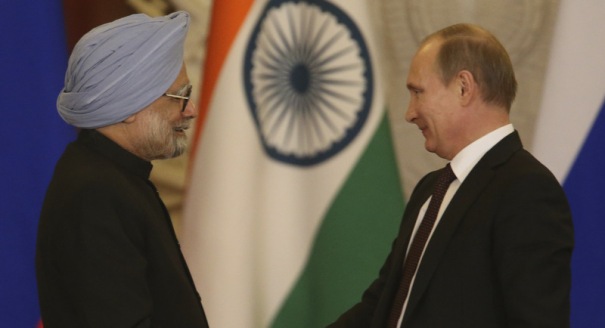
During the visit of the Indian Prime Minister Manmohan Singh to Moscow, the Russian side disclosed its plan to invite India to take part in the Geneva II. This idea was warmly welcomed by Syria.
This plan has not yet been converted into an official invitation to India and its agreement to attend the talks. But it has already demonstrated contradictions of the India’s position on Syria.
On the one hand, Delhi has traditionally had good relations with Damascus. According to the Business Standard report in October “President Assad expressed his whole-hearted gratitude to the people of India and the government for their consistent support to and solidarity with Syria at this crucial juncture.”
On the other hand, Delhi depends on trade with the Gulf countries, some of which are sponsors of the military opposition to Assad. There are thousands of Indian workers in these countries. It is obvious that India is not ready to emphasize differences in views on Syria with the Gulf countries because this would result in serious economic loses. Also to be mentioned is the extensive security cooperation between Delhi and Tel Aviv. An active support of Assad may reduce the level of trust between them.
Some observers believe that in this situation, “India may have more to lose than gain if it attends the Syrian negotiations in Switzerland,” and that it would “play safe by not getting involved in the negotiations.”
It seems that India could try to follow such advice not only because of its external relations, but also because of the domestic situation. Before general elections, the Indian authorities would prefer not to do anything which could be used by their opponents against them.
In this regard, some people could criticize the Russian plan to invite India to Geneva II, because even if India accepts this invitation, it would not be able to be a loyal ally of Russia at the negotiation table. I have two objections to such a position:
I would like to believe that Russia will be able to send to India an official invitation to Geneva II, and India will be able to make an important contribution to the resolution of the Syrian crisis.
Former Fellow, Nonproliferation Program, Moscow Center
Topychkanov was a fellow in the Carnegie Moscow Center’s Nonproliferation Program.
Recent Work

James M. Acton, Alexey Arbatov, Vladimir Dvorkin, …
Petr Topychkanov
Carnegie does not take institutional positions on public policy issues; the views represented herein are those of the author(s) and do not necessarily reflect the views of Carnegie, its staff, or its trustees.

As we close out another season of Strategic Europe, it is worth taking stock of the deep shifts underway.

Rym Momtaz
The hybrid warfare landscape is evolving rapidly, leaving policymakers without clear strategies. To better inform their work in addressing emerging challenges, governments must dig deeper into the underlying dynamics at play.


Raluca Csernatoni, Alicia Wanless
The EU had to compromise to adopt a twenty-first sanctions package against Russia, exposing growing cracks in the union’s resolve. Is this latest, weaker round worth it to keep pressure on Moscow?
Rym Momtaz, ed.

Trump is distracted and Ukraine wants Europe to step up. The continent’s leaders must find their voice and assert it in talks with Russia.

Alissa de Carbonnel

Mounting economic strain and battlefield losses will not necessarily make the Kremlin less dangerous. They could instead push Moscow toward a more aggressive hybrid campaign designed to test NATO’s Eastern flank, exploit allied hesitation, and fracture European resolve.

Maksym Beznosiuk