

Commentary
Dmitri Trenin
{
  "authors": [
    "Dmitri Trenin"
  ],
  "type": "commentary",
  "centerAffiliationAll": "",
  "centers": [
    "Carnegie Endowment for International Peace",
    "Carnegie Russia Eurasia Center"
  ],
  "collections": [],
  "englishNewsletterAll": "",
  "nonEnglishNewsletterAll": "",
  "primaryCenter": "Carnegie Russia Eurasia Center",
  "programAffiliation": "",
  "programs": [],
  "projects": [],
  "regions": [
    "East Asia",
    "Japan",
    "Russia"
  ],
  "topics": [
    "Security",
    "Military",
    "Foreign Policy"
  ]
}
Source: Getty
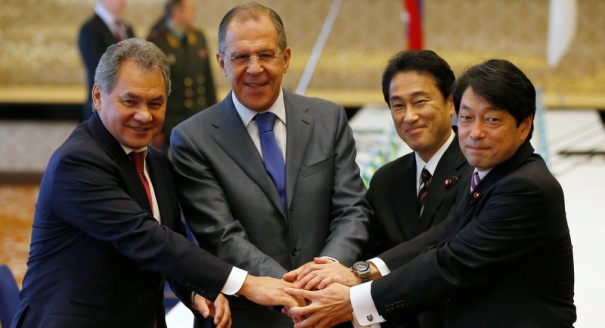
As Russia and Japan are carefully embarking on a fresh attempt to fully normalize their relations, closer and more regular contacts in the foreign and security field, including military exercises, may be useful as confidence-building.
In Tokyo all last week, I heard quite a few comments on the recently held inaugural 2+2 meeting between the foreign and defense ministers of Russia and Japan. The initiative for holding such conferences had come from the Japanese side, who were able to sell it to Moscow. For Japan, it is a big thing: Tokyo only maintains similar formats in relations with its principal ally, the United States, and also with another ally, Australia. Russia, by contrast, is not only a former Cold War adversary, but also a country with which Japan still does not have a peace treaty, which also means that there is a territorial issue between the two. What is then the purpose of the Russo-Japanese 2+2, and what are its prospects?
When the Japanese reached out to the Russians with their proposal, one thing they wanted to emphasize was their strategic autonomy. Historically, Tokyo had long been stung by Moscow's view of it merely as a Washington's ward. Of course, the Japanese had told their main ally of their intention to open a new dialogue window with the Russians, and the Americans raised no objections. Moscow, in turn, appreciated Tokyo's move: to the Russians, 2+2 is essentially a sign of a mature relationship, rather than an accessory of an existing alliance. Russia uses this format with countries as different as the United States; France; and, most recently, Egypt. If the Japanese now want to have a direct strategic dialogue with the Russians, this is welcome in Moscow as a sign of the world's increasingly "polycentric" nature.
More substantively, the major reason for Tokyo's overture to Moscow has been Japan's growing concern over China's assertive rise. An alliance with the United States remains vital, but it is not enough. From Tokyo's perspective, strengthening Japan's own link with China's strategic partner and close neighbor makes perfect sense. It is equally clear, however, that for the Russians there can be no question now of colluding with the Japanese behind China's back. As Foreign Minister Sergey Lavrov put it, "we are not making friends against anyone." Beijing's Global Times, commenting on this last Monday, betrayed China's nervousness over the Russo-Japanese rapprochement, but immediately assured its readers that Russia was not about to sell out China. This is a correct assessment: as long as Beijing remains friendly vis-a-vis Moscow, Russia will do nothing which would jeopardize the relationship with China.
So, where is the substance for the Russo-Japanese 2+2? It can hardly be debating the issue of the U.S.-Japanese cooperation on missile defense. Russian Defense Minister Sergei Shoigu's recent criticisms of BMD in Asia-Pacific notwithstanding, Moscow has few reasons to worry about Japan's part in the project, which is directed at North Korea (overtly) and China (less so), but has no capability against Russia's strategic assets. There are some areas, however, where cooperation may have primarily psychological rather than strategic value. As Russia and Japan are carefully embarking on a fresh attempt to fully normalize their relations, closer and more regular contacts in the foreign and security field, including military exercises, may be useful as confidence-building. Thus, expanding the circle of stakeholders in a stronger and more positive Russo-Japanese relationship may be the real strategic goal that the leaders in Moscow and Tokyo are pursuing.
Former Director, Carnegie Moscow Center
Trenin was director of the Carnegie Moscow Center from 2008 to early 2022.
Recent Work
Dmitri Trenin
Dmitri Trenin

The new U.S.–Denmark–Greenland agreement will help Washington exert political, economic, and financial dominance under the guise of security. Yet, it acknowledged Copenhagen’s and Nuuk’s sovereignty on the island.

Marc Pierini

A summer of escalation in the Black Sea has hurt Ukraine economically and is exacerbating world food security. A truce is needed—as is a broader reframing of Europe’s Ukraine strategy.

Thomas de Waal

Are Germany’s economic, industrial, and political struggles becoming a liability for the EU’s ability to rise to the geopolitical moment?

Rym Momtaz, ed.

European Commission President Ursula von der Leyen is about to give her annual address on the state of the EU. Here’s what she won’t—but should—say.
Rym Momtaz

The aftermath of the Ceuta crisis shows Europe has drawn the wrong lessons. Rather than doubling down on failed migration policies, the EU needs to address the underlying roots of such episodes.

Richard Youngs