

Article
C. Raja Mohan, Darshana M. Baruah
{
  "authors": [
    "C. Raja Mohan"
  ],
  "type": "legacyinthemedia",
  "centerAffiliationAll": "dc",
  "centers": [
    "Carnegie Endowment for International Peace",
    "Carnegie India"
  ],
  "collections": [],
  "englishNewsletterAll": "ctw",
  "nonEnglishNewsletterAll": "",
  "primaryCenter": "Carnegie India",
  "programAffiliation": "SAP",
  "programs": [
    "South Asia"
  ],
  "projects": [],
  "regions": [
    "South Asia",
    "India",
    "East Asia",
    "China"
  ],
  "topics": [
    "Global Governance",
    "Foreign Policy"
  ]
}
Source: Getty
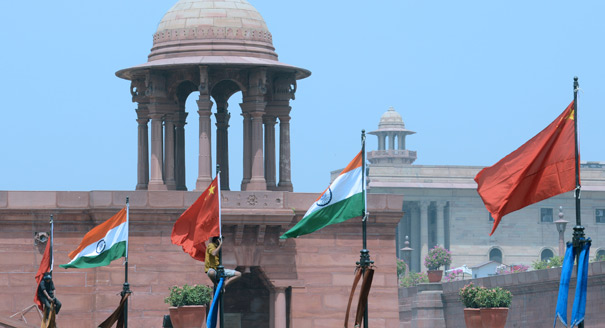
The rise of China demands Delhi intensify its cooperation with Beijing and prudently manage the multiple tensions that could undermine the bilateral relationship.
Source: Indian Express
"China won't like it." That has been a consistent refrain of the UPA government and the Congress party in shaping India's recent foreign policy. New Delhi's self-induced fear of provoking China has restricted the pursuit of beneficial engagement with other major powers and Asian neighbours. India's self-denial is hardly consistent with its proclamations on "strategic autonomy". But it is no secret that the UPA and the Congress deploy the argument of "strategic autonomy" only against the United States.
You don't have to be a genius to figure out that it is China's rising power that constricts Delhi's strategic policy in the subcontinent and the Indian Ocean. Even on the world stage, it is China that has made it difficult for India to pursue its aspirations. Beijing tried to block Delhi's historic civil nuclear initiative with Washington that sought to lift three and a half decades of international nuclear sanctions against India. China has also been the only permanent member of the UNSC that is unwilling to support India's membership of this exclusive club. Yet the Congress party wants Delhi to remain "equidistant" from Washington and Beijing.The wide divergence between India and China does not mean Delhi should limit its engagement with Beijing. On the contrary, the rise of China demands Delhi intensify its cooperation with Beijing and prudently manage the multiple differences. What is baffling, however, is the UPA's perverse policy of limiting India's cooperation with other countries by citing Beijing's sensitivities. Defence Minister A.K. Antony, for example, has stopped the Indian navy conducting multilateral exercises in the Indian Ocean, slowed down military cooperation with the US and limited India's defence diplomacy with China's neighbours in the name of "strategic autonomy". China does not take India's sensitivities into account when deepening defence cooperation with Pakistan. As an exponent of realpolitik, China does not expect India to negate its own interests. But if the UPA offers such deference, why should Beijing complain?
The next government in Delhi could hopefully learn a thing or two from Russia and China on how to play the game in a multipolar world. On the one hand, Moscow and Beijing are determined to limit American power. On the other, Moscow and Beijing seek separate bilateral deals with Washington. Russia's Vladimir Putin bails America's Barack Obama out of Syria. Russia plays hardball with Washington but seizes moments for expanded cooperation. China's Xi Jinping wants to build a new type of great power relationship with America. There are always enough people in Washington and Beijing who dream about a G-2 or a Sino-American condominium.
Put simply, in a multipolar world, the great powers play the field. No one gives up beneficial cooperation with one for fear of offending another. The motto is to engage all and cooperate with one to improve the bargaining power with the other.
Russia has drawn very close to China in the last two decades. But Moscow is not holding back from doing things that Beijing does not like. Consider two recent moves by Putin. Visiting Hanoi this week, Putin reaffirmed Russia's commitment to deepen the defence partnership with Vietnam. Putin is taking advantage of the tensions between China and Vietnam in the South China Sea and raising its own profile in East Asia. Moscow has already agreed to sell six Kilo-class submarines that would help Vietnam blunt China's growing naval might in the South China Sea. Surely, there is more to follow. Russia is also negotiating with Vietnam access arrangements to Cam Ranh Bay that will boost Moscow's naval presence in the South China Sea.
Russia is also cosying up to Japan, even as Beijing and Tokyo quarrel over a few islands in the East China Sea. Earlier this month, Russia and Japan held their first ever "two-plus-two" dialogue, involving the defence and foreign ministers of both sides. Russia is only the third country, after the US and Australia, that Japan has formed such a forum with at the ministerial level. Russia has not done this with any other country — not China, not India. As Russia and Japan try to resolve longstanding bilateral disputes, they have launched security and defence cooperation as part of an effort to improve their leverage with China. But the Delhi durbar under the UPA has locked itself in conceptual confusion and allowed presumed Chinese concerns to define the limits of India's foreign policy.
This article was originally published in the Indian Express.
Former Nonresident Senior Fellow, Carnegie India
A leading analyst of India’s foreign policy, Mohan is also an expert on South Asian security, great-power relations in Asia, and arms control.
Recent Work

C. Raja Mohan, Darshana M. Baruah


Alexander Gabuev, Paul Haenle, C. Raja Mohan, …
Carnegie does not take institutional positions on public policy issues; the views represented herein are those of the author(s) and do not necessarily reflect the views of Carnegie, its staff, or its trustees.

As we close out another season of Strategic Europe, it is worth taking stock of the deep shifts underway.

Rym Momtaz

The hybrid warfare landscape is evolving rapidly, leaving policymakers without clear strategies. To better inform their work in addressing emerging challenges, governments must dig deeper into the underlying dynamics at play.


Raluca Csernatoni, Alicia Wanless
The EU had to compromise to adopt a twenty-first sanctions package against Russia, exposing growing cracks in the union’s resolve. Is this latest, weaker round worth it to keep pressure on Moscow?
Rym Momtaz, ed.

Trump is distracted and Ukraine wants Europe to step up. The continent’s leaders must find their voice and assert it in talks with Russia.

Alissa de Carbonnel

Mounting economic strain and battlefield losses will not necessarily make the Kremlin less dangerous. They could instead push Moscow toward a more aggressive hybrid campaign designed to test NATO’s Eastern flank, exploit allied hesitation, and fracture European resolve.

Maksym Beznosiuk