

Commentary
Maria Lipman
{
  "authors": [
    "Maria Lipman"
  ],
  "type": "commentary",
  "centerAffiliationAll": "",
  "centers": [
    "Carnegie Endowment for International Peace",
    "Carnegie Russia Eurasia Center"
  ],
  "collections": [],
  "englishNewsletterAll": "",
  "nonEnglishNewsletterAll": "",
  "primaryCenter": "Carnegie Russia Eurasia Center",
  "programAffiliation": "",
  "programs": [],
  "projects": [],
  "regions": [
    "Russia"
  ],
  "topics": [
    "Political Reform"
  ]
}
Source: Getty
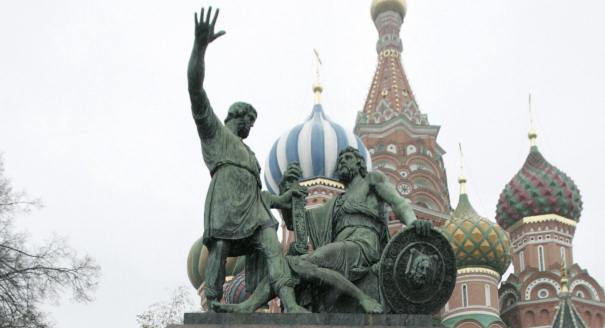
On November 4, President Putin spoke in the Kremlin about cohesion, consolidation, and indissoluble unity of the people of Russia. Government policies, in contrast, do more to deepen the xenophobic sentiments than to temper them. If the Day of National Unity was established as a step toward consolidating the Russian nation, today it sounds at best as a celebration of wishful thinking.
On November 4 this year, the Day of People’s Unity, President Putin spoke in the Kremlin about cohesion, consolidation, and indissoluble unity of the people of Russia. In sharp contradiction with his solemn speech, across town on the same day thousands of Muscovites staged a Russian march. Similar public gatherings of smaller scope were held in other Russian cities. Every year since 2005, such marches have brought together nationalist groups of various strains, ranging from relatively moderate ones to those chanting “White race is a pure race” or even “Sieg Heil.”
Though the events celebrated on November 4 date back four hundred years ago, the actual holiday was introduced by Vladimir Putin in late 2004. It has never been explained, however, why we are suddenly celebrating something that took place in early 17th century, something that we had never celebrated before, or just how those events are related to the Russian nationhood of the 21st century.
What happened in Russia four centuries ago was the establishment of a new dynasty (the Romanovs) that put an end to the tragic period in the Russian history called the Time of Troubles. Another way to describe it is a victory over Polish invaders who took advantage of the interregnum that had dramatically weakened the Russian state. Today’s Russia can hardly identify with the Romanovs’ statehood (or date its statehood back to the victory over Poles, for that matter). The Romanovs’ legitimacy was overturned in 1917; the monarchy was toppled, the tzar and his family shot. A new, Soviet legitimacy emerged from a victory of the “Reds” over the “Whites” in an atrocious fratricidal civil war.
The Soviet communist state lived for about seven decades; it celebrated as its main national holiday the revolution that had abolished the monarchy and based its legitimacy on the communist ideology. But in 1991, that nationhood also collapsed. Those stormy developments left the nation in a state of “rupture of traditions and national unity, demoralization of the society, deficit of mutual trust and responsibility,” as Putin said in a speech in early fall 2013. He also spoke about the lack of a shared historical narrative. “Assessment of certain historical events still polarizes the country and the society,” he said. He admitted that those who profess conflicted views are divided by mutual spite, hatred, even aggression. He emphasized the “fundamental” need to “find and strengthen national identity.”
One can hardly disagree that the task of building a new national identity is central to Russia’s development. And while Putin may admit the problem, during the years of his leadership he generally tried to marginalize and avoid it. In the course of its post-Communist development, Russia failed to reach a consensus, let alone a unity on what lies at the core of the Russian statehood. Instead it has become even deeper divided, and the issue of the Russian nationhood is no longer possible to ignore.
Of the many divisions, those along ethnic lines appear to be most dangerous in a country such as Russia, with its ethnic and religious diversity. Putin may extol “our diversity” that “has always been and remains the source of our beauty and our strength.” But such rhetoric that is easily traced back to the Soviet national pattern of “peoples’ friendship” and “USSR as a close family of peoples” sounds like hot air in today’s Russia where a significant majority shares the slogan “Russia is for Russians” and “Russianness” is not infrequently seen as a matter of blood. Episodes of ethnic violence and even riots have become more frequent, and surveys show a rising sense of ethnic tension: 43 percent said they feel it in their locality, up from 29 percent in 2012. “Stop feeding the Caucasus” is another slogan whose popularity is steadily growing. Those “from the Caucasus”—non-Slavic Russian citizens who live in the North Caucasus, in the south of Russia—are seen as alien, unwelcome, and not belonging in Russia.
Government policies do more to deepen the xenophobic sentiments than to temper them. And Russian officialdom is increasingly slipping to the language of ethnic identity. “Russky,” that is (ethnic) Russian, a term that has clear exclusive connotations, commonly occurs in contexts that call for an inclusive term “citizens of Russia.” In his recent speech the Russian patriarch, even as he called for the government to respect people’s interests and respond to their demands—did not speak about Russian citizens, not even about Orthodox Christians. He emphasized the ethnicity as he used terms such as russkie, russkie lyudi, russkaya molodezh which mean (ethnic) Russian people and (ethnic) Russian youth.
If the Day of National Unity was established as a step toward consolidating the Russian nation, today it sounds at best as a celebration of wishful thinking.
Former Scholar in Residence, Society and Regions Program, Editor in Chief, Pro et Contra, Moscow Center
Lipman was the editor in chief of the Pro et Contra journal, published by the Carnegie Moscow Center. She was also the expert of the Carnegie Moscow Center’s Society and Regions Program.
Recent Work
Maria Lipman
Maria Lipman
Carnegie does not take institutional positions on public policy issues; the views represented herein are those of the author(s) and do not necessarily reflect the views of Carnegie, its staff, or its trustees.

The EU’s responses to two recent incidents expose the gulf between European perceptions and capabilities. Unless the union can bridge that gap, it will never become a real geostrategic power.

Rym Momtaz

European states control several Overseas Countries and Territories around the world that carry strategic, economic, and environmental weight. As great powers challenge the rules-based order, defending them is a geopolitical imperative for Europe.

Marc Pierini

In supporting Europe’s far-right, MAGA and Russia both want the same thing: a weaker EU. Europe must defend itself without abandoning the openness these forces exploit.

Armida van Rij

As we close out another season of Strategic Europe, it is worth taking stock of the deep shifts underway.
Rym Momtaz

The hybrid warfare landscape is evolving rapidly, leaving policymakers without clear strategies. To better inform their work in addressing emerging challenges, governments must dig deeper into the underlying dynamics at play.


Raluca Csernatoni, Alicia Wanless