

Book
Europe is facing rising populism internally as well as external pressures from Russia, China, Turkey, and the United States.
Dimitar Bechev
{
  "authors": [
    "Alexey Arbatov"
  ],
  "type": "legacyinthemedia",
  "centerAffiliationAll": "",
  "centers": [
    "Carnegie Endowment for International Peace",
    "Carnegie Russia Eurasia Center"
  ],
  "collections": [],
  "englishNewsletterAll": "",
  "nonEnglishNewsletterAll": "",
  "primaryCenter": "Carnegie Russia Eurasia Center",
  "programAffiliation": "",
  "programs": [],
  "projects": [],
  "regions": [
    "Russia",
    "Western Europe"
  ],
  "topics": [
    "Security"
  ]
}
Source: Getty
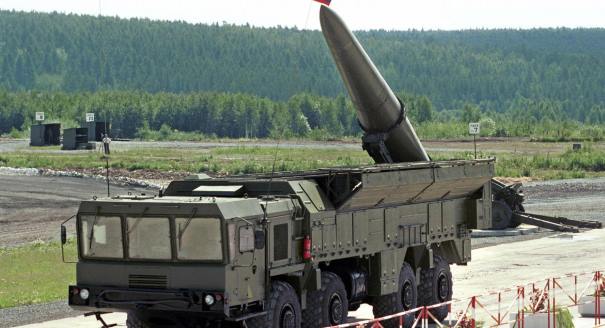
No agreement prohibits deploying of Iskander missiles along Russia western border, but it makes the military situation tense. It appears that Russia chose the path of escalation in relations with NATO.
Source: Ezhednevnyi Zhurnal
Rumors about the scheduled or actual deployment of Iskander missiles have been circulating for a long time. Actually, no agreement prohibits such a step if it indeed took place. Iskander missiles are not subject to the Intermediate-Range Nuclear Forces Treaty, since their range is less than 500 km. But, of course, it makes the military situation tense. Russia has long planned to take this step in response to the completion of the third phase of the U.S. missile defense program, which is to deploy missile interceptors in Poland. Although this deployment has not happened yet, Russian missiles are stationed there in order to target interceptor bases (radar installations and missile deployment sites).
At the press conference at December 19, 2013, Russian President Vladimir Putin emphasized, that “we have not actually taken such a decision yet.” At the same time, he noted about the Iskanders, that “they are just one possible response and certainly not the most effective, though in their particular class they are the most effective weapons system in the world.”
While this may be a possible explanation of the current events, one must note that what is happening now simply escalates tensions and is absolutely unwarranted. It is hard to imagine a scenario under which Iskander missiles would strike a NATO member that hosts interceptor bases. Moreover, the missiles to be deployed in Poland after 2015 are not the advanced missiles that could have been deployed in that country and on warships in the northern seas around 2020 as part of the fourth phase of the missile defense program. These missiles might potentially intercept Russian intercontinental missiles, and their possible deployment once caused a panic reaction. But the interceptors that are to be deployed in Poland are significantly less technically advanced and effective, and they surely pose no threat to Russian long-range missiles—even in terms of their technical capabilities. The missiles that were to be deployed during the fourth phase of the NATO plan also did not pose any significant threat to Russia, but this phase has now been canceled.It is clear that Russia chose the path of escalation. Putin was again very critical of NATO’s missile defense program, linking it to the negotiations on Iran’s nuclear projects and saying that the missile defense system seeks to undermine Russia’s defensive capabilities. But this is clearly a political campaign that has no strategic or technical basis. Apparently, it was decided to continue escalating tensions in this area.
It remains to be seen how the West might respond to these developments. Of course, the Iskanders are not the only bone of contention; the Ukrainian situation will also affect how the West will act. It is possible that the response may be offensive rather than defensive. For example, a large contingent of strike aircraft may be stationed in Poland or the Baltic countries. This contingent will be capable of conventional and nuclear strikes against all of European Russia. It is also possible to create Iskander-like missile systems if the West so chooses. This is unlikely in the foreseeable future, but it could be done, theoretically.
The missiles to be deployed in Poland during the third stage are intended to intercept Iranian missiles flying over Poland toward Great Britain or the United States, as well as missiles directed at Poland itself. Incidentally, these targets include Iskander missiles. Of course, Iskander missiles were not the original targets of the missile defense system, since the decision to deploy it in Poland was made before the rumors about Iskanders surfaced; nevertheless, the interceptors now have a new target. Russian scientists constantly boast that an Iskander missile will never be intercepted, but no such tests were conducted, so Russia should not jump the gun here. For the sake of curiosity, NATO and Russia could conduct such a duel in the form of a test to see if the missiles can in fact be intercepted. It is quite possible, although such tests are not likely to be conducted.
This article originally appeared in Russian in Ezhednevnyi Zhurnal.

Alexey Arbatov
Alexey Arbatov is the head of the Center for International Security at the Primakov National Research Institute of World Economy and International Relations.
Carnegie does not take institutional positions on public policy issues; the views represented herein are those of the author(s) and do not necessarily reflect the views of Carnegie, its staff, or its trustees.

Europe is facing rising populism internally as well as external pressures from Russia, China, Turkey, and the United States.

Dimitar Bechev

A notable degree of participative democracy has firmly arrived in Europe. But to have more far-reaching impact, democratic deliberation needs to move into a radically new phase.

Richard Youngs

Before the next wave of EU enlargement takes place, the union needs to grapple with thorny questions of how power is distributed among its members.


Emil Sondaj Hansen, Ditte Brasso Sørensen

The new U.S.–Denmark–Greenland agreement will help Washington exert political, economic, and financial dominance under the guise of security. Yet, it acknowledged Copenhagen’s and Nuuk’s sovereignty on the island.

Marc Pierini

A summer of escalation in the Black Sea has hurt Ukraine economically and is exacerbating world food security. A truce is needed—as is a broader reframing of Europe’s Ukraine strategy.

Thomas de Waal