

In The Media
John Judis
{
  "authors": [
    "John Judis"
  ],
  "type": "legacyinthemedia",
  "centerAffiliationAll": "dc",
  "centers": [
    "Carnegie Endowment for International Peace",
    "Malcolm H. Kerr Carnegie Middle East Center"
  ],
  "collections": [],
  "englishNewsletterAll": "menaTransitions",
  "nonEnglishNewsletterAll": "",
  "primaryCenter": "Carnegie Endowment for International Peace",
  "programAffiliation": "MEP",
  "programs": [
    "Middle East"
  ],
  "projects": [],
  "regions": [
    "North America",
    "United States",
    "Middle East",
    "Israel",
    "Palestine",
    "Levant"
  ],
  "topics": [
    "Security",
    "Foreign Policy"
  ]
}
Source: Getty
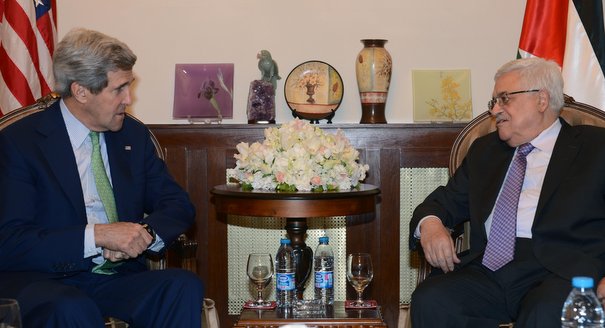
The State Department has been tight-lipped about the details of the negotiations, but leaks in the Israeli and Palestinian press suggest trouble ahead.
Source: New Republic
Are the talks between the Israelis and Palestinians headed toward a final deal in April, as Secretary of State John Kerry proposed last July, or are they, like a previous decade of talks, headed toward the dustbin? Recently, there have been disquieting signs from Washington, Jerusalem, and Ramallah that the two sides are far apart and that Kerry is backing away from his own plan for a “final status” agreement.
The State Department has been tight-lipped about the details of the negotiations, but leaks in the Israeli and Palestinian press suggest trouble ahead. According to these reports, Kerry, during his visit to Israel and the occupied West Bank earlier this month, agreed to Israeli Prime Minister Benjamin Netanyahu’s demand that even after a final agreement Israeli troops continue to be stationed in part of the Jordan Valley, which makes up about 30 percent of the West Bank. Some reports say the deal would station Israeli troops there for ten years; others, for as long as 30 years.
In 2008, Palestinian President Mahmoud Abbas had agreed in negotiations with Israeli Prime Minister Ehud Olmert that, after the establishment of a Palestinian state, NATO would be able to station troops along the Jordanian border. But in negotiations in September 2010 between Abbas and Netanyahu, the new Israeli prime minister insisted that Israeli troops remain in the Jordan valley for “many, many decades.” Abbas rejected Netanyahu’s demand, which would have, in effect, prolonged the occupation after it was supposed to be over. Now Netanyahu has reaffirmed the demand and, if reports are to believed, has won backing from Kerry.The Palestinians would probably agree to the continued presence of Israeli troops in the Jordan Valley during a transition period so long as they would be replaced by an international force. One Palestinian official told Al-Hayyat that they were willing to have Israel Defense Forces remain for “three years or a little longer, similar to what was done in the Sinai after the peace agreement with Israel.” But Israeli officials insist that this is insufficient, and not what they have in mind, and the Palestinians have rejected any long-term presence as “very bad ideas which we cannot accept.” The conflict on this point could sink the talks.
The other disquieting signs have to do with the American commitment to achieving a comprehensive and final agreement by April. Last July, Kerry declared his commitment to achieving “a final status agreement over the course of the next nine months.” Kerry was implicitly contrasting a “final status” agreement on borders, security, water, and refugees with the “framework” and “transitional” agreements reached in the past by Israelis and Palestinians—agreements that have wound up being breached and eventually discarded.
Palestinian official Yasser Abed Rabbo, who participated in the talks with Kerry in Ramallah, charged that the Secretary of State had shifted from a final status agreement to a “framework agreement.” And in speeches last weekend to a forum at the Brookings Institution hosted by Haim Saban, an American-Israeli who has contributed millions to the Democratic Party, Kerry and Obama seemed to back away from the promise of a final status agreement. In his speech, Kerry, while explaining the importance of a final-status agreement, said that “it is essential, in my opinion, to reach for a full agreement and to have a framework within which we can try to work for that.” That formulation seemed to leave the door open for an initial “framework” agreement that would lead to a final-status agreement. Later, Kerry called in a similar manner for the negotiation of a “framework” that “will have to establish agreed guidelines for subsequent negotiations that will fill out details in a full-on peace treaty.”
Obama, interviewed on stage by Saban, also appeared to back away from achieving a “final status” agreement by April. “I think it is possible over the next several months to arrive at a framework that does not address every single detail but gets us to a point where everybody recognizes better to move forward than move backwards.” Obama also assured Saban that Palestinian statehood would “have to happen in stages” and through a “transition period.”
In a press conference after the Saban speeches, State Department spokeswoman Jennifer Psaki denied that there had been a change in the American position on a final status agreement, but the reports of Kerry’s acceptance of the Israeli insistence that its troops remain in West Bank—which Psaki neither affirmed nor denied—along with the subtle changes in language in Kerry’s and Obama’s presentations last weekend suggest that the current negotiations between the Israelis and Palestinians may be in trouble.
Former Visiting Scholar
As a visiting scholar at Carnegie, Judis wrote The Folly of Empire: What George W. Bush Could Learn from Theodore Roosevelt and Woodrow Wilson.
Recent Work
John Judis
John Judis
Carnegie does not take institutional positions on public policy issues; the views represented herein are those of the author(s) and do not necessarily reflect the views of Carnegie, its staff, or its trustees.

Are Germany’s economic, industrial, and political struggles becoming a liability for the EU’s ability to rise to the geopolitical moment?

Rym Momtaz, ed.

European Commission President Ursula von der Leyen is about to give her annual address on the state of the EU. Here’s what she won’t—but should—say.
Rym Momtaz

Radical-right parties are expected to do well in upcoming elections in four of the EU's biggest member states. If successful, they could prevent the union from addressing key challenges ahead.

Stefan Lehne

The aftermath of the Ceuta crisis shows Europe has drawn the wrong lessons. Rather than doubling down on failed migration policies, the EU needs to address the underlying roots of such episodes.

Richard Youngs

Canadian Prime Minister Mark Carney has twice inspired praise for standing up to U.S. President Donald Trump: at the 2026 World Economic Forum in Davos and on Canada-U.S. trade negotiations. Is Carney showing a third way better than the EU has in dealing with the Trump administration?
Rym Momtaz, ed.