

Other
Political Violence Researchers, Rachel Kleinfeld, ed., Dalya Berkowitz, ed.
{
  "authors": [
    "Rachel Kleinfeld"
  ],
  "type": "legacyinthemedia",
  "centerAffiliationAll": "dc",
  "centers": [
    "Carnegie Endowment for International Peace"
  ],
  "collections": [],
  "englishNewsletterAll": "democracy",
  "nonEnglishNewsletterAll": "",
  "primaryCenter": "Carnegie Endowment for International Peace",
  "programAffiliation": "DCG",
  "programs": [
    "Democracy, Conflict, and Governance"
  ],
  "projects": [],
  "regions": [],
  "topics": [
    "Security",
    "Global Governance",
    "Foreign Policy"
  ]
}
Source: Getty
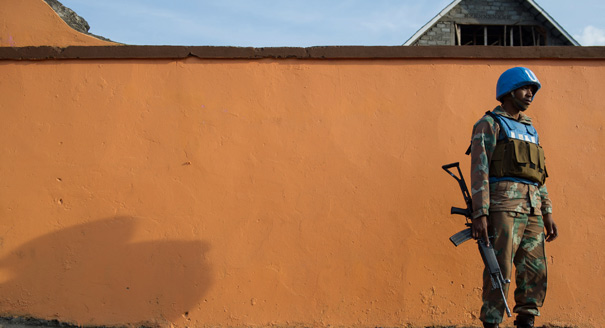
UN Peacekeepers are regularly deployed to deal with the world’s intractable problems. Sensible rules of engagement, a standing fund, and a well-trained reserve force would make them more effective.
Source: Breaking Defense
Islamists are regrouping in Mali, but France wants to draw its forces down to 1,000 troops, so who will fill the gap? The UN, which already has 5,500 soldiers on the ground. A fragile truce holds in the Central Africa Republic, where more than one million people have been displaced by gruesome fighting between Muslims and Christians. Send in the UN, say commentators. Syria’s civil war bleeds across Iraq, Lebanon, and Libya. The West is unwilling to act militarily. Could the UN help contain the fighting?
Common wisdom says that UN peacekeepers — at best — do little and — at worst — spread cholera to Haiti, sponsor prostitution rings in Bosnia, and need to be bailed out when they get themselves kidnapped. Even UN staff bemoan lack of learning, airtight bureaucratic silos, and a thousand other ills.
Remarkably, though all of this is true, the UN’s record is still pretty good. Of the 150 civil wars begun since the end of the Cold War, fewer than 10 are ongoing. The presence of international peacekeepers seems to be one of the key variables, according to studies cited in the Economist. In fact, the UN actually beats the U.S. in successful peacekeeping, according to a series of RAND papers. The U.S. spends more, deploys more troops and is less successful than the UN’s smaller and cheaper missions. For the amount the U.S. spent on one month of the Iraq war during its height, the UN could run all 17 of its then-ongoing peacekeeping missions for a year.The UN is far from perfect. But since the United States and other Security Council powers keep sending them to deal with the world’s most intractable problems, it’s time to help peacekeepers get better.
First: we need to allow blue helmeted troops to use force. Our image of blue helmets standing idle while guerrillas attack innocent civilians stems from the Security Council refusing sensible rules of engagement. We need to help broker truces wherever possible – and at the same time, authorize peace enforcement missions such as the Congo, so peacekeepers can protect themselves and those they are sent to help.
Second: It’s time to create a standing fund for peacekeeping. Currently, each time the Security Council authorizes a mission, the UN must go cup in hand to raise funds and get member states to loan it forces. No surprise that UN troops tend to arrive to conflicts late.
Finally, we need a force of reserve, on-call peacekeepers who have trained together. At $1,028 per soldier per month, UN pay rates are cash cows for developing countries and laughable for the West. With no joint training before they deploy, it is no surprise most UN forces are ill-trained troops from the developing world.
Nevertheless, 120,000 blue helmets are deployed across the world’s conflict zones. We are using UN peacekeepers, but we aren’t willing to admit it. A training institute to bring troops from the biggest contributing countries up to a standard level, and establishing minimum standards for all troop contributing militaries, would help these missions perform even better.
Such an institute could also serve a secondary purpose: supporting the professionalization of civilian-controlled militaries in the troop sending countries to reduce the likelihood of future conflict.
In Ghana, which had five military governments from independence through the 1980s, UN peacekeeping was key to breaking the cycle of coups and enabling civilian, democratic control. Peacekeeping provided troops with funds so they did not need to extract government resources to lead middle-class lives; status that did not involve playing a role in local politics; and professionalization. The Kofi Annan Institute, established in that leader’s home country, has played an ongoing role in professionalizing the armed forces and ensuring that even in the recent, highly contested election, they stayed in the barracks.
Today, Myanmar’s military want to become UN peacekeepers. Imagine if Ban Ki Moon left as his legacy a Peacekeeping Institute, set in his native South Korea, to help train troops from Myanmar and other Asian countries. Pakistan and Bangladesh, the two biggest contributors of troops, could be socialized into a more democratic form of enforcement. South Korea could share its own history of moving the military out of politics, its phenomenal growth story a clear testament to the success of democratic politics.
American ambivalence about the UN means that ambitious Security Council mandates are matched with paltry funding , slow entry and, often, an early exit. Those fearing world government would never allow a standing UN “army.” But a standing fund to pay for forces that have been trained together, authorized by the Security Council to use adequate force for the missions the UN is being given, is just common sense.
The American public has lost its appetite for international conflict. But international conflict has hardly slowed down. If we want the UN to do the job, let’s use 2014 to give them the best chance to succeed.
Senior Fellow, Democracy, Conflict, and Governance Program
Rachel Kleinfeld is a senior fellow in Carnegie’s Democracy, Conflict, and Governance Program, where she focuses on issues of rule of law, security, and governance in democracies experiencing polarization, violence, and other governance problems.
Recent Work
Political Violence Researchers, Rachel Kleinfeld, ed., Dalya Berkowitz, ed.
Rachel Kleinfeld
Carnegie does not take institutional positions on public policy issues; the views represented herein are those of the author(s) and do not necessarily reflect the views of Carnegie, its staff, or its trustees.

As we close out another season of Strategic Europe, it is worth taking stock of the deep shifts underway.

Rym Momtaz
The EU had to compromise to adopt a twenty-first sanctions package against Russia, exposing growing cracks in the union’s resolve. Is this latest, weaker round worth it to keep pressure on Moscow?
Rym Momtaz, ed.

Trump is distracted and Ukraine wants Europe to step up. The continent’s leaders must find their voice and assert it in talks with Russia.

Alissa de Carbonnel

Mounting economic strain and battlefield losses will not necessarily make the Kremlin less dangerous. They could instead push Moscow toward a more aggressive hybrid campaign designed to test NATO’s Eastern flank, exploit allied hesitation, and fracture European resolve.

Maksym Beznosiuk

Over the past ten years, NATO has held almost as many summits as it did during the entirety of the Cold War. Are they still useful, or is it time to stop holding annual meetings?
Rym Momtaz, ed.