

Commentary
Nathan J. Brown
{
  "authors": [
    "Nathan J. Brown"
  ],
  "type": "legacyinthemedia",
  "centerAffiliationAll": "dc",
  "centers": [
    "Carnegie Endowment for International Peace",
    "Malcolm H. Kerr Carnegie Middle East Center"
  ],
  "collections": [],
  "englishNewsletterAll": "menaTransitions",
  "nonEnglishNewsletterAll": "",
  "primaryCenter": "Carnegie Endowment for International Peace",
  "programAffiliation": "MEP",
  "programs": [
    "Middle East"
  ],
  "projects": [],
  "regions": [
    "North Africa",
    "Egypt"
  ],
  "topics": [
    "Political Reform"
  ]
}
Source: Getty
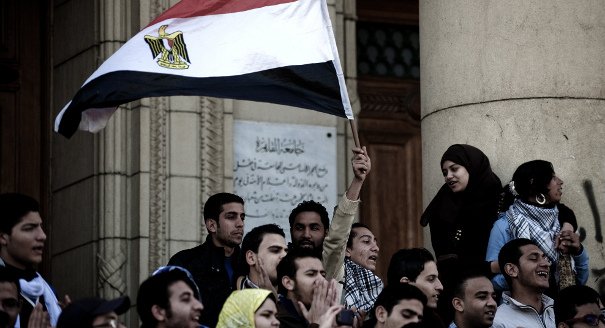
Egypt’s new constitution will not heal the country’s deep political wounds but it could result in a more powerful and coherent government.
Source: NPR’s All Things Considered
ARUN RATH, HOST: Now to another country where the political process has been animated by an intense mix of optimism and fear: Egypt. Voters there are deciding whether to adopt a new constitution this week. The hopes that sprang out of the popular uprising that ejected President Hosni Mubarak in 2011 had been tempered by the political instability in the years that have followed. Last summer, President Mohammed Morsi was overthrown in a military coup. And this week's constitutional referendum is the third in as many years.
Nathan Brown is a professor of political science at George Washington University and senior associate at the Carnegie Endowment. I asked him, why so many rewrites?
NATHAN BROWN: To be fair, the first one was really about an interim constitution. The next two, the one in December 2012 and this one, really are not about a fundamentally different document. It's much more about who's writing the document. The document that was passed in 2012 was written by an assembly dominated by the Muslim Brotherhood. The Muslim Brotherhood is now out of power, treated as a terrorist organization by the government, and there's a new group in charge that's writing this document.RATH: So how is the document different? What are the changes?
BROWN: Well, if you were to read through the two documents, you wouldn't see an enormous number of differences. What you would see would be a little bit more robust human rights protections in this one, a little bit less religious language and also what probably hasn't attracted enough notice, an awful lot of insulation for some institutions of the Egyptian state, like the military, the religious establishment and even the police.
They really are going to escape, I think, any kind of political oversight by any other branches of government. They're basically autonomous and able to run their own affairs as they see fit.
RATH: Do you think the referendum is going to pass?
BROWN: It's absolutely going to pass because the only people who are opposed to it are going to boycott it.
RATH: That would be the Muslim Brotherhood supporters.
BROWN: Absolutely, yes.
RATH: So why wouldn't they just vote against it, engage in the process?
BROWN: Well, there's two things. Number one, I think they might lose. That is to say the Muslim Brotherhood support has gone way down. They can't really campaign freely. But most of all, they think this entire process has been illegitimate. Egypt elected a president, they said, back in 2012. And any political process that moves forward has to be based on a recognition of the legitimacy of that election.
RATH: There are still factions in Egypt that are budding heads over the constitution, you know, even just beyond the Muslim Brotherhood. Assuming that it does pass, as you say it will, how far do you think that the constitution will go towards solving some of Egypt's very serious problems?
BROWN: Well, it's certainly not going to heal Egypt's deep political wounds, these divisions between the Islamists and the non-Islamists. It may perhaps result in a more powerful, more coherent government. The government that is there now is this kind of motley coalition of civilian political figures with the military and the security apparatus lurking very much in the wings.
You could have an elected president who would have a little bit more of a mandate, especially if that president comes from the military and can therefore rule partly from the military and partly from the regular constitutional framework. That's not a recipe for a real democracy, but it might be a political system that at least can make some firm decisions rather than the current pattern, which is of a government a little bit adrift.
RATH: Is it too cynical to ask if, you know, say, in another year or so, we'll be back here again talking about another referendum?
BROWN: It's not too cynical at all. Even some of the people who are writing the document said, well, this is really a document that might only last five or 10 years anyway. It's really for a transitional phase. So I don't think it's too cynical a question, but I'm not sure that we're going to see a continuing rewriting of the constitution.
What we will see, I think, is a political and authoritarian Egyptian political system that will gradually entrench itself. I don't think it'll solve the country's divisions, but I think it will be able to cling to power. And so the constitution that Egyptians are going to vote on and likely pass is one that they'll probably living with for a while.
RATH: Nathan Brown is a professor of political science at George Washington University and senior associate at the Carnegie Endowment. Nathan, thank you.
BROWN: Thank you for having me.
This interview was originally aired on NPR’s All Things Considered.

Nonresident Senior Fellow, Middle East Program
Nathan J. Brown, a professor of political science and international affairs at George Washington University, is a distinguished scholar and author of nine books on Arab politics and governance, as well as editor of five books.
Recent Work
Nathan J. Brown
Nathan J. Brown
Carnegie does not take institutional positions on public policy issues; the views represented herein are those of the author(s) and do not necessarily reflect the views of Carnegie, its staff, or its trustees.

As the EU confronts profound challenges, several leaders have called for fundamental reform to the union’s model—but only modest, superficial changes have resulted. What if Europe really could be reimagined from zero today: What should such a redesigned European order look like?

Richard Youngs, ed.

The EU’s new migration policy is not suited to today’s realities. With climate change increasingly becoming a driver of displacement, Europe needs to rethink its deterrence-focused approach.

Shana Tabak

Preparing candidate countries for EU membership is no longer enough. As the enlargement process becomes a reality, the union must also prepare its own societies.

Iliriana Gjoni
Countries face several hurdles in joining the EU, including the final stage of ratifying their accession treaties. Procedural reforms and substantive adjustments could help move the process forward.

Stefan Lehne
Europe has an interest in supporting Armenian leader Nikol Pashinyan as he tries to make peace with neighbors and loosen ties with Russia. But it is depersonalized support in the long term, not quickfire flash, that will win the day.

Thomas de Waal