

In The Media
Lina Khatib
{
  "authors": [
    "Lina Khatib"
  ],
  "type": "legacyinthemedia",
  "centerAffiliationAll": "dc",
  "centers": [
    "Carnegie Endowment for International Peace",
    "Malcolm H. Kerr Carnegie Middle East Center"
  ],
  "collections": [],
  "englishNewsletterAll": "menaTransitions",
  "nonEnglishNewsletterAll": "",
  "primaryCenter": "Malcolm H. Kerr Carnegie Middle East Center",
  "programAffiliation": "MEP",
  "programs": [
    "Middle East"
  ],
  "projects": [],
  "regions": [
    "Levant",
    "Syria",
    "Middle East"
  ],
  "topics": [
    "Political Reform",
    "Security",
    "Global Governance"
  ]
}
Source: Getty
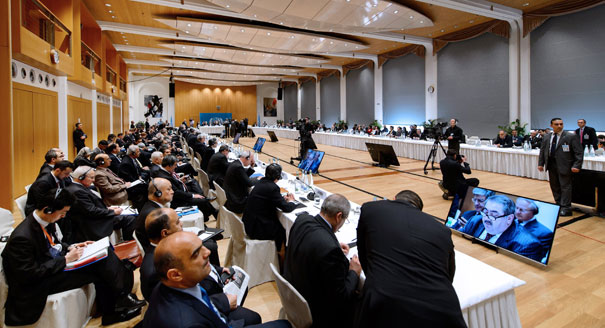
The significance of the Geneva II conference is not going to lie in its formal outcomes as much as in its behind-the-scenes talks.
Source: Al Jazeera
The much-anticipated Geneva II conference has proven to be somewhat of an anti-climax after it opened on January 22. But the significance of the conference is not going to lie in its formal outcomes as much as in its behind-the-scenes talks.
The conference has been a political litmus test. It has not only emphasised the wide political gap between rival stakeholders in the Syrian conflict, but also that between their expectations from Geneva II itself.
For the Syrian regime, Geneva II has been an opportunity to try to validate the "counter-terrorism" narrative it has been using to frame the conflict in Syria. The regime's participation is driven by its expectation of succeeding in selling this narrative to the international community, and consequently, keeping President Bashar al-Assad in power.But as demonstrated through the one-dimensional tone of Syrian Foreign Minister Walid Muallem's opening speech, this increasingly unconvincing narrative is the regime's only card in its justification of its brutal actions in Syria and its argument for the continuation of Assad's leadership. The Syrian National Coalition, on the other hand, sees in Geneva II the start of a process of political transition involving the departure of Assad.
That each side has come to Geneva II with different goals is not surprising, but it also emphasises the difficulty of conducting negotiations in the absence of common ground for having negotiations in the first place. Hopes for the talks' resulting in a political transition deal are low, especially that the Assad regime has been vocal about its unwillingness to compromise.
Further complicating matters are the growing internal divisions within the opposition, particularly after the departure of the Syrian National Council from the Coalition. This makes any agreement reached through Geneva II lacking in broad representation and also difficult to implement.
Implementation is further hindered by the presence of myriad rebel groups - especially jihadist armed ones - who have been both a product and producers of the conflict, and whose very existence is dependent on the perpetuation of the conflict. Finding a political solution to the conflict is not in the interest of these groups. Even increased humanitarian aid and localised truces and ceasefires - the best formal outcomes one can hope for as a result of Geneva II - are likely to be undermined by those groups.
But outside of its formal proceedings, the conference has been the first platform to bring together the regime, the opposition, and their respective international backers in the same space, and thus the opportunity for conducting informal multilateral conversations behind closed doors. Those conversations are hinting at the likelihood of future convergence between the United States and Russia with regard to Bashar al-Assad himself, despite their current divergent public statements about the issue.
Through Geneva II, the United States has acknowledged Russia's position of power as being parallel to its own, as opposed to secondary to it. This acknowledgment, coupled with both sides agreement that the solution to the conflict is a political one, makes the matter of Assad's own role secondary. It would not be unthinkable, post-Geneva II, to see Russia eventually accepting a political deal involving a change of leadership in Syria. Those elements of the Syrian regime who are more concerned about continuation of their own positions than about the presence of Assad would embrace such a deal if it came with certain guarantees.
Even though Geneva II itself is not going to be the place where a transition deal is sealed, participation in the conference carries an implicit recognition of the likelihood of a deal in the future. Geneva II is not going to have immediate concrete results, but the back-channel talks it is harboring are worth watching out for.
Former Director, Middle East Center
Khatib was director of the Carnegie Middle East Center in Beirut. Previously, she was the co-founding head of the Program on Arab Reform and Democracy at Stanford University’s Center on Democracy, Development, and the Rule of Law.
Recent Work
Lina Khatib
Lina Khatib
Carnegie does not take institutional positions on public policy issues; the views represented herein are those of the author(s) and do not necessarily reflect the views of Carnegie, its staff, or its trustees.

Are Germany’s economic, industrial, and political struggles becoming a liability for the EU’s ability to rise to the geopolitical moment?

Rym Momtaz, ed.

European states control several Overseas Countries and Territories around the world that carry strategic, economic, and environmental weight. As great powers challenge the rules-based order, defending them is a geopolitical imperative for Europe.

Marc Pierini

Mounting economic strain and battlefield losses will not necessarily make the Kremlin less dangerous. They could instead push Moscow toward a more aggressive hybrid campaign designed to test NATO’s Eastern flank, exploit allied hesitation, and fracture European resolve.

Maksym Beznosiuk

Over the past ten years, NATO has held almost as many summits as it did during the entirety of the Cold War. Are they still useful, or is it time to stop holding annual meetings?
Rym Momtaz, ed.

As the EU confronts profound challenges, several leaders have called for fundamental reform to the union’s model—but only modest, superficial changes have resulted. What if Europe really could be reimagined from zero today: What should such a redesigned European order look like?

Richard Youngs, ed.